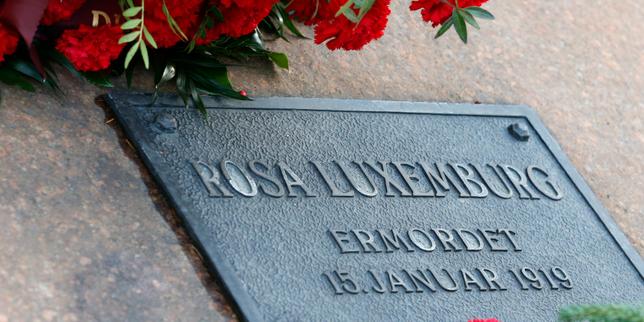
In the small town of Zamość, tucked away in the southeastern corner of Poland, a bronze plaque once marked the birthplace of one of the most influential political thinkers of the 20th century. Today, that space is empty. The removal of Rosa Luxemburg’s memorial is not a local zoning dispute or a simple matter of historical correction. It is a calculated act of state-sponsored amnesia. Poland’s current political climate has turned the memory of Luxemburg into a liability, forcing a revolutionary icon into a ghost-like existence within her own borders. While the rest of the world studies her theories on spontaneous strikes and democratic socialism, her homeland is actively scrubbing her name from the stone.
The struggle over Luxemburg’s legacy reveals a deep fracture in how modern Poland views its past. Under the Law on De-communization passed in 2016, the Institute of National Remembrance (IPN) has overseen the systematic removal of monuments, street names, and plaques associated with anything deemed "promoted communism." Because Luxemburg was a co-founder of the Social Democracy of the Kingdom of Poland and Lithuania (SDKPiL) and later the Communist Party of Germany, she falls under this broad, unforgiving umbrella. The nuance of her life—specifically her fierce criticism of Vladimir Lenin’s authoritarianism and her insistence on freedom of the press—is ignored in favor of a black-and-white nationalistic narrative. Don't forget to check out our earlier coverage on this related article.
The Ghost of Zamość
Walking through Zamość today, you will find a town that prides itself on its Renaissance architecture and UNESCO World Heritage status. It is a "pearl of the North." Yet, the silence regarding its most famous daughter is deafening. Local officials have largely complied with the national directive to distance the town from Luxemburg. When the memorial plaque was taken down in 2018, it was justified as a legal necessity. There was no public debate, no town hall meeting to discuss whether a woman who influenced global political thought deserved even a footnote in her birthplace.
The erasure is total. To the current Polish state, Luxemburg is a "foreign" entity, despite being born in a Poland that was then partitioned by the Russian Empire. This is the central irony of the nationalist project. By stripping her of her Polish identity, they are attempting to solve a PR problem. If she isn't Polish, they don't have to claim her. If they don't claim her, they don't have to reckon with the fact that a Jewish woman from Zamość became the intellectual heartbeat of the European Left. If you want more about the history here, TIME provides an informative summary.
A Prophet Ignored by Her Own
Luxemburg’s greatest "sin" in the eyes of the modern Polish right is not just her socialism, but her stance on Polish independence. She famously argued against a sovereign Polish state, believing that nationalism was a distraction from the international struggle of the working class. This position put her at odds with Jozef Pilsudski, the father of modern Polish independence. In a country where Pilsudski’s image is virtually sacred, Luxemburg’s skepticism of the nation-state makes her a heretic.
However, ignoring Luxemburg requires a massive amount of intellectual dishonesty. She was one of the first to warn that the Bolshevik Revolution would devolve into a dictatorship if it suppressed democratic freedoms. "Freedom is always and exclusively freedom for the one who thinks differently," she wrote from a prison cell. This wasn't the rhetoric of a mindless Soviet puppet. It was a critique of the very totalitarianism that Poland would later suffer under for decades. By grouping her with the Stalinist bureaucrats who came long after her death, the Polish state is committing a historical category error.
The IPN and the Bureaucracy of Memory
The Institute of National Remembrance acts as the gatekeeper of Polish history. It is a powerful body with the authority to investigate "crimes against the Polish nation" and dictate which historical figures are fit for public display. Their stance on Luxemburg is clear: she represents an ideology that brought ruin to Poland. When the IPN issues a directive to rename a street, the local government has little choice but to comply or face legal and financial repercussions.
This top-down management of history creates a sterile version of the past. It removes the friction that makes history actually useful. By purging Luxemburg, the IPN is not protecting Polish citizens from a "dangerous" ideology; it is depriving them of the ability to understand the complex intellectual ferment of the early 20th century. You cannot understand the rise of the European Left, the failure of the Weimar Republic, or the roots of democratic socialism without engaging with Luxemburg’s work.
The Jewish Element
One cannot discuss the erasure of Rosa Luxemburg without addressing the ethnic dimension. Luxemburg was born into a Jewish family during a period of intense anti-Semitism and Russification. Her identity was multifaceted, yet modern nationalist narratives prefer heroes who fit a specific, monolithic mold: Catholic, ethnically Polish, and staunchly pro-independence.
Luxemburg’s internationalism was partly a rejection of the narrow identity politics that marginalized people like her. When the state removes her plaque, they are also removing a piece of Poland’s Jewish history. This is part of a broader trend where the contribution of Jewish Poles to the nation’s intellectual and political life is either minimized or framed solely through the lens of the Holocaust. Luxemburg lived, wrote, and fought long before the Second World War, but her life is being retroactively simplified to fit current political needs.
Global Icon versus Local Pariah
Contrast the situation in Poland with that in Berlin. Every January, thousands of people march to the Friedrichsfelde Cemetery to honor the memory of Luxemburg and Karl Liebknecht, who were murdered by paramilitary Freikorps in 1919. In Germany, she is a symbol of the "other" Germany—the one that resisted both the Kaiser’s militarism and the eventual rise of the Nazis. There are squares, foundations, and schools named after her.
In the international academic community, Luxemburg’s theories on "The Accumulation of Capital" are more relevant than ever. Scholars use her work to analyze modern imperialism and the expansion of markets into non-capitalist environments. She is viewed as a pioneer of intersectional thinking, even if she didn't use the term herself. The disconnect is jarring. While the world sees a giant of political theory, the Polish state sees a ghost that needs to be exorcised.
The Economic Cost of Forgetting
There is a practical, almost cynical side to this erasure as well. Zamość is a tourist town. History is its primary export. By ignoring Luxemburg, the town is missing out on a global audience of historians, students, and political tourists who would travel specifically to see her birthplace.
When a city decides to bury its most famous residents because their politics are currently out of fashion, it signals a lack of confidence. It suggests that the current national identity is so fragile that it cannot withstand the presence of a dissenting voice from a hundred years ago. This isn't just a loss for the Left; it is a loss for the intellectual prestige of the country. A nation that is afraid of a plaque is a nation that is afraid of its own shadow.
The Resistance to Erasure
Not everyone in Poland is staying silent. Small groups of activists, academics, and left-wing politicians have staged protests and held "illegal" commemorations at the site of the removed plaque. These are often small affairs, attended by a few dozen people, but they serve as a reminder that memory cannot be entirely legislated from Warsaw.
These activists argue that Luxemburg is part of a "forgotten Poland"—a tradition of social justice and international solidarity that existed alongside the nationalist movement. They see the fight for her memory as a fight for the future of Polish democracy. If the government can decide which parts of the past are "legal," they can certainly decide which parts of the present are "acceptable."
Reclaiming the Narrative
To truly understand why the Polish state is so determined to bury Luxemburg, we have to look at the power of her ideas. She advocated for the "right to be different." She believed that the working class didn't need a vanguard of elites to tell them what to do; they could organize themselves. This kind of grassroots, anti-authoritarian thinking is inherently threatening to any government that seeks to centralize power and enforce cultural homogeneity.
Luxemburg’s life was defined by displacement. She was a Pole in a Russian-controlled territory, a woman in a male-dominated movement, and a Jew in a continent sliding toward catastrophe. Her refusal to fit into a single box is exactly what makes her relevant today—and exactly why she is being erased.
The Futility of the Hammer
History shows that the more you try to suppress a figure, the more potent they become as a symbol of resistance. The empty space on the wall in Zamość is, in its own way, a more powerful monument than the plaque ever was. It is a visual representation of a hole in the national consciousness.
The Law on De-communization may have succeeded in physical removal, but it has failed to address the intellectual legacy Luxemburg left behind. You can melt down bronze and rename a street, but you cannot delete the books she wrote or the influence she exerted on the development of modern Europe. The attempt to sanitize the past usually ends up highlighting exactly what the censors are trying to hide.
The tragedy of the Polish situation is that the country is denying itself a complex, world-class intellectual heritage in exchange for a shallow, comfortable myth. Rosa Luxemburg doesn't need Poland to validate her greatness; her place in the history of ideas is secure. It is Poland that needs Luxemburg—or at least, the intellectual honesty to acknowledge her existence.
The next time a visitor walks through the streets of Zamość, they might look at that empty space and ask why it's there. That question is the start of the very historical inquiry the state is trying to prevent. Memory is stubborn. It persists in the margins, in the archives, and in the refusal of a few to let a name be forgotten. The battle for Rosa Luxemburg is not about the past; it is about who has the right to define the Polish identity in the present.
Stop looking for the plaque and start looking for the reasons it was taken down. That is where the real history begins.


