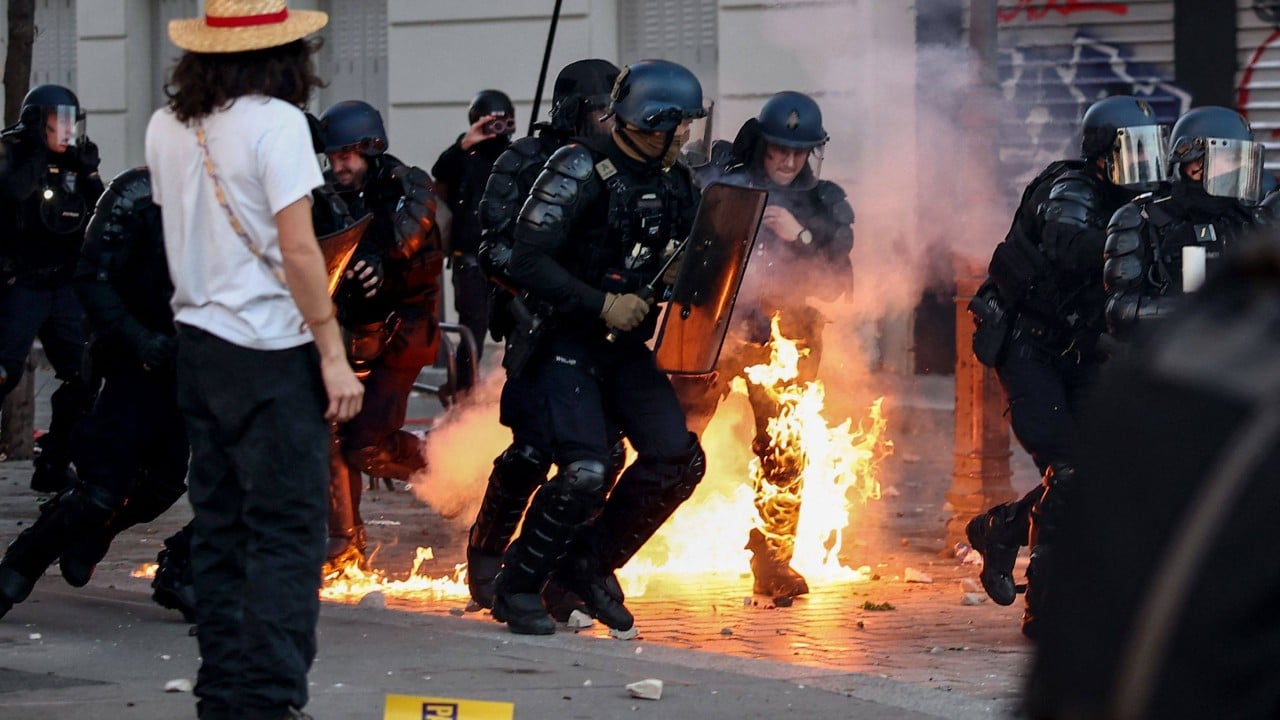
Reclassifying incendiary attacks on police from aggravated assault to attempted murder fundamentally alters the French state’s legal and tactical posture toward civil unrest. When prosecutors open an investigation for tentative d'homicide volontaire sur personne dépositaire de l'autorité publique (attempted voluntary homicide against a person holding public authority), the state ceases treating street violence as a public order nuisance and begins processing it as lethal asymmetrical warfare.
Standard news reporting treats a judicial probe into petrol bomb attacks as a reactive headline. That framing misses the structural mechanics of French criminal procedure and urban policing doctrine. To understand why this reclassification occurs, what operational pressures trigger it, and how it reshapes both street tactics and judicial outcomes, the situation must be analyzed through three interlocking frameworks: the legal architecture of intent, the physics and tactical asymmetry of incendiary projectiles, and the institutional cost function of judicial escalation.
The Legal Architecture of Lethal Intent
In the French Penal Code, the distance between aggravated violence (violences volontaires avec arme) and attempted murder (tentative d'homicide volontaire) rests entirely on the proof of animus necandi—the specific, conscious intent to kill. Historically, prosecutors investigating riots or violent demonstrations defaulted to aggravated violence charges. Demonstrating that a masked individual in a chaotic crowd intended to kill a specific officer, rather than merely injure, disperse, or intimidate a police line, presents an immense evidentiary hurdle.
Opening an attempted murder probe bypasses the lower-tier correctional courts (tribunal correctionnel), where sentences are capped and processed rapidly, and places the case directly under the jurisdiction of an investigating magistrate (juge d'instruction) ahead of a potential trial in the Cour d'assises (criminal jury court).
This procedural shift triggers three immediate operational capabilities for French law enforcement:
- Extended Pre-Trial Detention: Under a criminal felony investigation (information judiciaire), suspects can be held in pre-trial detention (détention provisoire) for up to four years while the magistrate builds the case, compared to months for misdemeanor public order offenses.
- Intrusive Surveillance Authorization: Felony classification unlocks legal authorization for real-time geolocation tracking, IMSI-catcher deployment, prolonged telephone wiretaps, and night-time searches that are restricted or unavailable in standard public order investigations.
- Forensic Resource Allocation: Cases routed to specialized criminal brigades (brigades criminelles) receive priority access to DNA profiling, ballistic trajectory reconstruction, and digital forensics—resources normally reserved for organized crime or counterterrorism.
The legal mechanism relies on inferring intent from the lethality of the weapon and the target zone. French jurisprudence increasingly recognizes that throwing a glass container filled with flammable liquid at a human target wearing synthetic riot gear constitutes a dol éventuel (reckless disregard so extreme it equates to intent) or direct lethal intent. When a projectile is aimed at the head, neck, or torso of an officer, prosecutors argue that the perpetrator accepted death as a probable outcome.
The Asymmetry of Incendiary Projectiles in Urban Policing
To understand why the state elevates these incidents to attempted murder, one must examine the physical mechanics of a petrol bomb (Molotov cocktail) deployed against modern riot police units such as the CRS (Compagnies Républicaines de Sécurité) or the Gendarmerie Mobile.
Standard police protective equipment is engineered primarily to absorb kinetic energy. Polycarbonate shields, Kevlar-reinforced helmets, and padded torso armor effectively mitigate blunt-force trauma from paving stones, steel ball bearings, and batons. However, kinetic armor creates severe vulnerabilities when exposed to liquid accelerants.
- The Wicking and Trapping Effect: Flame-retardant fabrics used in police uniforms are designed to resist brief flash heat, not sustained liquid fuel combustion. When a glass bottle shatters against a shield or helmet, burning gasoline splashes downward, pooling in the creases of boots, gloves, and the gaps between the helmet visor and neck guard.
- Thermal Transfer and Asphyxiation: Even when outer garments do not ignite fully, rapid thermal transfer causes severe second- and third-degree burns beneath the armor. Simultaneously, the sudden consumption of oxygen and inhalation of superheated toxic fumes inside a closed visor induces immediate respiratory distress and disorientation, neutralizing an officer within seconds.
- Tactical Disintegration: A single direct hit forces an entire police squad to break formation. Two to three officers must immediately abandon the defensive line to extinguish a burning colleague and evacuate them through a hostile environment. This creates a localized breach in the perimeter, exposing the remaining unit to encirclement or secondary kinetic assaults.
From a tactical perspective, a petrol bomb is not a crowd-control countermeasure; it is an area-denial and casualty-producing weapon. Unlike fireworks or mortars—which are widely used in French protests to create noise, smoke, and psychological pressure—an incendiary device has a high probability of causing permanent disfigurement or fatality. The deployment of these devices signals a transition from expressive protest violence to targeted attrition against state personnel.
The Institutional Cost Function of Judicial Escalation
Opening an attempted murder probe is not a cost-free decision for the French Ministry of Justice or the Ministry of the Interior. It represents a calculated gamble that trades short-term political and operational friction for long-term deterrence.
The Deterrence Mechanism
The primary objective of the attempted murder classification is behavioral modification among core rioters. In the ecosystem of French urban unrest—whether driven by political radicalization, anti-police animus, or localized socio-economic flashpoints—participants frequently calculate the risk-reward ratio of arrest. Standard public order arrests often result in suspended sentences, community service, or brief prison terms of six to twelve months. By elevating the charge to attempted homicide, which carries a maximum sentence of life imprisonment when committed against a police officer (Article 221-4 of the Penal Code), the state attempts to shatter that risk calculation. Even if the charge is ultimately downgraded to aggravated violence years later during trial, the immediate prospect of a Cour d'assises prosecution acts as a severe deterrent.
The Evidentiary Bottleneck and Acquittal Risk
The second limitation of this strategy lies in the courtroom. French criminal juries require rigorous proof of individual guilt. In chaotic nocturnal clashes involving dozens of masked individuals, isolating the exact person who threw a specific bottle—and proving beyond a reasonable doubt that they intended to kill rather than merely damage a police vehicle—is exceptionally difficult.
If prosecutors overreach by charging suspects with attempted murder based solely on circumstantial proximity or digital metadata, they risk high-profile acquittals or humiliating downgrades years after the event. An acquittal in a heavily publicized case undermines the credibility of the judiciary and reinforces narratives among anti-state groups that the legal system is being weaponized for political theater rather than objective justice.
Political Polarization and Escalation Cycles
Judicial escalation also alters the political dynamics surrounding civil unrest. Police unions routinely demand attempted murder classifications after severe attacks to validate the mortal danger faced by their members and to secure institutional backing. Conversely, civil liberties organizations and defense attorneys argue that applying felony homicide statutes to protest-related violence criminalizes dissent and conflates chaotic street fighting with premeditated murder.
This dynamic creates a feedback loop. When the state responds to incendiary attacks with felony homicide investigations, hardcore elements within protest movements often adapt by adopting tighter operational security—abandoning mobile phones, utilizing burner communications, and operating in smaller, more decentralized cells. Rather than eliminating the violence, extreme legal pressure can professionalize the perpetrators, making future intelligence gathering significantly harder for domestic security services (Renseignement Territorial).
Operational Realities of the Investigation Phase
Once an attempted murder investigation is initiated, the operational burden shifts from public order units to investigative branches. The success or failure of the probe depends on overcoming three specific forensic obstacles inherent to street-level incendiary attacks:
- Destruction of Biological Evidence: Unlike a knife or a firearm recovered at a crime scene, a petrol bomb destroys its own primary surface area upon detonation. The heat of combustion degrades epithelial cells and DNA traces left on the glass during assembly, forcing investigators to rely on unburned glass fragments, bottle caps, or cloth wicks that survived the initial flash.
- Supply Chain Tracing: Investigators must work backward from the chemical signature of the accelerant and the specific manufacture of the glass bottles. This involves canvassing local fuel stations for CCTV footage of individuals filling jerrycans and auditing retail outlets for bulk purchases of specific glass containers.
- Digital Triangulation: Because physical evidence at the point of impact is often compromised by water cannons, tear gas, and trampling, convictions frequently hinge on digital reconstruction. Analysts synchronize timestamps from police body-worn cameras, municipal surveillance networks, and cell-tower dumps to place a suspect’s device at the exact coordinates of the launch point within a narrow temporal window.
Strategic Imperatives for State Institutions
The decision to prosecute petrol bomb attacks as attempted murder marks a permanent structural adjustment in how France manages high-intensity civil disorder. However, relying solely on maximum-severity criminal charges to contain street violence exposes the state to diminishing returns if the evidentiary foundation cannot sustain convictions.
To prevent this legal strategy from eroding into symbolic posturing, judicial and policing authorities must execute three precise operational adjustments:
- Deploy Dedicated Forensic Evidence Teams Inside Riot Formations: Standard riot units cannot secure crime scenes while under active attack. France must expand the integration of specialized, armored evidence-gathering units (unités de police technique et scientifique embedded with public order squads) tasked exclusively with photographing launch trajectories, collecting unburned bottle remnants immediately post-impact, and tagging digital timestamps in real time.
- Establish Strict Evidentiary Thresholds Prior to Felony Classification: Prosecutors should reserve the attempted murder charge strictly for incidents involving direct, documented trajectories toward human targets supported by corroborating visual or biometric data. Charging peripheral participants with attempted homicide dilutes the legal standard and guarantees courtroom reversals that weaken long-term deterrence.
- Re-Engineer Protective Gear for Thermal Mitigation: Judicial deterrence operates on a timeline of years; officer survival operates in seconds. Procurement budgets must prioritize full-coverage, liquid-impermeable flame-resistant underlayers and sealed visor-to-collar interfaces, removing the primary physical vulnerability that makes the petrol bomb an effective tactical weapon in the first place.