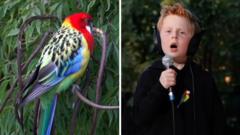
A seven-year-old kid from Sydney just wrote a better indie-rock track than half the bands currently headlining festivals. His name is Miles Phillips. His breakout track is called Eastern Rosellas, and it has already pulled in over 1.5 million views across Instagram and TikTok.
If you spend any time scrolling through social media right now, you have probably run into thousands of comments typing things like CAN'T STOP LISTENINGGGGG. Critics are comparing the snappy rhythm and infectious energy to bands like The Strokes, Vampire Weekend, and The B-52s.
How does a kid in primary school accidentally launch a viral pop-rock anthem about native Australian parrots? The story goes deeper than a cute internet trend. It exposes how digital culture consumes art, how families nurture creativity, and why raw authenticity still wins over corporate formulas.
The Raymond Island Inspiration Behind Eastern Rosellas
Every great song starts with a specific moment. For Miles, that moment happened on a family holiday at Raymond Island.
While standing on a veranda, Miles threw out bird seed. Pigeons flocked to the deck. Lorikeets darted around. But one particular group caught his attention.
"There were pigeons, there were lorikeets, there were rosellas, but the one bird... the main bird that stood out to me was definitely the eastern rosella," Miles explains.
The birds were bold. They tapped directly on the glass windows when the seed ran out, demanding a refill. That persistent tapping and the vibrant, striking red and yellow plumage of the eastern rosella sparked an immediate musical idea. Standing there watching the wildlife, the core chorus spilled out: "Eastern rosellas, eastern rosellas, look at the beautiful colours."
He didn't overthink it. He didn't run market research or try to optimize for an algorithm. He just noticed something cool in nature and turned it into a chant.
From Family Keyboard Jam To Full Band Production
Back home in Sydney, Miles brought the chorus to his father, Joel Phillips. Instead of brushing it off as kid nonsense, Joel treated it like a real project.
The pair sat down at their family keyboard, figured out the chords, and mapped out a structure. Miles handles the structural breakdown with surprising precision for a second-grader.
"It starts off with a little idea that I just have, and then I think of bigger ones, and then I get bigger ones until I'm happy with it," Miles says.
They filmed themselves singing the bare-bones version at the piano and dropped it online at the end of June. The internet did what the internet does. People latched onto the pure joy of it.
Soon after, Joel recorded and released a "full band version" featuring punchy guitars and driving drums. The track jumped straight onto Spotify and started getting regular rotation on commercial and indie radio stations. Established artists like Ben Lee and Ball Park Music even stepped up to record their own covers of the tune.
Why People Thought It Was AI
When the track first blew up, a bizarre internet debate took over the comment sections. Skeptics wondered if the whole thing was generated by artificial intelligence.
Think about that for a second. We have reached a point in culture where a piece of music that is catchy, whimsical, and slightly eccentric immediately triggers suspicion. People assumed a machine manufactured it because organic human creativity often feels too sanitized nowadays.
When media outlets tracked down the family, they found a kid sitting on a back porch surrounded by Lego bricks and sketchbooks. There were no machine learning models involved. Just a kid with spiked hair, a colorful parrot badge pinned to his blazer, and a two-year drum-playing habit.
The panic over synthetic media highlights a deep cynicism in modern entertainment. We are so used to hyper-produced, algorithmic pop designed to maximize retention that genuine childlike observation feels alien.
The Parent Factor In Raising Creative Kids
You cannot talk about this viral phenomenon without looking at the household environment. Joel Phillips has spoken openly about what it takes to encourage kids to make things instead of consuming them all day.
"It's giving permission, it's just normal to sing, it's just normal to go and create something, it's not normal to stay on a screen all day," Joel notes.
Most parents complain about screen time while offering no alternatives. The Phillips household treats imagination as an active daily practice. Miles has been tapping rhythms with his hands for as long as his family can remember, moving on to actual drum kits as coordination caught up with ambition.
When kids grow up in a space where writing a silly song about a bird is met with enthusiasm rather than a dismissal to go do homework, weird and wonderful things happen. Creativity isn't an innate mystical trait given to a chosen few. It is a habit nurtured by adults who refuse to crush weird ideas.
What Musicians Can Learn From A Seven-Year-Old
Adult songwriters spend months agonizing over branding, hook optimization, playlist placement, and genre trends. They strip the life out of their own work trying to satisfy invisible gatekeepers.
Miles Phillips bypassed all of that. He saw a bird. He liked its colors. He wrote a repetitive, punchy chorus that gets stuck in your head instantly.
If you want to create things that resonate—whether that is music, writing, or software—take a page out of the Eastern Rosellas playbook. Stop trying to engineer a masterpiece for a broad demographic. Look closely at a specific, real-world detail that caught your eye today. Build a simple framework around it. Keep the energy high, drop the corporate polish, and share it before your inner critic talks you out of it.