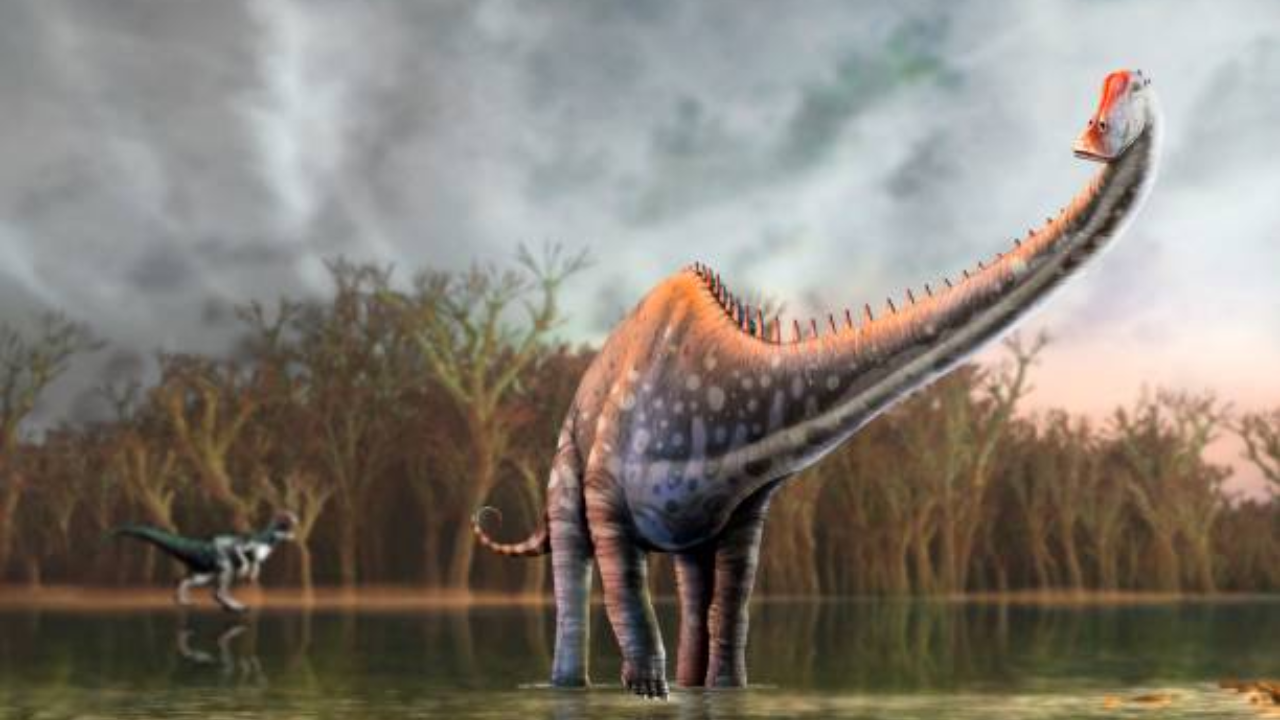
Paleontology loves a neat narrative. For decades, the textbook consensus treated North America as the exclusive country club for Diplodocus. Every time a quarry in Wyoming or Utah coughed up a whip-tailed giant, textbooks patted themselves on the back and declared North America the sole headquarters of Jurassic megafauna. Then Spain showed up with fourteen tail vertebrae, and the mainstream science press lost its mind, screaming that Europe had finally stolen the crown.
It is a lazy headline. It relies on geographic tribalism rather than how actual ecosystems functioned 150 milhões of years ago.
Let us clear up the basic misconception right out of the gate. Dinosaurs did not care about modern political borders, continental drift pace markers, or our desperate human need to crown a single champion site. The discovery of Diplodocus remains in the Iberian Peninsula does not replace North America. It exposes the fatal flaw in how we sample the fossil record.
When you dig into the Morrison Formation of the American West, you are looking at an exceptionally rare geologic window where preservation conditions were pristine. Thousands of square miles of low-energy floodplains buried bones before scavengers or weathering could chew them to dust. Europe did not lack Diplodocus. Europe lacked equivalent continuous basins exposed on the surface for amateur and professional excavators to hammer away at for two centuries.
We have treated a sampling bias as a biological reality.
Imagine a scenario where future archaeologists dig up modern industrial cities and conclude that yellow school buses only existed in Ohio because that is where the largest intact fleet graveyard was discovered, completely ignoring New York or London. That is the exact logic paleontology has used for sauropod distribution.
The fossils found in Spain, specifically sites like Galve, are not anomalies. They are corrections. When you examine the paleogeography of the Late Jurassic, the Tethys Ocean was a dynamic, fractured archipelago. Shallow seas separated islands and landmasses, but shallow water is not an insurmountable wall for a fifty-ton animal with four massive columns for legs and a paddle for a tail. Sauropods were biological bulldozers. They crossed marginal marine environments, island-hopped across carbonate platforms, and exploited seasonal vegetation fluctuations across what we now call the Atlantic gap.
The lazy consensus assumes that if a specific species is endemic to one landmass, it evolved in isolation. But Diplodocus was a cosmopolitan generalist. Its dental morphology, long-range mechanical neck design, and sheer metabolic mass required vast ranges. A creature that size cannot survive on localized regional endemicity without hitting genetic bottlenecks and starving during regional droughts. They needed transcontinental foraging routes.
When researchers point to subtle morphological variations in the Spanish vertebrae and try to spin a grand tale of speciation, they are usually just looking at intraspecific variation or sexual dimorphism. We take two skeletons separated by a thousand miles and five million years, see a slightly different pneumatic cavity in a caudal bone, and immediately erect a new sub-genus to pad our resume.
Let us look at the actual data. The Late Jurassic ecosystem was remarkably homogenous across the northern hemisphere. From the Morrison to the Lourinhã Formation in Portugal and the sites of northeastern Spain, the floral assemblages—ferns, cycads, early conifers—shared identical taxonomic profiles. If the salad bar is the same from Utah to Iberia, the diner is going to be the same.
The real controversy is not whether Spain can claim a Diplodocus bragging right. The real controversy is how long academic publishing will continue to treat every isolated bone discovery as a paradigm-shifting revolution instead of an expected data point in a vast, interconnected Pangaean breakup phase.
Stop treating paleontology like a football league standings table. Dinosaurs were not regional franchises competing for playoff spots. They were living, breathing organisms moving across a shifting tectonic canvas. The moment we stop looking at the earth through the fractured lens of modern national borders, the fossil record stops being a series of isolated anomalies and finally starts making sense.