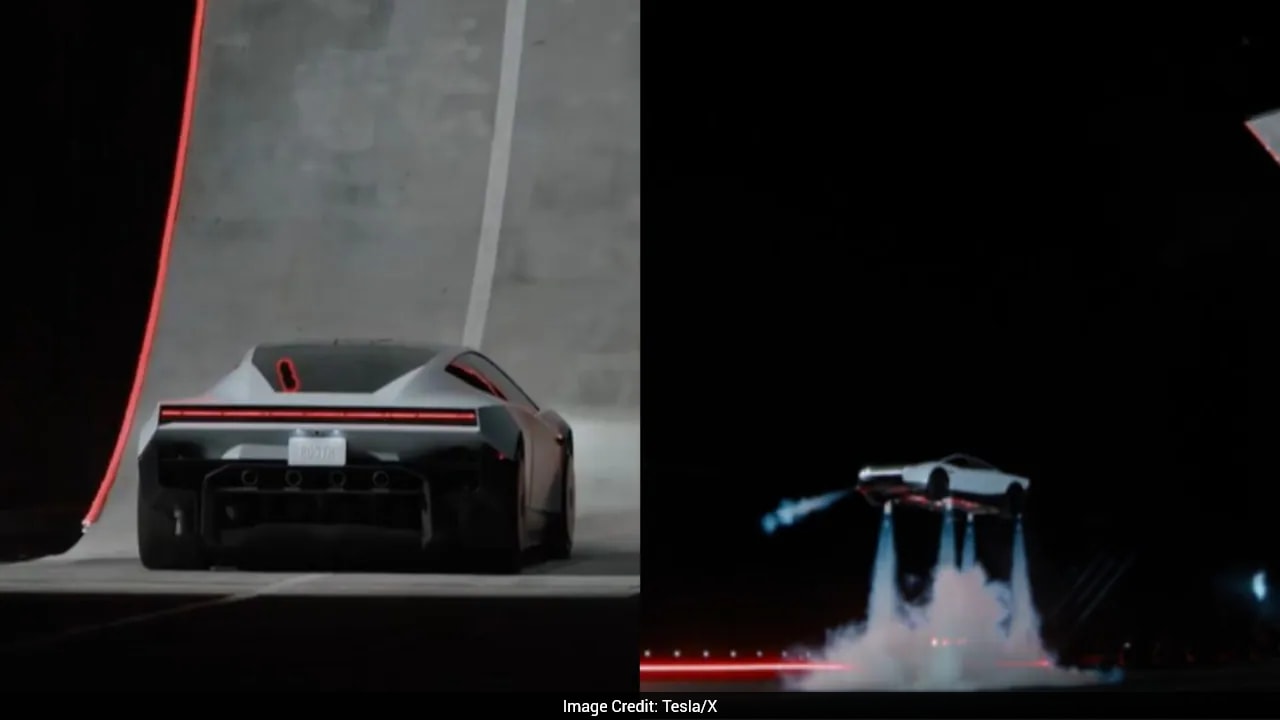
A sports car is not a rocket. A canyon is not a launchpad. Gravity does not care about hype.
Every time a headline pops up claiming a Tesla Roadster will fly across the Grand Canyon, automotive blogs and armchair futurists lose their minds. They picture a sleek electric coupe blasting out of thin air, banking over red rock cliffs like an X-Wing, and touching down smoothly on the other side while tourists cheer. It makes great clickbait. It sells ads. It feeds the lazy consensus that enough money, software, and bravado can bully Newtonian mechanics into submission.
It cannot. Not even close.
The competitor coverage on this topic treats a vague hint about future demonstrations as if a flight itinerary is already booked. It conflates marketing theater with aerospace engineering. Worse, it asks the wrong question entirely. People keep asking whether a Tesla Roadster can fly over the Grand Canyon. The real question is why anyone with a basic grasp of fluid dynamics, structural loads, and aviation regulation thinks a street car with cold-gas thrusters is going to clear a mile-deep chasm in front of a crowd.
The Lazy Consensus Around Rocket Cars and Canyon Hops
Standard coverage repeats the same tired script. Musk mentions thrusters or dramatic demos. Writers treat it like a near-certainty. Readers imagine sustained, airplane-style flight or smooth, controlled hovering across a massive geological gap.
That mental picture is flat-out wrong.
Start with the geography. The Grand Canyon is not a narrow creek you can jump on a dirt bike. Depending on where you measure, the rim-to-rim width spans roughly 4 to 18 miles, with depths reaching around 6,000 feet. Even a narrow crossing involves huge distances, unpredictable canyon winds, severe thermal updrafts, and zero forgiving landing zones if something goes wrong mid-span.
Now look at the vehicle. A production or near-production sports car is designed around road tires, suspension geometry, crash structures for highway impacts, and battery packs that are already heavy. Adding pressurized gas tanks and thrusters to a car body does not turn it into an aircraft. You do not get effortless flight just by venting compressed air or nitrogen.
I have spent years watching companies and engineering teams blow millions chasing flashy hardware demos that ignore mass fractions and energy density. When teams try to bolt aerospace hardware onto a ground chassis without respecting weight budgets, the math catches up fast. Either the thrusters are too weak to lift the car meaningfully, or the tanks and structural reinforcement add so much mass that performance collapses.
Flight Versus Ballistic Hopping A Distinction Nobody Makes
People throw around the word "flying" like it means one thing. In physics and aviation, it means several very different things.
- Aerodynamic flight uses wings or lifting surfaces moving through air to generate lift. A roadster does not have high-aspect-ratio wings capable of sustaining level flight at low speeds without massive structural changes.
- Powered vertical or near-vertical thrust requires thrust greater than weight at every moment you want to stay aloft or climb. Pushing a heavy car upward and holding it there takes enormous thrust-to-weight capability and huge amounts of propulsive impulse.
- Ballistic or semi-ballistic trajectory means imparting velocity or upward impulse and letting gravity and aerodynamics dictate the arc until you come back down.
When people imagine a car "flying over the Grand Canyon," they picture controlled, sustained flight with margin for error. What cold-gas thrusters on a car could realistically do—if packaged safely at all—is short, dramatic bursts for acceleration, cornering assist, or a brief hop. Turning a brief burst into a multi-mile canyon crossing changes the energy requirement by orders of magnitude.
Specific impulse matters here. Cold-gas thrusters are prized in spacecraft attitude control because they are simple, clean, and reliable in vacuum for small nudges. They have low specific impulse compared to chemical rockets, meaning they burn through reaction mass quickly for the amount of impulse delivered. In Earth's atmosphere, against a heavy car, mass runs out fast.
Imagine a Scenario Where You Try to Clear the Rim
Imagine a scenario where an engineering team actually tries to launch a thruster-equipped Roadster from the South Rim toward the North Rim.
First, you have to accelerate or launch the car cleanly without shredding the suspension, ripping off body panels, or losing control on uneven pavement or a ramp. If you use a ramp, you are dealing with launch angles, vertical g-loads, and pitch stability the instant the tires leave the ground. A car's center of gravity and moment of inertia are tuned for four contact patches on asphalt, not free flight.
Second, once airborne, control surfaces are minimal. A car body is a bluff aerodynamic shape, not a streamlined fuselage with active control surfaces tuned for high-speed or post-stall airflow. If a crosswind hits inside the canyon—and canyon winds are notorious for swirling, shear, and sudden gusts—small thrusters may not have enough control authority to keep the nose pointed where you want.
Third, landing is where dreams go to die. Touching down at speed or from height with a heavy battery pack slams energy straight into wheels, struts, and frame rails. Without aerospace landing gear, energy-absorbing stroke, or a long runway, a rough landing turns a publicity stunt into a crumpled wreck.
What Heavy Hitters in Aerospace and Automotive Know
Ask seasoned propulsion engineers at organizations like NASA, SpaceX, or legacy aerospace primes what happens when you mix ground vehicles and reaction thrusters, and you will hear the same sobering trade-offs. Tsiolkovsky's rocket equation is undefeated. Every kilogram of tankage, valves, lines, and structure you add to carry propellant requires more effort to move.
In the automotive world, chassis engineers from Porsche, Ferrari, or motorsport teams know how unforgiving weight is. Every extra pound hurts braking distance, tire wear, and structural stiffness. You cannot casually treat a sports car like a space capsule and expect both to perform well.
To be completely fair to my own contrarian stance, there is a downside to dismissing bold stunts out of hand. Wild ideas sometimes push engineers to test unconventional subsystems, build public excitement around hard tech, and ask whether existing limits are real or merely habitual. Dismissing a concept completely can blind you to clever incremental breakthroughs—like improved handling dynamics, quick bursts of acceleration, or novel thermal and pressure management.
Still, excitement is not thrust. A press quote is not a flight test.
Dismantling the Questions Everyone Keeps Asking
Will a Tesla Roadster actually fly over the Grand Canyon?
Almost certainly not in the way most people picture. A dramatic marketing tease or a controlled demo in a closed, safe environment is vastly different from clearing a massive natural canyon with passengers or high stakes. Treating a hint as an imminent canyon crossing confuses showmanship with flight readiness.
Can thrusters make a car hover or fly like a drone?
No. Hovering requires continuous thrust equal to or greater than total weight for the entire duration of the hover. Carrying enough stored gas or propellant to hover a heavy car for more than a few seconds—while keeping the car safe and structurally sound—runs straight into weight and volume walls.
Why talk about thrusters on a sports car if it cannot fly across a canyon?
Because attention is currency, and spectacle drives conversation. A car that moves impossibly fast off the line or uses directional thrust to enhance acceleration or cornering grabs eyeballs even if it never leaves the ground for long. The gap between "thruster-assisted performance" and "canyon flight" is where the hype lives.
What would it actually take to cross a canyon safely?
An aircraft. Wings, propulsion designed for sustained lift or thrust, certified avionics, trained pilots, weather minimums, and proper airspace approval. There is a reason aviation exists as a separate discipline from automobile manufacturing.
Actionable Advice That Actually Works
If you are an engineer, founder, investor, or reader evaluating bold hardware claims, stop reading headlines and start checking physics and incentives.
- Separate the headline from the hardware. Look at what exists in metal and test stands today versus what was said in a casual remark or stage banter.
- Check the mass budget first. Whenever someone promises flight, levitation, or wild performance from an existing platform, ask where the extra weight goes and how much thrust or lift counters it.
- Define the flight regime. Ask whether the claim describes a split-second impulse, a short hop, aerodynamic glide, or sustained powered flight. Most confusion comes from blending those categories.
- Watch the regulatory and safety gatekeepers. Major landmarks, public spaces, and aerial maneuvers face strict safety, environmental, and aviation rules. Even if physics allowed a stunt, permits and risk management often stop it cold.
- Invest in boring fundamentals when building real products. If you are building vehicles or hardware, master reliability, thermal control, structural margins, and manufacturability before chasing viral stunts.
The canyon will still be there tomorrow, wide and quiet, waiting for anyone who mistakes a good line for a flight plan.