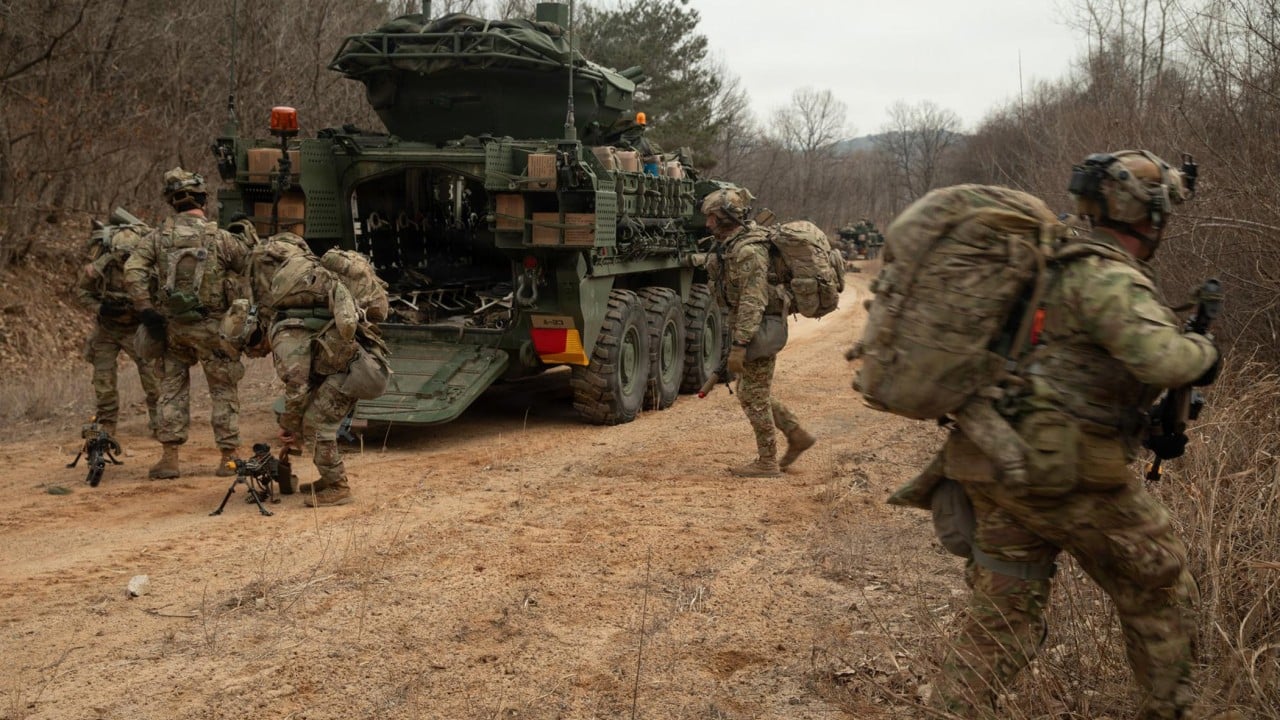
Every time a theater commander floats the idea of using US forces in South Korea for missions beyond the peninsula, the defense press treats it like an inevitable evolution of strategy. It is not. It is a distraction.
Read the standard line again. Commanders warn of wider regional threats. Analysts nod along about "strategic flexibility." Commentators argue that parking tens of thousands of elite troops on the Korean Peninsula just to stare across the 38th parallel wastes precious capacity when contingencies loom in the Taiwan Strait or the South China Sea. Recently making waves lately: The Borderline of Paper and Iron.
That sounds reasonable at a cocktail party. In the real world of force posture, logistics, and alliance politics, it is lazy consensus dressed up as grand strategy.
What People Actually Mean by "Beyond the Peninsula"
Before attacking the premise, define the terms accurately. When military leaders and defense commentators talk about using US Forces Korea (USFK) for missions beyond the peninsula, they rarely mean sending infantry divisions to fight a ground war in another country overnight. More information into this topic are detailed by The Guardian.
USFK is anchored by the Eighth Army, the Seventh Air Force, and key naval and missile-defense components. Its core mission under the Mutual Defense Treaty has long centered on deterring and, if necessary, defeating North Korean aggression alongside the Republic of Korea (ROK) armed forces. "Strategic flexibility"—a concept pushed hard during the George W. Bush administration and revived whenever regional tensions spike—refers to the ability to redeploy forces or assets stationed in Korea to other contingencies in the Indo-Pacific.
Here is the first misconception people swallow whole: they treat USFK like a spare tire sitting in a trunk that you can bolt onto any car whenever a flat happens elsewhere.
Force posture does not work that way. Bases are ecosystems. A wing of fighter jets or an air-defense battery in Korea is tied to hardened shelters, munitions stockpiles, intelligence feeds, fuel pipelines, maintenance depots, and combined command arrangements with South Korean counterparts. Pull key pieces out during a crisis, and you do not simply gain a mobile strike force; you degrade deterrence in one theater to patch a hole in another.
The Wrong Question Everyone Is Asking
When a commander says US troops in South Korea must be ready for missions beyond the peninsula, the public immediately asks: Can USFK deploy outside Korea if a crisis breaks out in the Taiwan Strait or South China Sea?
That is the wrong question. The real question is whether trying to make South Korea a multi-purpose regional launching pad weakens the exact deterrence that keeps the region from blowing up in the first place.
Look at how people frame the "People Also Ask" questions around this topic. They ask whether Seoul agrees to regional roles, whether pulling troops hurts North Korea deterrence, or whether China sees USFK as a wider threat. Each question treats "strategic flexibility" as a free lunch—a way to get more regional muscle without paying a steep strategic price.
There is no free lunch in military geography. Every asset has opportunity costs, political friction, and friction in movement. Treating USFK as a regional utility knife ignores both the map and the alliance bargain that keeps American forces on the ground in the first place.
The Battle Scars of "Strategic Flexibility"
I have watched defense planners and corporate strategists alike fall in love with "optionality" on paper only to get burned by reality on the ground. In the private sector, I have seen companies blow millions on "multi-purpose" facilities and flexible supply hubs designed to serve three markets at once—only to discover during a real crunch that specialized, dedicated capacity beats jack-of-all-trades setups every time.
Defense suffers from the exact same fantasy. On a PowerPoint slide, a squadron in Osan or Kunsan can pivot anywhere in the Western Pacific. In practice, moving fuel, spare parts, munitions, and command-and-control nodes across hundreds of miles of contested water and airspace takes time, tanker support, airlift, and diplomatic clearance.
Even more importantly, alliances run on trust and clear expectations. South Korea hosts US troops primarily to deter and counter North Korea, a threat sitting less than forty miles from Seoul's capital region. Tell the South Korean public that American forces in their country are really there to fight broader regional wars—especially wars over Taiwan that could drag South Korea into direct conflict with Beijing—and domestic political support for the alliance fractures fast.
That is why Washington and Seoul have spent decades dancing carefully around the wording of strategic flexibility. Whenever American officials push too hard for an explicit regional mandate, Seoul pushes back or hedges. Ambiguity keeps the alliance standing, even when it frustrates hawks in Washington.
Why the "Wasted Capacity" Argument Falls Apart
The classic argument made by proponents of outward-facing missions goes like this: North Korea's conventional military is aging compared to South Korea's increasingly sophisticated forces, while China's military modernization is the pacing challenge. Therefore, keeping US forces bottled up facing north is a mismatch of priorities.
That argument misses how deterrence actually works on the peninsula.
South Korea has built an impressive military, complete with advanced missile systems, submarines, stealth aircraft, and a growing defense-industrial base. Yet North Korea continues to expand its nuclear arsenal, test solid-fuel intercontinental and tactical missiles, and deepen military ties with Russia. Deterrence against a nuclear-armed, unpredictable regime in Pyongyang does not run on autopilot just because Seoul is wealthy and modern. It relies on visible, integrated US-ROK readiness, extended deterrence guarantees, and continuous combined training.
Imagine a scenario where Washington quietly shifts air-defense batteries, intelligence assets, or rotational units out of South Korea to bolster a crisis response near Taiwan. Even if Pyongyang does not launch an immediate invasion, North Korea's leadership watches posture shifts closely. A perceived dip in readiness on the peninsula invites probing, missile provocations, or coercion right when Washington least wants a second crisis.
Heavy hitters in international security—from seasoned alliance scholars like Victor Cha to longtime Indo-Pacific strategists—have long pointed out that South Korea's geographic position makes it both vital and vulnerable. It sits at the crossroads of China, Russia, Japan, and the Korean Peninsula. Treating it merely as a springboard for external missions underestimates how tightly peninsular stability is wired into broader Northeast Asian security.
Comparing the Two Mindsets
| Dimension | "Beyond the Peninsula" Mindset | Peninsula-First Realism |
|---|---|---|
| Core Premise | USFK should act as a flexible regional reserve for wider Indo-Pacific contingencies. | Deterrence on the peninsula is a full-time, high-stakes mission that underpins regional stability. |
| Main Blind Spot | Assumes assets can pivot without degrading local readiness or alienating Seoul. | Can look overly static if regional threats shift rapidly toward maritime and air domains. |
| Alliance Impact | Risks political backlash in South Korea over unwanted entanglement in external conflicts. | Preserves clear alliance purpose, though it requires constant adaptation to North Korea's nuclear growth. |
| Operational Reality | Faces logistics, basing, airspace, and diplomatic hurdles during a crisis. | Leverages established bases, hardened infrastructure, and deep combined command habits. |
The Downsides of Keeping the Focus Tight
Honesty requires admitting the flaws in my own argument. A strict peninsula-first posture is not without real costs.
First, geography in East Asia is unforgiving. If a major crisis erupts in the Taiwan Strait or the East and South China Seas, US planners will look at every aircraft, tanker, missile interceptor, and command node in the region. Pretending USFK exists in a vacuum is unrealistic; commanders will always weigh regional needs when lives and national interests are on the line.
Second, over-indexing on North Korea can make defense planning look backward-looking if Washington fails to adapt force posture across the broader Indo-Pacific. Critics rightly warn that the US military cannot afford rigid silos when facing a peer competitor with long-range strike capabilities.
Third, relying too heavily on diplomatic caution with Seoul can breed complacency. South Korea itself has to wrestle with tough questions about its role in regional security, freedom of navigation, and stability beyond its immediate border.
The problem is not that commanders ask hard questions about regional readiness. The problem is pretending that turning US forces in South Korea into a multi-purpose regional expeditionary force is easy, cost-free, or smart.
What Leaders Should Do Instead
If you want real readiness rather than bumper-sticker strategy, stop treating South Korea as an all-purpose deployment depot and start fixing the actual bottlenecks.
- Protect core peninsular deterrence first. Never hollow out air defenses, intelligence, or combined command readiness in Korea just to create the illusion of flexibility elsewhere. If North Korea senses a distraction, everyone pays.
- Build dedicated regional capacity instead of borrowing from Peter to pay Paul. If the Pentagon needs more mobile air, missile defense, logistics, and strike capacity for contingencies beyond the peninsula, invest in true mobile and distributed forces rather than cannibalizing a frontline alliance posture.
- Be candid with Seoul about shared regional stakes. Do not ambush allies with sudden shifts in mission framing. Have honest, sustained talks about how South Korea can contribute to broader regional stability—through maritime security, logistics, industrial output, and diplomatic coordination—without forcing a brittle all-or-nothing choice.
- Plan for crisis friction honestly. War games fail when they assume frictionless redeployment. Model diplomatic delays, airspace limits, tanker shortages, and parallel North Korean provocations before a crisis starts.
Commanders will keep talking about missions beyond the peninsula because their job is to look across the whole map. Everyone else should stop mistaking a broad mandate on paper for free capability in reality.


