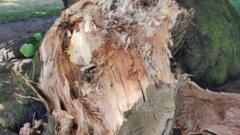
Summer brings backyard barbecues, long beach days, and baking hot sunshine. You rarely look up at the giant oak tree in your yard and think, that thing is about to snap. You should. When temperatures spike for days on end, mature trees suffer in silence. Then, a sudden storm rolls through, or a calm morning arrives, and a massive limb or the entire trunk comes crashing down.
Can a heatwave cause trees to fall? Absolutely. And it happens much more often than people realize. For an alternative look, read: this related article.
Most folks assume trees love the sun. They need light to photosynthesize, after all. But there is a massive difference between a warm summer afternoon and an unrelenting, weeks-long heatwave combined with drought conditions. When the mercury stays trapped in the upper nineties or hundreds, trees face a severe physiological crisis. They undergo extreme stress, their root systems shrink, and their internal plumbing basically breaks down.
Let's break down why this happens and what you can actually do to keep your property safe. Related reporting on this trend has been published by Vogue.
The Hidden Drought Stress Inside the Trunk
Trees are basically giant water pumps. On a normal day, roots draw moisture up from the soil, pulling it through the trunk and out through microscopic pores in the leaves. This process, called transpiration, cools the tree down and keeps the wood hydrated and flexible.
During a brutal heatwave, the air gets so dry and hot that water evaporates from the leaves faster than the roots can replace it. To survive, the tree panics. It shuts its leaf pores to stop losing water.
This defense mechanism creates a dangerous internal vacuum. If the heat drags on, the water columns inside the trunk can literally snap. Arborists call this cavitation. Once cavitation happens, parts of the tree can no longer transport water at all. Those branches dry out completely from the inside out, turning heavy, living wood into brittle tinder.
Brittle Wood and Sudden Branch Drop
Have you ever walked under a grand old shade tree on a dead-calm August afternoon and heard a loud crack? A heavy branch detaches and plummets straight to the ground, even though there is zero wind.
This phenomenon has a very unscientific name: summer branch drop.
Tree biologists still debate every single mechanical detail, but the consensus points straight back to heat and moisture stress. When wood dries out rapidly under extreme thermal loads, the cellular structure changes. The wood loses its natural elasticity. It stops bending in the wind and starts snapping instead.
If you park your car under a large sycamore or elm during a heatwave, you are playing structural roulette. Those branches are heavier than they look, and when heat makes them brittle, they fail without warning.
How Roots Shrink and Fail Underground
The real danger isn't always what you see in the canopy. It is what happens underground.
Tree roots need oxygen, water, and microbial life to thrive. When a heatwave bakes the earth, the topsoil turns into concrete. Clay soils bake, crack, and shrink. As the soil shrinks, it literally tears the fine, delicate feeder roots away from the surrounding earth.
Without those feeder roots, the tree loses its anchor.
Furthermore, homeowners often respond to a heatwave by turning on the sprinkler system every single day for ten minutes. This is a massive mistake. Shallow, daily watering only dampens the top inch of soil. The tree roots stay near the surface instead of driving deep down into the earth where moisture actually lingers. When a heavy summer thunderstorm hits with 50 mile per hour wind gusts, a tree with a shallow, heat-stressed root system has zero leverage. It flips right out of the ground, root ball and all.
Spotting the Warning Signs Before Disaster Strikes
You do not need a degree in forestry to spot a heat-stressed tree that is ready to fail. You just need to look past the green leaves and pay attention to the structure.
- Premature leaf drop: If your maples or birches are dumping green or yellow leaves in July, the tree is sacrificing parts of itself to save the whole. That is a distress signal.
- Vertical cracks in the bark: Extreme temperature swings between blistering days and warm nights cause the outer layers of the trunk to expand and contract faster than the inner wood. Look for fresh, deep splits in the bark.
- Fungal growth at the base: Heat stress weakens a tree's immune system. Opportunistic fungi and root rots move in quickly. If you see mushrooms sprouting directly from the soil near the trunk, the root system is likely compromised.
- Excessive deadwood: Notice a sudden abundance of dead twigs and small branches littering the lawn beneath the canopy? The tree is already cutting off resources to those zones.
Protecting Your Trees When Temperatures Spike
You cannot control the weather, but you can manage how your landscape handles it. Stop treating your trees like lawn grass. They need deep, infrequent drinks, not a daily misting.
When a heatwave hits, run a soaker hose or let a garden hose trickle slowly near the outer edge of the canopy—known as the drip line—for a few hours once a week. This encourages roots to grow deep underground where the soil stays cooler and retains moisture longer.
Spread a thick layer of organic mulch across the root zone, keeping it a few inches away from the actual trunk. Mulch acts like insulation, keeping the soil temperature significantly lower and locking in precious moisture when the sun is relentlessly beating down.
If you have massive, mature trees looming over your roof, driveway, or patio, do not wait for a storm to test their strength. Bring in a certified arborist for a proper structural assessment before the peak of summer. A small investment in professional pruning and deep-root watering can save you thousands of dollars in property damage down the road.
Keep an eye on your landscape when the weather turns punishingly hot. Listen to your trees, give them the deep water they desperately need, and don't assume that a clear, calm summer day means everything is safe.