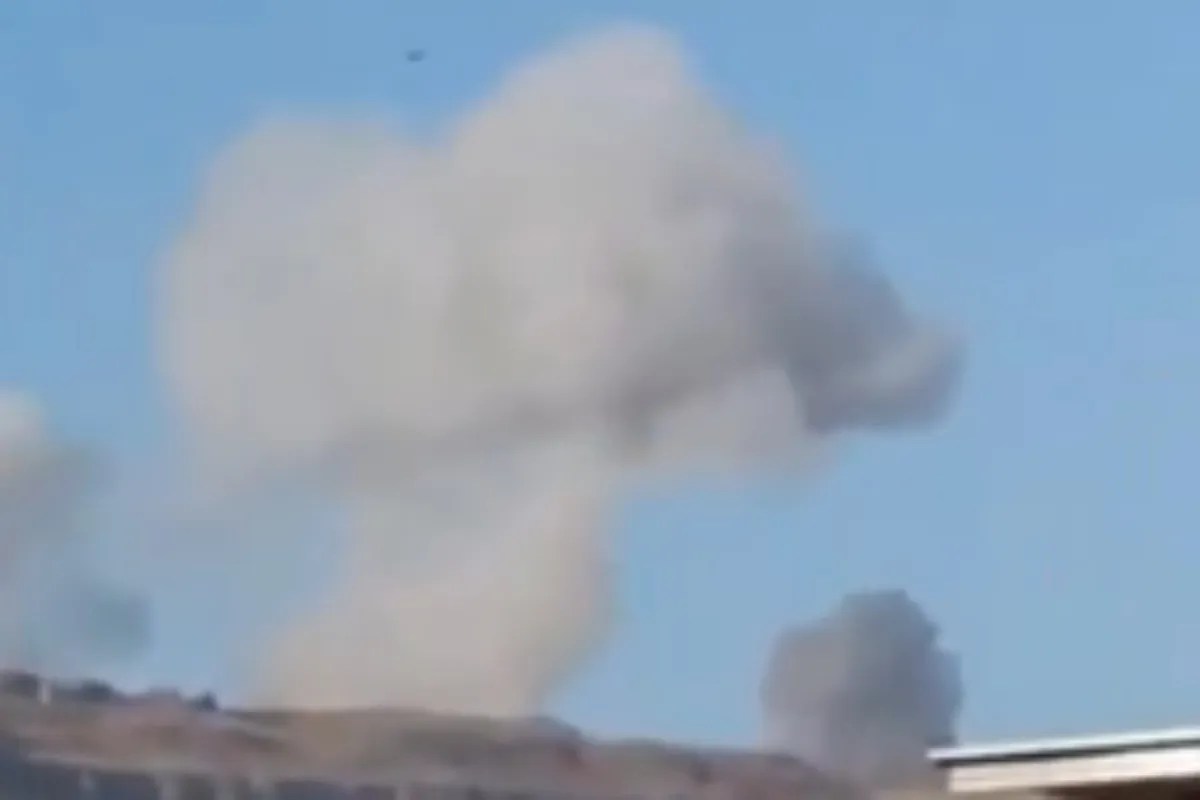
Everyone is celebrating the indictment of an incarcerated Iranian operative over a botched bomb plot targeting RAF Fairford. Politicians are taking victory laps. Pundits are applauding transatlantic intelligence sharing. Security analysts are treating the disruption of a crude incendiary device aimed at a Gloucestershire airfield as a masterclass in counter-terrorism.
They are all missing the point.
If you look closely at the anatomy of the RAF Fairford plot, you do not see a triumphant Western defense against a sophisticated state adversary. You see a terrifying shift in how asymmetric warfare operates—and a glaring blind spot in how Western security apparatuses measure success. Celebrating the capture of a prison-bound middleman running a cut-rate sabotage network is like bragging about catching a shoplifter while the vault is being emptied through the floorboards.
The lazy consensus in defense circles goes like this: Iran’s Islamic Revolutionary Guard Corps (IRGC) is desperate, degraded, and forced to rely on incarcerated criminals and amateur proxies because Western sanctions and intelligence operations have choked off their elite capabilities.
That narrative feels great in a press briefing. It is also dangerously wrong.
The Myth of "Amateur" Statecraft
When news breaks that an Iranian operative already sitting in an American prison orchestrated a plot against a critical Royal Air Force base—one that routinely hosts US Air Force B-52 Stratofortresses and B-1B Lancers—the immediate reaction is ridicule. How incompetent must Tehran be to run an external operation from behind bars using low-level recruits?
I have spent years dissecting state-sponsored covert networks, and I have watched billion-dollar defense programs fail to anticipate basic human behavior because analysts project their own institutional logic onto adversaries. Western intelligence agencies prize perfection, deniability, and precision. They view an operational failure—like a device failing to detonate or a handler getting indicted—as proof of the enemy’s weakness.
Tehran does not play by that rulebook.
In the intelligence community, there is a concept known as disposable deterrence. Unlike traditional espionage, which relies on deeply embedded, highly trained officers operating under diplomatic or non-official cover, disposable deterrence treats human assets like cheap ammunition. You do not care if 90 percent of the rounds miss the target or jam in the chamber. You care that the cost of firing them is near zero, while the cost to the defender of stopping every single one is astronomical.
Consider the economics of the RAF Fairford incident.
- The Adversary’s Cost: A few thousand dollars routed through cryptocurrency or hawala networks, a burner phone smuggled into a correctional facility, and a handful of expendable criminals willing to take cash for arson or sabotage.
- The Defender’s Cost: Months of multi-agency surveillance across the Atlantic, forensic exploitation, judicial proceedings, heightened force protection conditions across UK military installations, and millions of taxpayer dollars burned on perimeter security upgrades.
Calling this "incompetence" misunderstands the assignment. If an adversary can force the United States and the United Kingdom to mobilize high-tier counter-intelligence resources just to swat away a plot run out of a prison cell, the adversary is winning the war of attrition.
Why RAF Fairford Was Never About the Explosion
To understand why the mainstream coverage gets this backward, look at the target itself.
RAF Fairford is not just another regional airfield. It is the United States Air Force’s only forward operating location for heavy bombers in Europe. When Washington wants to signal resolve to Moscow or Tehran, B-52s fly out of Fairford. During the 2003 invasion of Iraq, Fairford was a primary launchpad for strategic bombing campaigns. It is one of the most heavily guarded, symbolically loaded pieces of real estate in the Western alliance.
Did the plotters realistically expect a crude, remotely coordinated bomb to obliterate a squadron of hardened strategic bombers?
Hardly. Even a rudimentary understanding of military airfield architecture tells you that strategic bombers do not sit unguarded next to a chain-link fence waiting for a suitcase bomb.
The objective was psychological and political, not kinetic.
State-sponsored terror has evolved past the era of the 1983 Beirut barracks bombing, where mass casualties were the sole metric of success. Today, the goal is friction. Every time a plot is uncovered near a joint US-UK facility, it triggers a cascade of bureaucratic paralysis. Base commanders lock down gates. Local police divert patrols from domestic crime to guard military perimeters. Diplomats spend weeks managing fallout instead of advancing strategic initiatives.
Imagine a scenario where ten different prison handlers across Europe and North America simultaneously task ten petty criminals to place fake or crude devices outside ten NATO airbases. None of them need to detonate. Not a single window needs to break. Within forty-eight hours, European air logistics would grind to a halt under the weight of mandatory security sweeps and threat assessments.
That is the reality of modern gray-zone conflict. You do not need to destroy the runway if you can convince the tower it isn't safe to clear takeoffs.
The Prison Blind Spot Nobody Wants to Admit
The most glaring failure in this entire saga is not that an Iranian operative plotted an attack. It is where he did it from.
Western corrections systems are built on an outdated model of containment. The underlying assumption is simple: put a dangerous individual behind concrete and steel, monitor their mail, record their landline calls, and neutralize their ability to project power outside the wire.
Anyone who has actually examined prison intelligence knows that maximum-security facilities have become command-and-control hubs for transnational crime and state-backed terrorism.
Smuggled micro-phones, corrupt guards, encrypted messaging apps, and legal-mail loopholes allow incarcerated operatives to maintain real-time operational tempo with networks spanning three continents. In many ways, a prison cell provides better operational security for a handler than a safe house in Tehran or Istanbul.
Think about why.
- Zero Travel Footprint: An operative in prison never crosses a border, never triggers an Interpol red notice, and never gets tailed by surveillance teams through an airport terminal.
- Predictable Routine: Intelligence agencies assume an incarcerated target is already neutralized. Resources naturally shift away from active monitoring toward suspects currently at large.
- Built-In Recruitment Pool: Prisons are networking conventions for the exact type of desperate, violent, or financially motivated individuals that intelligence services love to use as cutouts.
When Western officials announce charges against an inmate for masterminding an international plot, they frame it as the system working. In truth, it is an indictment of a custodial architecture that cannot even stop contraband electronics from entering its most secure wings.
You cannot claim victory over an adversary’s external operations while they are actively running them from inside your own federal facilities.
Dismantling the "Cutout" Fallacy
If you read standard defense commentary on the Fairford case, you will inevitably run into the claim that Tehran’s use of criminal proxies proves its intelligence services are weak. Experts routinely cite the dismantling of Hezbollah’s traditional European networks or the assassination of top IRGC commanders as evidence that Iran has been forced to scrape the bottom of the barrel.
This is a textbook misreading of outsourced tradecraft.
According to research from institutions like the Washington Institute for Near East Policy and Europol’s annual terrorism trend reports, state actors have deliberately shifted away from deploying ideological operatives in Europe. Why? Because ideological operatives leave trails. They travel to Qom or Mashhad for training. They attend specific mosques or cultural centers. They show up on watchlists years before they ever touch a detonator.
Common criminals do not have that profile.
A gang member in London, a drug trafficker in Antwerp, or a petty arsonist in Birmingham has zero ideological connection to the Islamic Republic. They do not chant slogans. They do not hold encrypted meetings with diplomatic attachés. They take money to do a job, and half the time they do not even know who is actually paying them.
To a counter-terrorism database built to flag radicalization indicators, these recruits are invisible until the moment they act.
This is not a sign of Iranian desperation. It is an adaptation to Western surveillance dominance. Since 2001, the United States and its allies have constructed the most invasive signals-intelligence and biometric tracking apparatus in human history. If an IRGC officer tries to fly into Heathrow with bomb-making manuals, they will be intercepted before they clear customs.
So Tehran stopped flying officers into Heathrow. Instead, they subcontracted the risk to the local underworld.
What People Are Actually Asking—And Why the Questions Are Wrong
Whenever a story like the RAF Fairford plot hits the headlines, public curiosity clusters around a few predictable questions. Almost all of them are framed around flawed premises.
"How close did the bomb plot come to succeeding?"
This is the wrong metric. Asking how close a crude incendiary device came to blowing up a B-52 misses the strategic reality. In asymmetric warfare, the attempt is the operation. Even if the device had the destructive power of a wet firecracker, the operational goal was achieved the second British and American security services had to divert elite counter-intelligence assets to track it down, arrest the conspirators, and prosecute the case. Measuring success solely by body count or crater size is a 20th-century habit that blinds us to 21st-century coercion.
"Does this mean Iran is preparing for open war with NATO?"
No. Open war with NATO is the one outcome Tehran is actively trying to avoid, because a conventional exchange would erase the regime’s military infrastructure in seventy-two hours. Plots like RAF Fairford are calibration tools. They are designed to sit strictly below the threshold of armed conflict—violent enough to remind London and Washington that their homeland bases are reachable, yet deniable and contained enough to avoid triggering Article 5 or massive retaliatory airstrikes.
"Why didn't sanctions stop Iran from funding overseas operations?"
Because covert action is absurdly cheap. Sanctions devastate national economies, collapse currencies, and starve conventional military procurement of spare parts and semiconductors. They do almost nothing to stop an intelligence service from moving fifty thousand dollars through informal value transfer systems or stablecoins. You cannot sanction your way out of low-cost sabotage.
The Uncomfortable Truth About Counter-Intelligence Defense
Here is where the conventional playbook falls apart—and where even my own contrarian view runs into a hard wall.
If an adversary is willing to burn through endless disposable recruits to conduct low-level sabotage against critical infrastructure, you cannot arrest your way out of the problem.
Law enforcement is inherently reactive. Even when intelligence agencies successfully penetrate a plot early—as they did in the Fairford case—the end result is a years-long legal process that consumes massive judicial and investigative bandwidth to put one replaceable pawn in a cell. Meanwhile, the state sponsor simply spins up three more cells using different encrypted channels and a fresh batch of local recruits.
I have seen security teams burn millions on predictive threat-modeling software and perimeter sensors, only to realize that an attacker doesn't need to breach the fence if they can bribe a contractor or pay a local teenager to toss a drone over the wall.
At the same time, we have to be honest about the downside of shifting away from this reactive model. Moving toward aggressive preemption—whether through offensive cyber disruption of prison communications, extraterritorial covert action against handlers, or sweeping domestic surveillance of criminal networks—carries massive civil liberties risks and high potential for diplomatic blowback. Democracies are structurally terrible at fighting dirty wars in the gray zone because transparency and due process are features of our system, not bugs.
Admitting that vulnerability is the first step toward fixing it. Pretending we are winning because we indicted a guy who was already in prison is pure delusion.
How Western Security Must Actually Respond
If defense planners want to stop playing whack-a-mole with proxy sabotage networks, they need to abandon the celebratory press releases and overhaul three broken assumptions.
1. Treat Correctional Facilities as Active Battlespaces
It is absurd that high-profile operatives convicted of espionage, sanctions evasion, or terrorism charges retain any capacity to communicate outside strictly monitored channels. Jamming cellular frequencies inside high-security wings, eliminating unmonitored legal-mail loopholes for designated national security threats, and conducting continuous signals sweeps inside federal and allied prisons should be baseline protocol. If an inmate can orchestrate an attack on a strategic bomber base in England from a cell in the United States, the prison system is functionally compromised.
2. Shift from Disrupting Pawns to Imposing Asymmetric Costs on Handlers
Indicting a state operative who is already serving a life sentence or sitting safely behind borders does nothing to alter the adversary’s risk calculus. Deterrence only works when the cost imposed exceeds the value of the operation. When a state sponsor uses criminal proxies to target strategic military infrastructure, the response cannot be limited to a Department of Justice press conference. It requires immediate, painful, and deniable retaliation against the specific intelligence directorates authorizing the funds—crippling their financial rails, exposing their covert front companies globally, and disrupting their domestic communications infrastructure.
3. Harden Soft Logistics, Not Just Hard Targets
Security planners obsess over the perimeter fence of bases like RAF Fairford while ignoring the civilian ecosystem that keeps the base running. Fuel contractors, waste management drivers, local telecommunications nodes, and off-base housing are infinitely softer targets than a guarded flight line. Proxy networks thrive in the seams between military security and civilian policing. Closing those gaps requires integrating local law enforcement into counter-intelligence fusion centers before a plot is detected, rather than waiting until an incident forces an emergency coordination meeting.
Stop Applauding the Bare Minimum
The intelligence officers and investigators who tracked down the RAF Fairford plotters did their jobs well. They prevented an attack on allied soil and exposed a transnational network before anyone was hurt. They deserve credit for tactical execution.
What does not deserve credit is the strategic complacency surrounding the story.
As long as Western leaders view the disruption of low-cost, prison-directed sabotage as evidence of enemy weakness rather than proof of enemy adaptability, the cycle will repeat. Tehran will keep spending pennies to force Washington and London to spend millions. More criminal cutouts will be recruited. More crude devices will be assembled in suburban garages. And more press releases will be written praising the system for catching threats that should never have been able to organize in the first place.
You do not win a war of attrition by celebrating every time you intercept a cheap bullet with an expensive shield.