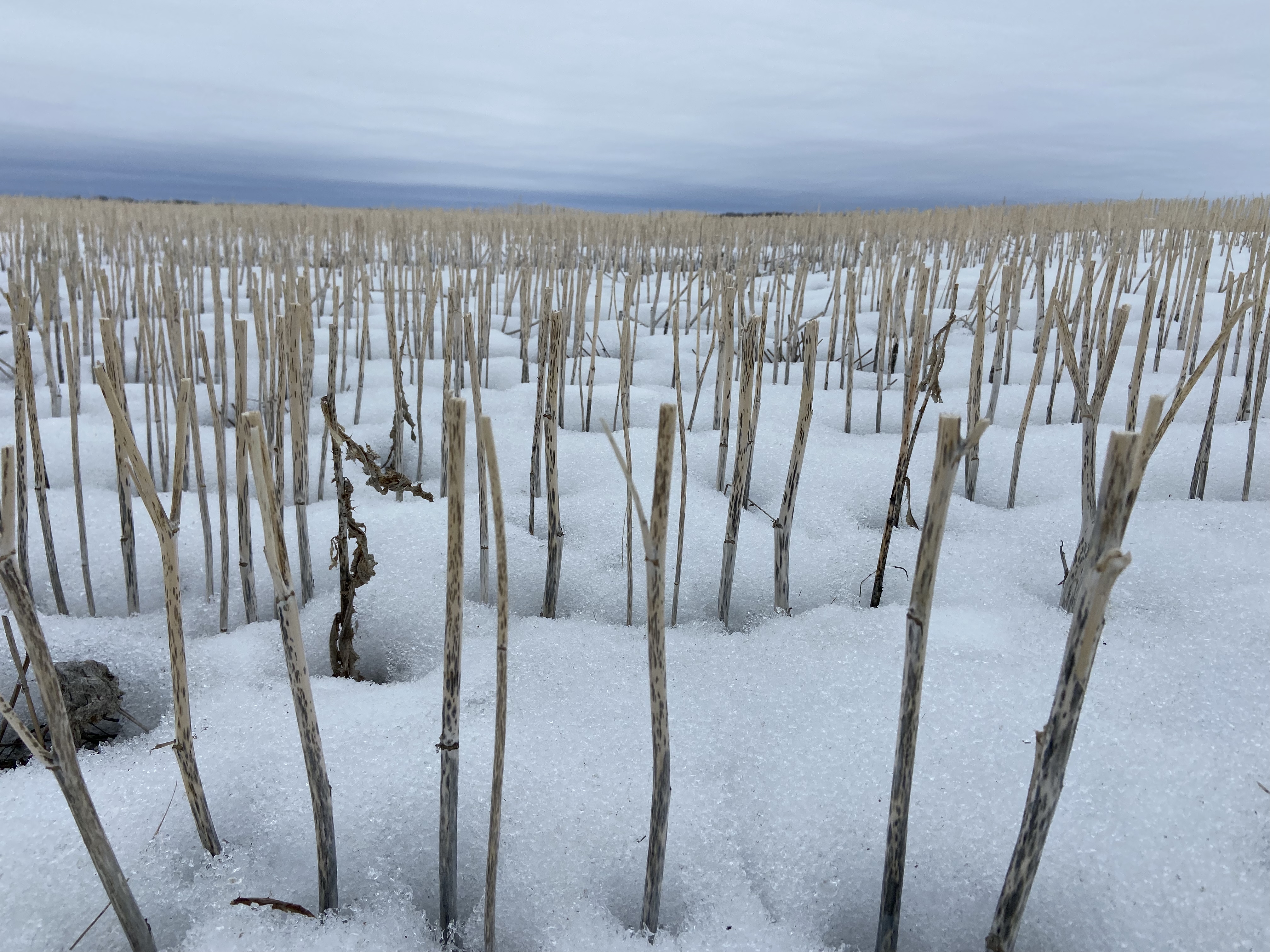
The coffee in Elias’s mug didn’t just get cold; it surrendered.
He watched the steam vanish against the kitchen window as the first grey light of an Alberta morning crept over the horizon. It wasn't the usual creeping dawn. It was a bruise-colored sky, heavy and low, moving with a speed that felt predatory. Out here, where the horizon stretches until it snaps, you don't need a barometer to tell you when the pressure drops. You feel it in the hinge of your jaw. You hear it in the way the wind begins to whistle a different, sharper tune through the siding of the farmhouse.
The Alberta clipper was coming.
Most people hear the word "clipper" and think of vintage sailing ships, lean and fast, cutting through the Atlantic. The meteorological version isn't much different. It’s a low-pressure system that hitches a ride on the polar jet stream, screaming out of the Canadian Rockies and sliding southeast across the Prairies toward Northern Ontario. It doesn't linger like a heavy, wet spring storm. It strikes. It’s a blitzkrieg of ice and wind.
The Ghost on the Highway
If you’ve never driven Highway 1 through Saskatchewan during a clipper, consider yourself lucky. Imagine a world that has been erased by an artist who only uses white paint.
Consider a hypothetical driver—let’s call her Sarah—trying to make it from Saskatoon to Regina before the hammer drops. She sees the forecast: ten to fifteen centimeters of snow. She thinks, I’m Canadian, I can handle ten centimeters. But the snow isn't the problem. The snow is just the ammunition. The wind is the shooter.
As the clipper descends, the wind gusts hit 70, 80, sometimes 90 kilometers per hour. That modest snowfall is suddenly whipped into a frenzy, lifted from the frozen ground and swirled into a "whiteout."
Sarah’s world shrinks to the three feet of pavement immediately in front of her hood. Then, the pavement vanishes too. The "invisible stakes" here aren't metaphors; they are the literal edges of the road that have merged with the ditch. Her heart hammers against her ribs—a frantic, rhythmic drumming that competes with the thud of the wipers. This is the human element of a weather report. It isn't about "millibars" or "isobars." It’s about the sweat cooling on a driver’s palms while the heater screams at full blast.
A Geography of Shivers
The Prairies are often misunderstood as a monolith of flatness, but the clipper treats each province with a specific kind of cruelty.
In Alberta, the storm is often a dry, biting affair. It’s the "brrr-ace" mentioned in the headlines—a sudden plunge in temperature that can drop the mercury by fifteen degrees in a single afternoon. It catches the unprepared. It catches the person who ran to the grocery store in a light jacket because it was "only minus five" when they left the house.
By the time the system reaches Manitoba, it has gathered momentum. The Red River Valley becomes a wind tunnel. There are no trees to break the assault, nothing to stop the wind from pushing a car right off the asphalt. This is where the logistics of a nation begin to stumble. Truckers, the lifeblood of the Canadian economy, are forced to pull over into crowded rest stops, their rigs idling like great, shivering beasts. Every hour they sit is a delay in the fruit reaching the shelf or the parts reaching the factory.
Then comes Northern Ontario.
The landscape changes from the open sea of the Prairies to the rugged, rock-strewn Shield. Here, the clipper finds moisture. As it skims across the top of the Great Lakes, it picks up steam, transforming from a fast-moving wind event into a heavy-hitting snow machine. Places like Kenora and Thunder Bay don't just get a dusting; they get a burial. The roads through the Shield are narrow, winding ribbons cut through granite. There is no "ditch" to slide into—only rock and pine.
The Calculus of Survival
We talk about weather in the abstract because it’s easier than acknowledging how vulnerable we are. We use terms like "system" and "front" to give ourselves the illusion of control. But for someone like Elias, the farmer watching the sky, the clipper is a series of hard choices.
He has to decide if the cattle are sheltered enough. He has to check the generator, knowing that a snapped line in this wind could mean thirty-six hours without heat. There is a specific kind of silence that falls over a rural house when the power dies during a storm. It’s a heavy, pressing silence that makes you listen to the house itself—the groaning of the timber, the rattling of the glass.
Logically, we know the sun will come back. We know the snowplows—those yellow-clad saints of the Canadian winter—will eventually roar down the concessions. But in the middle of the clipper, logic feels thin.
The math of the storm is unforgiving.
- Wind Chill: When the wind hits 60 km/h at -15°C, exposed skin freezes in under ten minutes.
- Visibility: At its peak, a clipper can reduce visibility to near-zero in seconds, a phenomenon known as "flat light" where the sky and ground become indistinguishable.
- Velocity: These storms can travel at 50 km/h, meaning they can cross entire provinces in a single day.
It is a reminder that despite our fiber-optic cables and heated seats, we live at the mercy of a moving mountain of air.
The Shared Breath
There is, however, a strange, flickering warmth that occurs when the cold gets this bad. It’s the only part of a clipper that isn't biting.
It’s the neighbor who shows up with a tractor to clear a driveway without being asked. It’s the stranger who stops to help push a sedan out of a snowbank, their breath mingling in a white cloud as they heave against the metal. We are never more aware of each other than when the environment tries to erase us.
In the city, the clipper is an inconvenience. It’s a delayed commute, a cancelled flight, a salt-stained pair of boots. But in the heart of the country, it is a rite of passage. It is the seasonal tax paid for the privilege of living under that massive, unobstructed sky.
Elias finally turned away from the window. He grabbed his heavy parka—the one with the frayed sleeves and the smell of diesel—and zipped it up to his chin. He didn't need the radio to tell him what was happening anymore. He could hear the first gust hitting the barn door, a low, guttural roar that sounded like a freight train coming across the fields.
He stepped out into the mudroom, his boots clicking on the cold linoleum. He reached for the door handle, took a breath, and stepped out to meet the wind.
The horizon was gone. There was only the roar, the white, and the work that needed to be done.