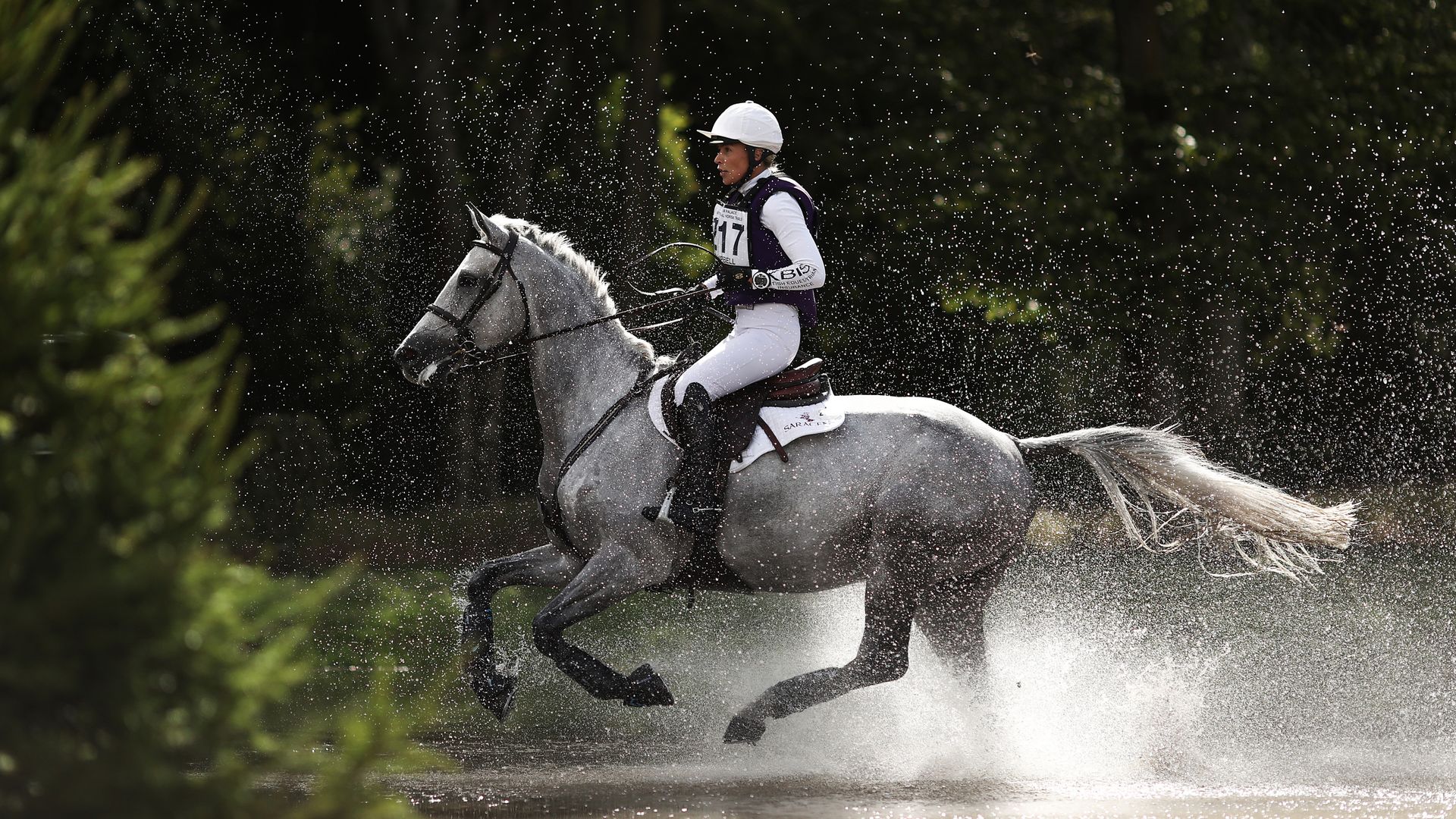
The death of a British rider following a rotational fall is not merely a tragic accident. It is the predictable outcome of a sport that balances on a razor-thin margin between athletic excellence and physics-defying catastrophe. When a horse clips a solid timber fence with its chest, its momentum does not stop; it pivots. The animal becomes a half-ton pendulum, flipping over the obstacle and landing directly on the rider. This specific mechanic, known as the rotational fall, remains the most lethal threat in equestrian sports, accounting for the vast majority of rider fatalities despite decades of safety innovations.
While the mainstream media often focuses on the grief of the community, the real investigation lies in the engineering of the course and the biological limits of the horse. We are looking at a discipline where the equipment has evolved, but the fundamental danger of the "fixed" fence remains an immovable reality.
The Physics of a Kill Zone
In eventing, the cross-country phase is the ultimate test of bravery. Unlike show jumping, where poles are designed to fall at the slightest touch, cross-country fences are solid. They are logs, stone walls, and massive wooden tables bolted into the earth. When a horse misjudges its take-off or tires in the final minutes of a long course, its front legs or chest may hit the top rail.
Because the fence does not give way, the energy has nowhere to go but upward and over. The horse’s hindquarters swing over its head in a somersault. For the rider, there is no "falling off." They are strapped by gravity into the direct path of the horse’s spine. A horse weighs roughly 1,200 pounds. When that weight descends from a height of four feet, the force of impact far exceeds what any modern body armor or helmet can withstand.
The industry has attempted to mitigate this through frangible technology. These are pins and clips designed to break when a certain amount of vertical or horizontal force is applied, dropping the rail and preventing the flip. However, these devices are not universal. They are expensive, require specific installation, and—most controversially—do not trigger in every type of collision. A "soft" hit that is still enough to trip a horse might not meet the pressure threshold required to break the pin.
The Fatigue Factor and Course Design
We have to talk about the clock. Modern eventing has shifted from a test of endurance to a high-speed sprint. As riders push for faster times to stay competitive, they take greater risks with their lines and approach angles.
Fatigue plays a silent role in these fatalities. Toward the end of a ten-minute gallop, a horse’s proprioception—its internal sense of where its limbs are—begins to fail. Lactic acid builds up. The heart rate nears its limit. A tired horse hangs its toes. On a stadium jumping course, this results in a four-penalty point error. On a cross-country course, it results in a funeral.
Course designers face an impossible mandate. They must create "bold" questions that challenge the world’s best athletes while ensuring the "average" professional stays safe. There is an inherent conflict here. If a course is too easy, it fails as a championship test. If it is too technical, it creates "traps" where a split-second misunderstanding between horse and rider becomes a death sentence.
The Culture of Silence Around Risk
There is a gritty, stoic pride in the British equestrian scene. It is a world of early mornings, muddy boots, and an unspoken acceptance that the animal you love might accidentally kill you. This "get back on" mentality is vital for the sport's survival, but it often stifles the necessary critique of governing bodies.
Whenever a rider dies, the immediate response is a flurry of tributes and a "review of circumstances." But these reviews rarely lead to radical structural changes. The sport clings to the "solid fence" tradition because it is the identity of eventing. To make every fence knock-down would be to turn cross-country into show jumping on grass. The purists argue that the danger is what defines the discipline.
This raises a grim question for the industry. Is the "spectacle" of the solid fence worth a human life every few years?
Critics within the veterinary community have long argued that we are breeding horses that are too fast and too "hot" for the traditional obstacles. We are pairing Thoroughbred speed with Warmblood jumping power, creating a vehicle that moves faster than the human brain can sometimes process in a crisis. When things go wrong at 20 miles per hour, the window for correction is non-existent.
The Myth of Protective Gear
Marketing departments for safety vests would have you believe that an air jacket is a silver bullet. These vests inflate via a CO2 canister when a rider is thrown from the saddle, providing a cushion around the neck and torso. They are remarkable pieces of kit.
But an air jacket is designed to protect you from the ground. It is not an exoskeleton. It cannot protect the ribcage or internal organs from the crushing force of a horse landing directly on top of a rider. In many rotational falls, the rider is pinned under the horse before the tether even pulls the trigger to inflate the vest.
We are seeing a dangerous trend where riders feel "invincible" because they are wearing $1,000 worth of safety tech. This leads to bolder riding and, paradoxically, more dangerous mistakes. Safety gear is a secondary backup; it is not a substitute for a horse that is fit enough and a rider who is focused enough to avoid the fall in the first place.
Institutional Responsibility and the Path Forward
The British Eventing (BE) and the FEI (International Federation for Equestrian Sports) have tightened the rules on "yellow cards" for dangerous riding. If a rider is seen jumping out of a stride that is clearly unsafe, they can be sanctioned. This is a start, but it puts the burden on officials who are often hesitant to penalize high-profile riders in the heat of a competition.
Data collection is another hurdle. While every fall at a sanctioned event is recorded, the "near misses" often go undocumented. We lack a comprehensive database that tracks the specific biomechanics of every "trip" or "stumble" that didn't result in a fall but could have. Without that data, course designers are working with a partial map.
True reform requires a shift in how we value "clears." Currently, the scoring system rewards speed above almost everything else. If the sport shifted its weighting to prioritize "style" or "technical accuracy"—similar to how some junior divisions are judged—the incentive to gallop at breakneck speeds toward solid timber would diminish.
The Human Cost of Tradition
Behind every headline about a fallen rider is a family, a stable full of horses, and a community left reeling. The tragedy in the UK isn't an isolated incident; it's a symptom of a sport that hasn't yet reconciled its 19th-century roots with 21st-century safety expectations.
We continue to build fences that do not move for an animal that cannot always clear them. Until the "solid" nature of the cross-country fence is fundamentally re-evaluated—either through mandatory frangible technology on every jump or a total redesign of the obstacles—we are simply waiting for the next somersault.
The equestrian world likes to say that the horse never intends to hurt the rider. That is true. But the horse is an flight animal being asked to perform a high-stakes stunt over an unforgiving landscape. When the physics of the rotational fall take over, intent doesn't matter. Only the weight of the horse and the hardness of the ground remain.
The sport must decide if it is willing to evolve past the "tradition" of the fixed obstacle, or if it will continue to accept these deaths as the "price of admission" for the ultimate equestrian test. This isn't about bad luck. It's about a mechanical failure inherent to the way the sport is currently constructed.