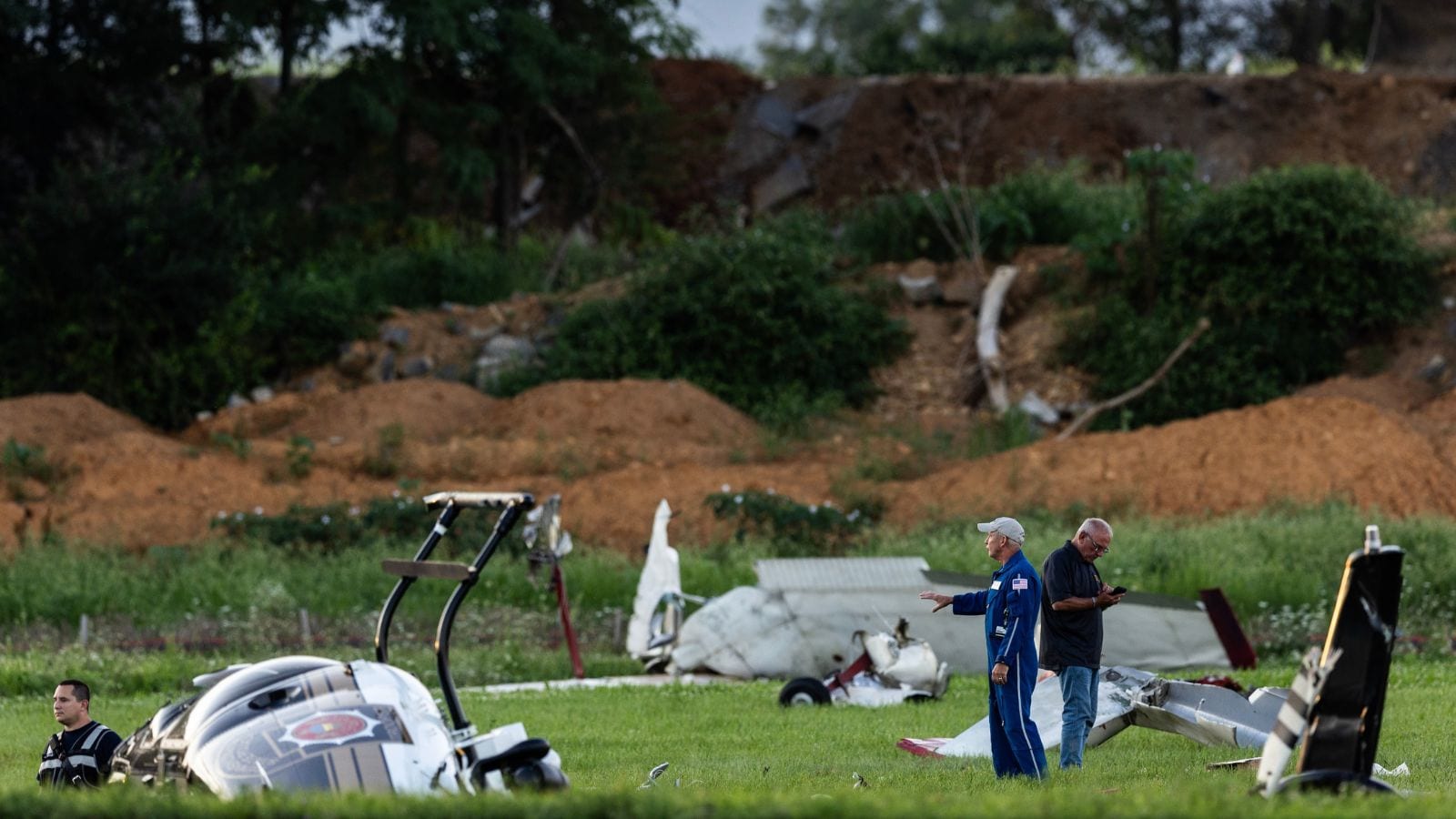
Dusk over Carlisle Airport does not arrive with a dramatic flourish. It bleeds in slowly, painting the Cumberland County horizon in bruised shades of violet and gray, turning the flat ribbon of tarmac into a quiet stage. On any ordinary Wednesday evening, the airspace above this regional airfield in central Pennsylvania is an exercise in predictable choreography. Pilots talk on common frequencies. Engines hum a steady, domestic drone. The world below goes about its supper.
Then came the sound.
Witnesses later tried to describe it, grasping for words that could hold the raw violence of the impact. It was not a metallic scraping or a mechanical whine. It was a sudden, concussive fracture that tore through the evening air just before seven o'clock.
In that split second, two distinct stories collided.
A Pennsylvania State Police Bell 407 helicopter, hailing from Harrisburg, was hovering low to the ground in a grassy area adjacent to the runway. Aboard were two members of the state police elite aviation unit—Corporal Bryce Korman and Trooper Jason Mills—engaging in routine training exercises. They were working through maneuvers that require total concentration, trusting the open space around them, entirely unaware of what was descending from behind.
At the same time, a small, single-engine Cessna 150—a classic two-seat trainer aircraft—approached the runway. What happened next remains the central focus of a joint investigation by the Federal Aviation Administration and the National Transportation Safety Board. According to state police briefings, as the Cessna came down along the tarmac, it veered hard to the right at the absolute last moment.
There was no time to evade. The pilots in the helicopter could not see the airplane approaching from their rear.
The impact was catastrophic. The Cessna, built from aluminum and lightweight frames, was shredded into countless pieces. The force of the blow sheared the helicopter's rotor blades and its tail boom, sending the heavily modified aircraft rolling inverted before it crashed onto its side and partially onto its roof.
Silence rushed in to fill the vacuum left by the noise.
In the immediate aftermath, the cockpit of the Bell 407 became a trap of twisted metal and shattered glass. Both troopers were stuck inside, bleeding, disoriented, and pinned by the wreckage. For a few agonizing moments, the outcome hung by a thread.
Survival in aviation often comes down to cold reflex and sheer adrenaline. Korman, despite his own injuries, managed to find leverage. He pushed against a cabin window until it gave way, shattering outward. Working through the narrow aperture, he reached back inside to pull his partner clear of the wreckage. First responders arrived to find a scene of utter devastation, yet miraculously, both troopers survived, later stabilized at Penn State Hershey Medical Center.
For the lone occupant of the Cessna—the pilot whose identity was withheld pending family notifications—there was no second chance. The sky had demanded the ultimate price.
Accidents in uncontrolled airspace, where airports operate without active control towers and rely instead on pilot-to-pilot radio communications, carry a unique brand of vulnerability. Every time a pilot takes off, they enter a silent pact with the invisible geometry of the atmosphere. They trust that vectors will not cross, that blind spots will remain empty, and that human error will not choose the exact same coordinate in time and space.
When that pact breaks, the debris field is measured in yards, but the grief is immeasurable.
Governor Josh Shapiro later surveyed the wreckage and noted that the night could have been unimaginably worse for the state police family. Relief, however, sits uncomfortably alongside sorrow. Investigators will spend months combing through radar data, radio logs, and fragmented aluminum to answer why a routine training flight intersected with a fatal trajectory.
Yet long after the NTSB clears the runway and the investigators pack their clipboards, the larger truth remains suspended in the air above Carlisle. The sky is vast, beautiful, and utterly unforgiving of a single misplaced degree.