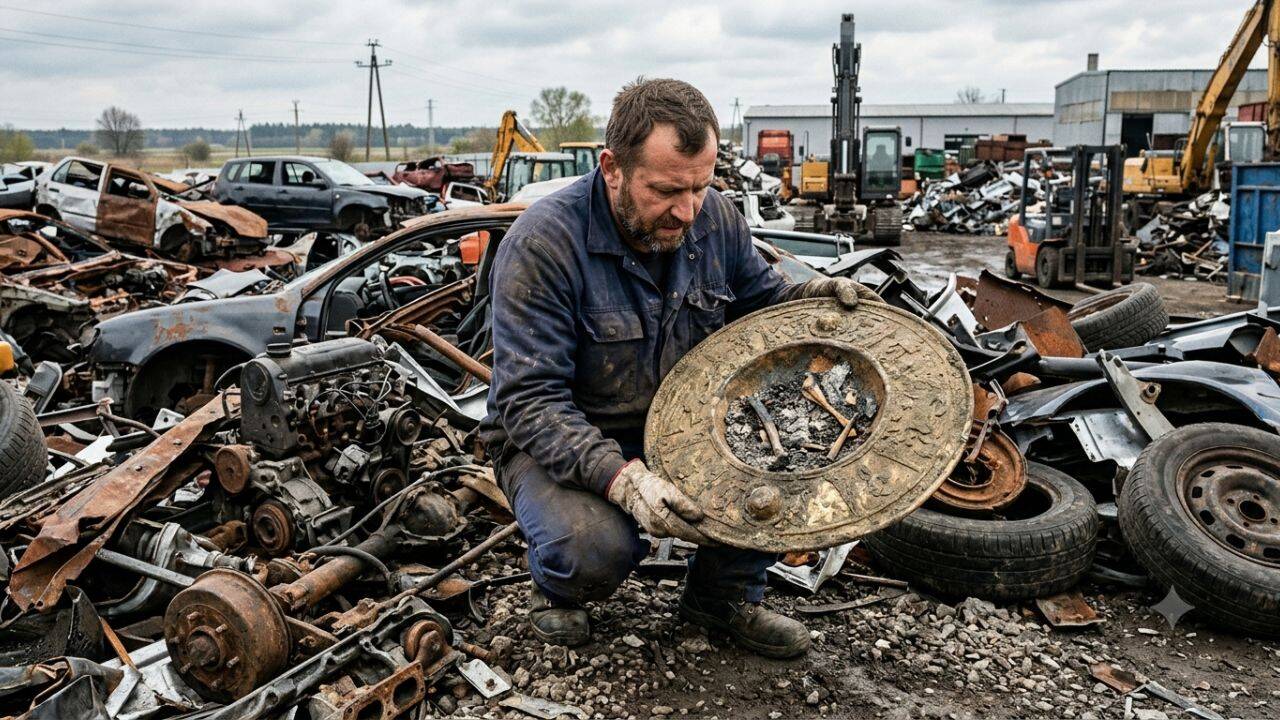
Every internet historian lost their collective mind when the headlines dropped about a man rummaging through a Polish scrapyard and unearthing an 1,800-year-old Roman shield boss fused with human remains. The amateur archaeology crowd treated it like a miracle. The mainstream media framed it as a quirky, accidental lottery win of historical preservation.
They are all completely, dangerously wrong.
This isn't a heartwarming story about a lucky treasure hunter. It is a loud, blaring alarm bell exposing the absolute failure of modern archaeological infrastructure and heritage tracking. If a piece of imperial Roman military equipment—complete with human biofact material—can end up tossed in a heap of scrap metal in Central Europe without a single institution noticing until a hobbyist trips over it, our entire system of artifact protection is a total joke.
Stop treating this as a lucky accident. Start treating it as a systemic disaster.
The Scrapyard Myth And The Illusion Of Provenance
The lazy consensus says that ancient artifacts wander. Objects travel through trade, migration, or the chaos of the Migration Period, eventually landing far from home. Sure, the amber roads existed. Yes, Germanic tribes traded with Rome, and auxiliary soldiers brought gear back to Barbaricum.
That narrative is a comforting security blanket designed to hide a much darker reality: the black market looting machine is entirely unbothered by borders, laws, or museum ethics.
When an object like this surfaces in a scrap yard rather than a stratified archaeological excavation, we lose 90% of its data value instantly. Provenance isn't just a fancy word antique dealers use to inflate prices; it is the scientific context of the find. Soil chemistry, micro-stratigraphy, spatial relationship with the surrounding environment—that data is gone forever because some middleman dumped a piece of antiquity alongside old tractor parts.
We do not have a robust network of heritage protection. We have a sieve.
Why Bureaucracy Encourages Looting
Let us look at the structural incentive problem. If you find a priceless piece of antiquity while digging in your yard or sorting industrial waste in parts of Europe, what happens?
In many jurisdictions, the moment you report a significant archaeological find, the state seizes it, the site gets locked down for years of unfunded academic gridlock, and you get pennies on the dollar—if you are lucky. In the worst-case scenarios, finders face criminal investigation for illegal excavation.
What does that incentivize? Silence.
It drives the entire market underground. It turns historical preservation into a high-stakes smuggling operation. People do not hand treasures over to local museums because the institutional framework treats citizens like criminals rather than stewards of history.
Imagine a scenario where finders of extraordinary historical assets receive immediate, market-value compensation alongside open-source digital cataloging rights. Looting would plummet overnight because transparency would finally pay better than secrecy.
Instead, we cling to nineteenth-century bureaucratic models that treat antiquities like state-owned hostage property. The result? Roman shields in Polish scrap yards.
Dismantling The Antiquity Trade Fallacy
People love to ask how an artifact traveled hundreds of miles outside the Roman limes. They look for grand historical narratives about battles, migrations, or diplomatic gifts.
Wrong question.
The real question is: how many other second-century military artifacts are currently sitting in shipping containers, private warehouses, or scrap heaps right now, ignored because they do not look shiny enough for a museum display case?
Antiquity trafficking is a multi-billion-dollar global enterprise. Organized networks move stolen cultural property across European borders with the same ease as illicit electronics or scrap metal. A corroded iron umbo attached to decayed bone fragments doesn't look like high art to a border guard. It looks like garbage. And that is precisely how it slips through the cracks.
We romanticize the romantic discovery while ignoring the rot at the foundation of heritage management.
The Hard Truth About Amateur Archaeology Versus Academic Gatekeeping
There is an ongoing culture war between professional archaeologists and metal-detecting hobbyists. Academics call them looters; hobbyists call academics elitist gatekeepers hoarding the past.
Both sides are partially right, and both are entirely failing the material record.
Professional archaeology is chronically underfunded. Universities and state agencies cannot possibly monitor every square mile of soil, every construction site, or every industrial recycling yard. They rely on a defensive, exclusionary posture that pushes ordinary people away from science.
Meanwhile, independent detectorists and scrapyard pickers often lack the training to document context properly, leading to the destruction of non-portable data.
The solution is not to ban metal detecting or pretend that amateurs don't find things professionals miss. The solution is radical integration. Train the finders. Build rapid-response archaeological units that can deploy to an industrial site or a farmer's field within hours. Decentralize the protection of the past.
The Mic Drop
A rusty piece of Roman iron pulled from a Polish junk pile isn't a testament to the far-reaching glory of the Roman Empire. It is a monument to our collective institutional incompetence, rotting in plain sight while we applaud the person who found it by accident.