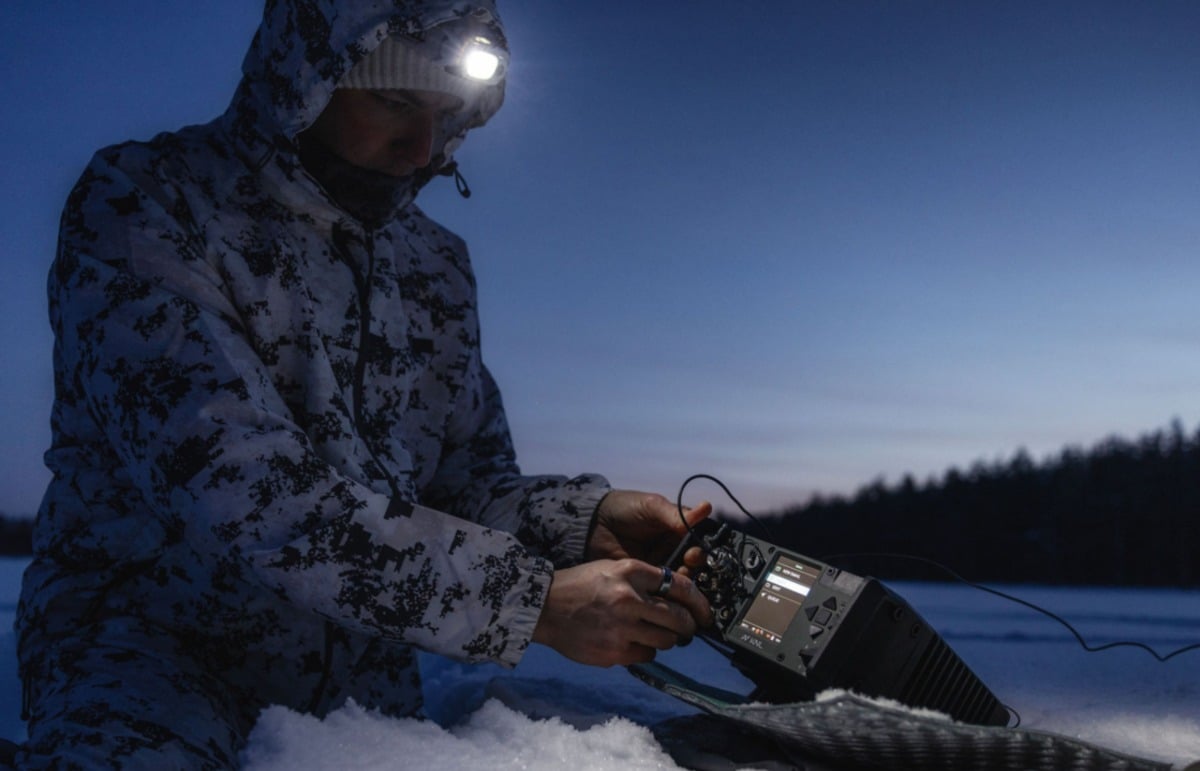
Radio silence is no longer a viable tactic. On the modern battlefield, if your communications network cannot survive aggressive electronic warfare, your forces are effectively blind, deaf, and isolated. Finland shares a massive border with Russia, a nation that treats electronic warfare as a primary weapon rather than a secondary support function. Because of this reality, the Finnish Defence Forces are aggressively overhauling their tactical communication infrastructure with hardware designed explicitly to operate through the heaviest jamming environments imaginable.
The strategy focuses heavily on replacing legacy analog systems with highly advanced software-defined radios and cognitive network equipment. This transition is not just about upgrading old hardware; it represents a fundamental shift in how military units maintain a common operating picture when the spectrum itself is actively under attack.
The Cognitive Network Advantage
Traditional military radios rely on fixed frequencies or predictable frequency-hopping patterns. If an adversary has sufficient processing power and monitoring hardware, they can isolate those frequencies and flood them with noise, effectively cutting off communication. Finland is addressing this vulnerability by integrating Cognitive Networked High Frequency (CNHF) systems developed by KNL.
These cognitive radios do not just hop frequencies; they analyze the radio spectrum in real time. The system evaluates channel conditions across thousands of potential frequencies simultaneously. When the hardware detects deliberate interference or atmospheric noise, it shifts the communication link to a clean frequency in less than half a second.
[Signal Transmitting] ---> [Jamming Detected] ---> [Spectrum Scanned] ---> [Link Re-established in <0.5s]
This rapid turnaround happens entirely automatically without requiring human intervention. It ensures that dismounted soldiers and mobile command units do not lose vital connectivity when seconds matter.
Operating Without Satellites
A critical requirement for Finland's new radio hardware is the ability to function in completely denied environments. Modern military operations are heavily dependent on Global Navigation Satellite Services (GNSS) like GPS for both positioning and precision timing. Electronic warfare units regularly target these satellite signals, creating massive dead zones where standard commercial and military equipment fails.
The hardware deployed by the Finnish Defence Forces handles timing and synchronization internally, removing any reliance on external space-based infrastructure. By utilizing proprietary wideband waveforms and advanced electronic counter-countermeasures, these radios can build independent mesh networks that span from local tactical ranges to thousands of kilometers. They transform every individual radio into an intelligent node capable of routing data around jammed zones dynamically.
Software Defined Upgrades
Alongside long-range cognitive HF systems, Finland has scaled up its deployment of handheld and vehicular software-defined radios via multi-million euro serial procurements with domestic defense contractor Bittium. The deployment of the Tough SDR family of radios targets broadband tactical communications for the Army, Navy, and Air Force.
| Feature | Legacy Analog Systems | Modern Software-Defined Radios |
|---|---|---|
| Frequency Control | Hardwired, static crystal oscillators | Dynamically programmable via software |
| Bandwidth | Narrowband voice only | Wideband tactical IP data and voice |
| Adaptability | Requires hardware replacement to update | Upgradable in the field via software patches |
| Jamming Resistance | Minimal to none | High via adaptive waveforms and cancellation |
Because these units are completely software-driven, their performance parameters, encryption layers, and anti-jamming waveforms can be updated throughout their operational lifecycle. When a new jamming technique emerges on the battlefield, the response does not involve rebuilding the radio hardware; it involves pushing a software patch that alters how the radio processes signals.
Integrating with the Modern Digital Battlefield
These tactical radios are far more than rugged walkie-talkies. They serve as mobile IP routers on the battlefield, integrating directly into broader C4ISR (Command, Control, Communications, Computers, Intelligence, Surveillance, and Reconnaissance) networks. They support standard network protocols like Ethernet, VPNs, and wireless LANs right out of the box.
This native IP compatibility means that a soldier in a forward trench can transmit targeting data, telemetry, and encrypted text messages across the exact same hardware used for secure voice communications. The network automatically compresses and prioritizes this data based on available bandwidth, ensuring that critical command data gets through even when the link is constricted by electronic interference.
To prepare tactical networks for highly contested environments, defense communication managers should prioritize several key steps:
- De-couple synchronization mechanisms from GNSS dependency to prevent total network failure during localized GPS blackouts.
- Transition from legacy fixed-frequency hardware to agile software-defined platforms that allow rapid waveform adjustments.
- Implement cognitive automated frequency management to reduce the configuration burden on operators during high-stress electronic warfare engagements.
- Ensure all forward-deployed tactical assets utilize self-healing mesh networking protocols to maintain local data routing when primary long-range links are severed.
Finland’s systematic overhaul of its tactical communications infrastructure provides a clear blueprint for modern defense procurement. By assuming the electromagnetic spectrum will be heavily contested from day one, they are building a resilient, adaptable network that treats electronic warfare resistance as a foundational feature rather than an afterthought.