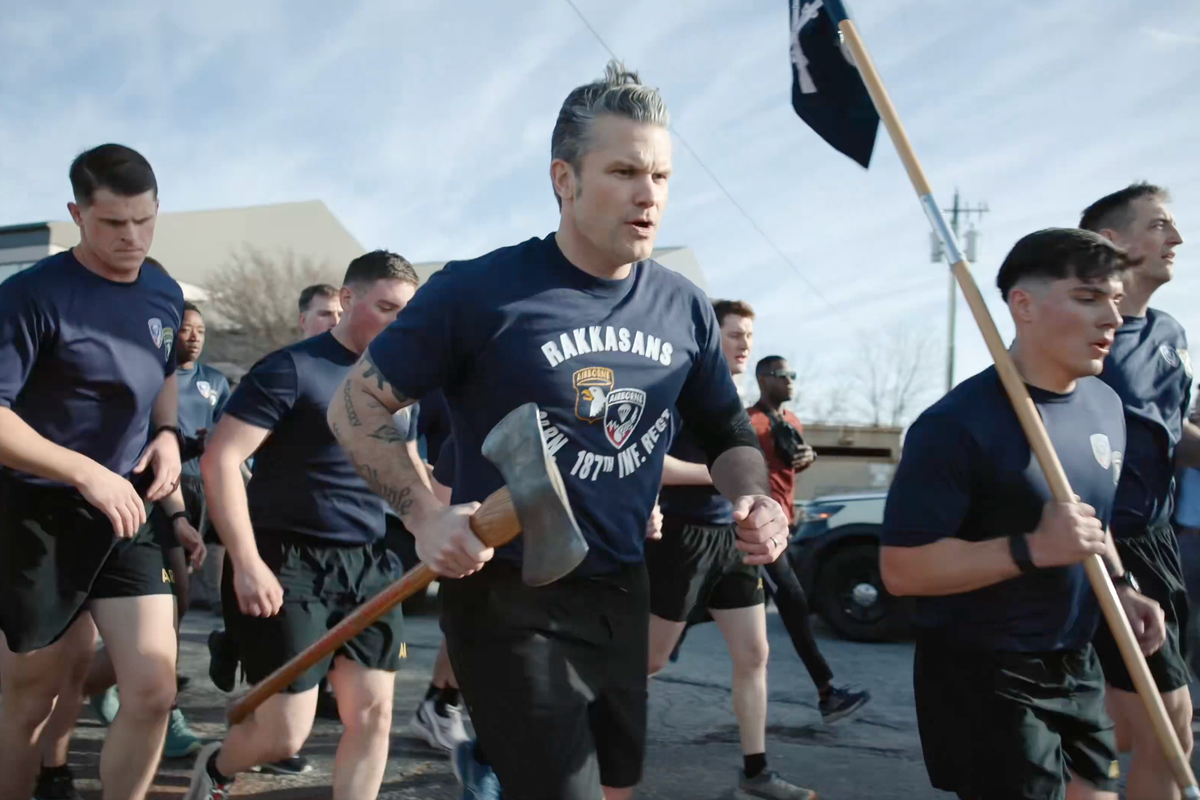
Fitness influencers love to dog-pile on viral video footage. When clips circulate of high-profile political figures or public personalities grinding through suboptimal, awkward, or unconventional training routines, the internet's exercise elite race to drop reaction videos. They dissect every degree of joint angle. They sneer at momentum. They lecture about hypertrophy, optimal tension curves, and injury risks.
They are missing the entire point.
The recent online commentary surrounding Pete Hegseth’s military fitness clips highlights a massive blind spot in modern fitness culture. Traditional gym influencers judge movement strictly through the lens of bodybuilding mechanics and comfortable gym aesthetic standards. But functional resilience, combat readiness, and real-world toughness operate on an entirely different operational physics.
The Flaw In Optimal Gym Logic
The mainstream critique relies on a comfortable assumption: every workout must maximize muscle hyper-isolation while minimizing systemic discomfort and mechanical breakdown.
If a movement doesn't isolate the target muscle group perfectly, the internet algorithms label it trash.
That logic breaks down the moment you step outside a climate-controlled commercial gym. Real-world physical stress doesn't come with smooth pulley systems, balanced barbells, or adjustable benches. In tactical environments, manual labor, or chaotic sports, load distribution is uneven. Fatigue is systemic. Workouts designed around chaotic, high-volume, non-traditional movements aren't meant to build symmetrical biceps; they build mental friction resistance and work capacity under adverse conditions.
When you look at combat readiness testing across military branches, the goal isn't peak aesthetic physique. It's work capacity under fatigue. Crying about form degradation in high-intensity, stress-adaptation exercises ignores decades of conditioning protocols used by elite athletic and military programs worldwide.
Hypertrophy Versus Work Capacity
Standard fitness channels measure success by three primary metrics:
- Mechanical tension
- Metabolic stress
- Symmetrical muscle damage
Tactical and functional physical culture measures success by entirely different metrics:
- Central nervous system stamina under physical strain
- Multi-planar trunk stability during uncoordinated loads
- Grit, repeatability, and psychological tolerance for discomfort
Critiquing a combat-oriented workout because it doesn't isolate the lateral deltoid is like criticizing a rugby match because the players aren't running with track-and-field sprint posture. It misinterprets the objective entirely.
The Form Police Myth
Every armchair trainer on social media claims that non-standard form guarantees immediate injury.
This argument is scientifically lazy.
The body adapts to the demands placed upon it. This principle—Specific Adaptations to Imposed Demands—applies to awkward angles just as much as it applies to pristine bench presses. When athletes slowly expose their connective tissues to variable movement patterns, awkward loads, and high-fatigue states, they build tissue resilience.
"You don't get injured because a movement is awkward. You get injured because you applied intensity to a position your connective tissue was never prepared to handle."
If an individual only trains in pristine, perfectly stabilized planes of motion, they become fragile. The second life forces them to lift a heavy object off-center while exhausted, their body breaks down. High-volume, grit-focused workouts train the body to handle non-ideal biomechanics.
Stop Training For The Mirror
The viral mockery of unconventional, grind-it-out fitness routines exposes a deeper cultural rot: we have traded real performance for sanitized optimization.
Modern fitness culture has convinced millions of people that if a exercise isn't scientifically proven by a 12-week study on untrained college students to maximize hypertrophic response, it has zero value. We have analyzed the human spirit out of physical training.
Is every viral military workout routine a masterpiece of exercise programming? Of course not. Some drills are inefficient. Some are designed purely for visual flair or high-intensity mental conditioning rather than long-term joint health.
But attacking these routines for failing to match bodybuilder guidelines shows a complete lack of understanding regarding why people push themselves through brutal physical challenges in the first place.
Training isn't just about physiology. It's about psychology.
If you spend your whole life chasing optimal, perfect reps inside a rack, you might look great under spot lights. But the minute reality demands real, ugly, uncoordinated strength, you'll fold.
Put down the biomechanics textbook, step off the pristine leg press, and learn to handle a little chaos.