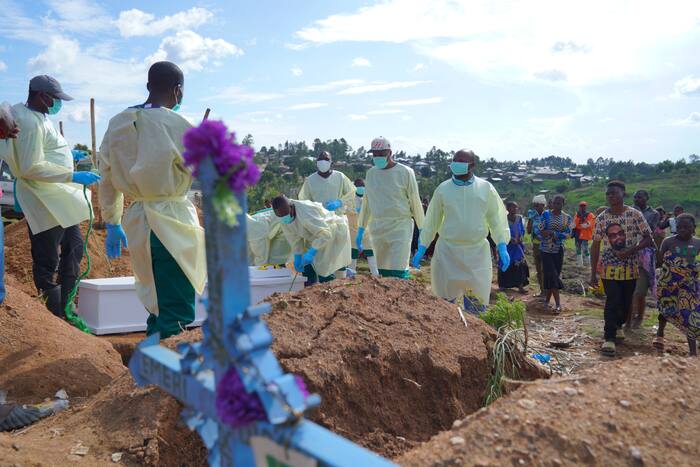
Five thousand.
Say it slowly, letting the weight settle behind your ribs before you even think about a map, a clinic, or a press release. Five thousand funerals held in quiet forest clearings and crowded town squares across the Democratic Republic of the Congo. Five thousand families who watched a fever start like any ordinary malaria or typhoid and turn, within days, into a terrifying storm of bleeding, exhaustion, and grief.
Numbers do something strange to the human mind when they get large enough. They flatten. A statistic is tidy; it fits in a headline without breaking a glass. Yet a person dies alone in a heat-soaked room while relatives stand outside a rope line, waving from twenty feet away because touching the body of someone you love can carry a death sentence of its own.
To understand why fear of a wider, continent-spanning outbreak is rising so sharply right now, we have to look past the ticker tape. We have to trace how a virus moves through human habits, fragile infrastructure, and the quiet places where borders exist only on paper.
The Fever That Rewrites a Household
If you have never stood near an active Ebola treatment center in central Africa, it is easy to picture outbreak response as a clean, clinical machine. White suits. Flashing lights. Order.
Reality is much louder. And much warmer.
Sweat beads on the inside of a face shield within ten minutes. Every breath fogs the plastic slightly, turning the person standing across from you into a soft-edged silhouette. You learn to listen with extra care—to the rasp of a dry cough, the tremor in a mother’s voice, the sudden silence when a child stops crying.
Consider a hypothetical family—let us call them the Kasongo household—living in a bustling trading town near the eastern border of the Democratic Republic of the Congo. This scenario is illustrative rather than a record of a single real family, though scenes like it have played out across North Kivu and Ituri for years.
In this hypothetical story, father and son both ride motorcycle taxis along red-dirt roads that link small farming villages to busy regional markets. One evening, the father comes home shivering. His head pounds. His joints ache as if he has been hauling timber all day. Nobody panics at first. Fever is a weekly visitor in the tropics. He takes whatever medicine is on hand and lies down on a woven mat.
Two days later, vomiting and watery diarrhea set in. Fluid leaves the body faster than a cup can refill it. Weakness turns heavy, almost leaden. By day four, the household is no longer dealing with a routine illness; they are fighting a biological ambush.
Here is the cruelty of filoviruses like Ebola: early symptoms mimic diseases people live alongside every single week. By the time unmistakable warning signs appear—unexplained bruising or bleeding, profound exhaustion, organ stress—the virus has already had days to move through close contacts. A spouse wiping a brow. A child handing over water. A neighbor helping carry a sick relative to a clinic.
I have sat on wooden benches outside rural health posts where people waited in quiet dread, torn between two fears. One fear is the sickness itself. The other is walking into an isolation ward and never coming out—or worse, having your community whisper about your house long after the fever passes.
When mistrust takes root, containment slows down. When containment slows down, five thousand deaths stop looking like a peak and start looking like a milestone on a longer road.
Why Borders Rarely Stop a Virus
Mapmakers love straight lines and neat colors. Viruses do not care about either.
Across the Democratic Republic of the Congo, movement is lifeblood. People cross rivers in dugout canoes before sunrise. Traders carry cassava, charcoal, beans, and secondhand clothes across porous frontiers into neighboring countries where languages, cousins, and markets overlap seamlessly. A border post might have a health screening desk with a thermometer and a handwashing bucket—and right beside it, dozens of footpaths wind quietly through tall grass and trees.
To picture how easily a localized crisis can stretch toward a continental worry, use a simple metaphor. Think of an outbreak like sparks drifting over dry brush on a breezy afternoon. Most sparks land on damp soil and die out. One lands on dry tinder three miles away. Multiply that across hundreds of miles of connected trade routes, bus corridors, and crowded transit hubs, and the question shifts from whether a spark can travel to how fast responders can stamp it out when it lands.
That is why health officials watch every new flare-up with such tight-jawed urgency. Each time an infected person travels while incubating the virus—or while feeling mildly unwell and pushing through a journey to reach family or work—the chain of transmission stretches further from the original forest edge.
Consider what happens next when a case surfaces in a densely connected city or a major transport hub:
- Contact tracers suddenly face dozens or hundreds of names instead of a handful.
- Hospitals already stretched thin by everyday emergencies must divert staff, protective gear, and isolation beds on short notice.
- Rumors travel faster than ambulances, sometimes convincing scared families to hide sick relatives or flee before teams arrive.
None of this means a continent-wide catastrophe is inevitable. History shows that rapid ring vaccination, swift isolation, safe and dignified burials, and honest community engagement can choke off outbreaks even in unforgiving terrain. Yet every new wave tests a system that has already been running a marathon for years.
The Invisible Weight on Those Who Stay
Ask anyone who has spent months inside an outbreak response, and they will rarely talk first about virology textbooks. They talk about fatigue.
Chronic fatigue. The kind that sits behind your eyes even after eight hours of sleep.
Local nurses, community health workers, ambulance drivers, and burial teams carry a burden that rarely makes headlines. Many of them live in the very communities hit hardest. They know the shopkeeper whose son fell ill. They recognize the voice of the elder pleading for answers. When fear spikes, stigma often lands right on the people trying to help—neighbors avoiding the health worker’s house, landlords worrying, children teased at school.
And there is a deeper, quieter grief: watching the world’s attention drift.
When a crisis crosses a dramatic round number—five thousand lives lost—it briefly commands global focus. Cameras turn toward the region. Statements are issued. Pledges circulate. Then, weeks later, another headline grabs the spotlight, and the daily grind continues out of sight.
A virus does not operate on a news cycle. It keeps replicating. It keeps probing for gaps in surveillance, funding, and trust.
I still remember a conversation with a young community health volunteer in eastern Congo during a tense stretch of rainy weather. Mud caked his boots up to the shins. His notebook was damp around the edges, filled with names, dates, and follow-up visits. When I asked how he kept going day after day despite the risk and exhaustion, he looked down at his pen and said simply that if nobody from the neighborhood knocked on those doors, people would die behind closed curtains out of fear.
That sentence has stayed with me for years. Courage in an outbreak rarely looks dramatic. Most days, it looks like showing up again tomorrow.
What Five Thousand Losses Really Ask of Us
If you are reading this from thousands of miles away, it is fair to ask why a death toll in Central Africa should tug at your sleeve tonight.
Maybe you feel overwhelmed by bad news already. Maybe global crises blur together until your mind puts up a shield just to get through the week. I get that. Compassion fatigue is real, and pretending otherwise doesn't help anyone.
Still, there is a reason public health experts repeat a hard truth whenever an outbreak grows large or threatens wider spread: infectious diseases do not stay neatly tucked inside distant corners of the world when travel and trade tie regions together. More immediately, five thousand human lives lost in the Democratic Republic of the Congo represent thousands of unfinished stories—teachers, farmers, mothers, students, elders whose absence leaves holes that no aid package can sew back together.
Addressing the fear of wider spread requires more than emergency airlifts after the fire is roaring. It demands steady investment in local laboratories, reliable supply chains, fair support for frontline workers, and respect for local communities long before the next alarm bell rings.
Because the real turning point in any outbreak happens long before a case reaches a distant capital or a major airport. It happens in a quiet conversation between a trusted local nurse and a frightened family deciding whether to step forward for care.
Rain falls hard on red earth in the eastern hills, washing fresh ruts into the roads before dawn, while a single lantern glows in a doorway where someone is waiting for help to arrive.