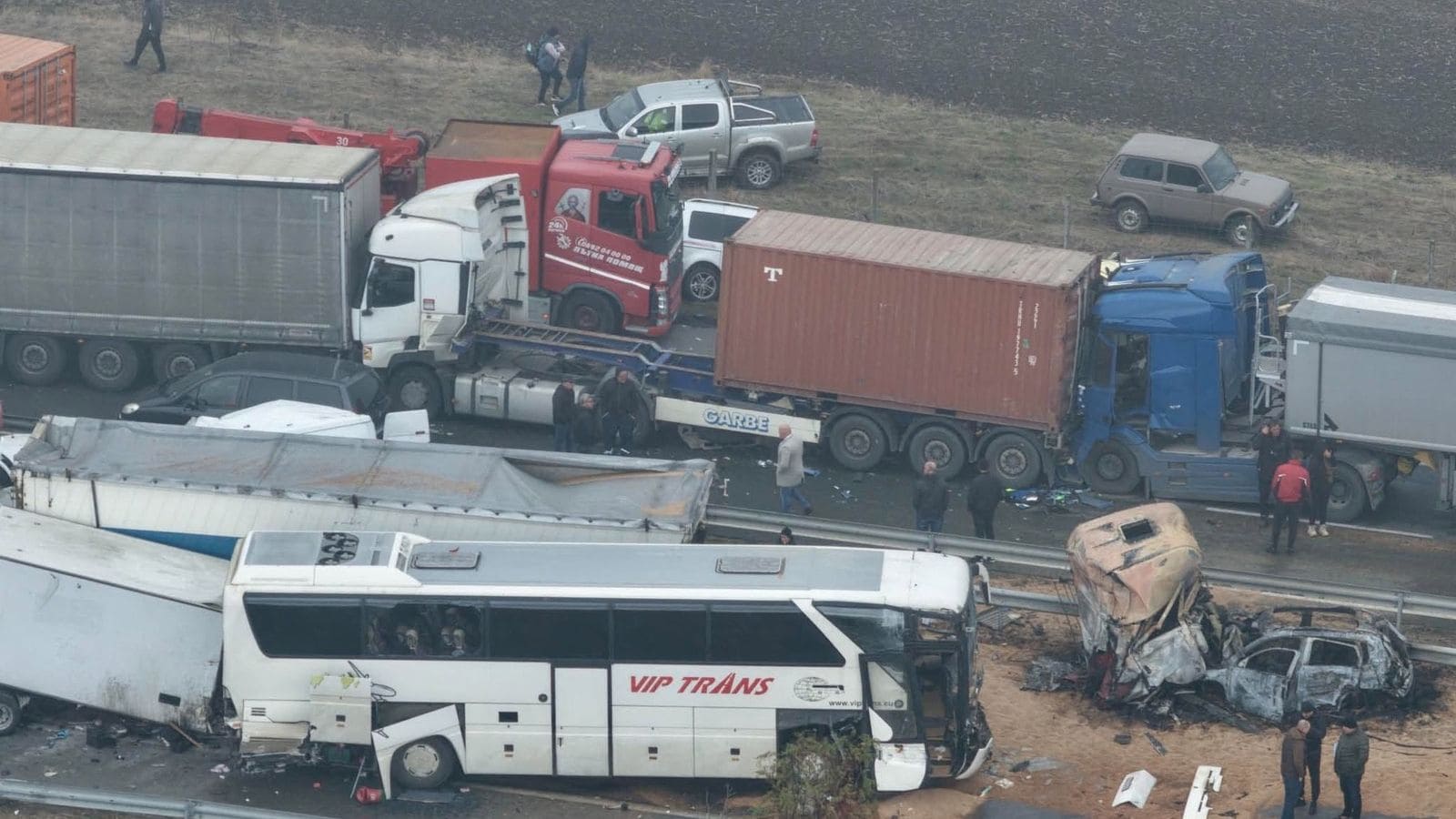
Metal does not scream when it tears. That is a lie Hollywood taught us. In reality, when eighty tons of freight and family sedans collide at a hundred kilometers an hour in the middle of a Bulgarian night, the sound is a dull, wet thud—like a heavy sack of grain hitting stone—followed immediately by the suffocating silence of a stalled engine and the hiss of punctured radiators.
I know this sound because I have stood on the shoulder of the Trakia Motorway at three in the morning, tasting diesel smoke and wet asphalt in the back of my throat, watching blue emergency lights fracture against a wall of autumn mist.
A headline tells you that eleven people died in a motorway pileup in Bulgaria and dozens more were injured. Eleven. A tidy, two-syllable number that fits comfortably into a morning news ticker while you stir sugar into your coffee. Dozens. A vague, comforting plural that allows the brain to file the tragedy away under the category of distant, unavoidable misfortune.
But numbers are an anesthetic. They numb us to the physics of what actually happens when a vital European transit artery turns into a blind corridor of twisted steel.
The Anatomy of a Blind Corridor
To understand why a Bulgarian highway becomes a trap, you first have to understand the geography of haste.
Bulgaria sits at the literal crossroads of southeastern Europe. The Trakia and Struma motorways are not merely domestic roads; they are the concrete veins carrying Turkish cargo trucks toward Munich, Greek families returning from weekend trips, and Bulgarian commuters rushing between Sofia and the Black Sea coast.
Consider a hypothetical driver—let us call him Georgi—leaving Plovdiv at dusk. Georgi is not reckless. He has driven this stretch of asphalt a hundred times. He checks his mirrors, keeps his hands at ten and two, and watches the red taillights ahead of him like a lighthouse in a choppy sea.
Then, the temperature drops three degrees in the span of four kilometers.
River valleys and low-lying plains across the Balkan peninsula are notorious for radiation fog—a dense, milky blanket that does not roll in gently, but materializes out of the ground like smoke from a sudden fire. Visibility drops from five hundred meters to fifteen in the time it takes to change a radio station.
Think of driving into sudden, thick fog at highway speeds like running full-sprint through a dark hallway where someone has silently moved the furniture. Your brain is still processing the layout of the room you saw three seconds ago, while your body is already hurtling toward a wall that was not there a moment before.
In that fraction of a second, physics takes over from human intention. A car moving at 120 kilometers per hour travels more than thirty-three meters every single second. By the time Georgi’s eyes register the sudden flare of brake lights ahead, by the time the electrical impulse travels from his brain to his right foot, his vehicle has already eaten up the buffer zone.
And behind Georgi is a forty-ton semi-truck whose driver has been staring at the white lines for nine hours straight.
When Infrastructure Meets Human Fatigue
Why do multi-vehicle pileups in Bulgaria carry such a devastating fatality rate compared to the European Union average?
The answer is not simple bad luck, and it is certainly not that Bulgarian drivers care less about their lives than drivers in Sweden or Germany. Road safety data from the European Commission consistently places Bulgaria near the top of the continent's road mortality charts, with fatality rates often hovering more than double the EU average. That statistic is the surface symptom of a deeper, structural illness.
First, there is the illusion of safety that comes with a newly paved highway. When a government lays down fresh blacktop and paints crisp white lines, drivers subconsciously treat the road like a modern, smart-sensor corridor. They assume there will be electronic overhead signs flashing warnings of black ice or stalled traffic ahead. They assume the shoulder is wide enough to serve as an escape lane.
Too often, those assumptions are fatal.
On many stretches of Balkan transit routes, lighting is sparse, variable-message warning boards are either absent or dark, and guardrails are designed to standards from a different era of automotive weight. When a single vehicle spins out on a patch of black ice or slows abruptly in a pocket of mist, there is no automated network to warn the drivers two kilometers back. The warning system is simply the crunch of the first impact.
Then there is the human toll of the supply chain. Europe’s economy runs on tight delivery windows. A freight driver hauling produce from the Turkish border at Kapitan Andreevo toward Central Europe faces border queues that can stretch for days. Once they finally clear customs, the clock is screaming at them. Fatigue sets in—not the dramatic kind where your head drops to your chest, but the quiet, insidious micro-sleep where your eyes stay open while your cognitive processing shuts down for two full seconds.
In a chain-reaction crash, those two seconds are the difference between a scuffed bumper and a multi-car inferno.
The Physics of the Second Impact
Surviving the first crash in a pileup is often just the prelude to the real terror.
When emergency responders arrive at a major motorway collision in Bulgaria, they rarely find a single point of impact. They find a chaotic, overlapping graveyard of metal stretching across hundreds of meters. Survivors who have stepped out of their battered sedans, dazed and bleeding from airbag burns, suddenly realize they are standing in the middle of an active high-speed lane with zero visibility.
I remember talking to a paramedic from Sofia a few years ago who had worked a winter pileup outside Ihtiman. He told me that the hardest part of the job was not the blood—it was the sound of approaching engines you could hear long before you could see their headlights. You would be kneeling beside a trapped passenger with hydraulic cutters, listening to the whine of a turbocharger growing louder in the mist, praying the driver behind that sound had spotted the red flares you threw down fifty meters back.
Often, they hadn't.
When dozens of people are injured in a single event, rural and regional emergency networks face an immediate, overwhelming bottleneck. Ambulances must navigate the same treacherous weather and backed-up traffic that caused the crash in the first place. Local hospitals in smaller provincial towns—facilities built to handle routine appendectomies and broken wrists—are suddenly flooded with crush injuries, severe burns, and blunt-force trauma.
The survival of the injured comes down to the "golden hour," that critical sixty-minute window after trauma when rapid surgical intervention determines whether a person walks out of the hospital or leaves in a hearse. On a gridlocked motorway shrouded in fog, that golden hour evaporates in the time it takes to clear a path through jackknifed trailers.
The Culture of Speed and the Myth of Control
We have to be honest about our own complicity when we get behind the wheel.
There is a specific kind of bravado that infects highway driving across Eastern Europe—and frankly, anywhere long, straight stretches of road tempt the right foot. We tell ourselves that our reflexes are sharper than the guy in the lane next to us. We flash our high beams at a driver doing the speed limit in the passing lane, impatient to shave four minutes off a three-hour drive.
When fog rolls in or rain slicks the oil out of the asphalt, slowing down feels like an admission of weakness. If you drop your speed to fifty kilometers per hour in low visibility while traffic is still surging past you at ninety, you feel exposed—like a rock sitting in the middle of a rushing river. So, against your better judgment, you press the accelerator just enough to match the flow of the herd.
We become lemmings following a pair of glowing red dots into the gray unknown.
The tragedy of the Bulgaria motorway pileup is not that a freak weather event ambushed innocent people. Weather is predictable; fog in river valleys during temperature inversions is as reliable as the tides. The tragedy is the collision between predictable weather, aging road infrastructure, economic pressure on freight haulers, and our own stubborn refusal to respect the basic laws of momentum.
What Changes After the Sirens Fade
Every time a mass-casualty crash makes headlines in Sofia, Plovdiv, or Burgas, the script plays out with exhausting familiarity.
Ministers express their condolences to the grieving families. The Ministry of Interior announces a temporary crackdown on speeding, deploying extra patrol cars with radar guns for a week or two. Pundits on morning television debate whether the asphalt mixture was substandard or whether driver education needs an overhaul.
And then, three weeks later, the patrol cars pull back, the fog lifts, and the speedometers creep right back up to one hundred and forty.
Real change on these corridors requires stripping away the political theater and addressing the brutal mechanics of how people actually drive. It means installing automated fog-detection sensors linked directly to illuminated speed-limit gantries that physically enforce slower speeds through automated cameras—not next year, not after another feasibility study, but as standard equipment on every kilometer of transit motorway.
It means enforcing mandatory rest periods for cross-border freight drivers with teeth, shifting the financial penalty away from the exhausted driver sitting in the cab and onto the logistics companies that set impossible delivery schedules.
Most of all, it requires a quiet, personal reckoning every time we turn a key in the ignition.
The Weight of Eleven Chairs
Strip away the traffic statistics, the infrastructure budgets, and the investigative reports, and you are left with a much simpler, heavier reality.
Eleven people woke up on the morning of that crash with mundane, unfinished plans. Someone had a dentist appointment scheduled for Thursday. Someone had left a half-read book on a nightstand. Someone had promised their kid they would bring home pastries from a bakery on the coast.
They did not die in a "pileup." That word is too mechanical, too sterile. They died in the cold, smelling wet metal and scorched rubber, waiting for help while strangers fought through the mist to reach them.
The next time you are driving down a highway and the world ahead of you begins to turn gray, remember the physics of those thirty-three meters per second. Take your foot off the gas. Turn on your hazard lights if traffic slows suddenly. Let the impatient driver behind you flash their lights and rage at the delay.
Arriving twenty minutes late is an inconvenience. Never arriving at all is a silence that echoes in eleven empty dining room chairs for the rest of time.