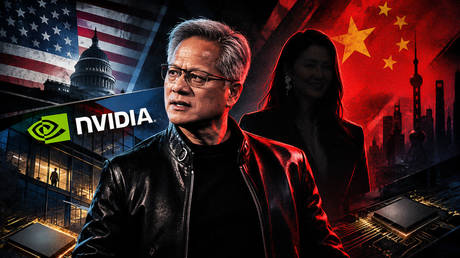
Tech gossip thrives on palace intrigue. A whisper of a "honeypot" scandal hits the press, and suddenly every armchair analyst on Wall Street asks the exact same breathless question: Who is trying to oust Jensen Huang?
They are asking the wrong question. Learn more on a similar subject: this related article.
The lazy consensus assumes Silicon Valley operates like a medieval court where a well-placed scandal can topple a king and hand the crown to a rival duke. It treats Nvidia like a standard Fortune 500 bureaucracy—interchangeable parts, bloated middle management, and a board of directors waiting for an excuse to swap the CEO.
That narrative is pure fiction. It misunderstands corporate governance, silicon physics, and the terrifying reality of how Nvidia actually operates. You do not oust Jensen Huang because there is nobody left to catch the falling knives. More journalism by The Verge explores related perspectives on this issue.
The Structural Impossibility of a Coup
Let us dismantle the premise that an internal faction or an activist board could push Huang out over a fabricated or opportunistic scandal. To pull off a corporate coup, conspirators need two things: leverage and a viable successor. At Nvidia, neither exists.
Look at the organizational chart. Most tech giants run on layers of vice presidents shielding the chief executive from reality. Huang notoriously flattened Nvidia’s hierarchy decades ago. He has roughly forty to fifty direct reports. There is no Chief Operating Officer acting as an heir apparent. There is no shadow cabinet waiting in the wings.
I have sat in boardrooms where companies blew millions trying to engineer "founder transitions," only to watch their engineering velocity collapse within two quarters. When a company’s entire operational nervous system routes through one founder’s brain, removing that founder isn't a leadership change. It is a lobotomy.
Even if a shadowy group of institutional investors wanted Huang gone, the board mechanics make it dead on arrival. Nvidia’s board is stocked with longtime allies who understand that Huang’s personal brand and technical intuition are the primary reasons the company commands a multi-trillion-dollar valuation. A board that fires the architect of the modern compute era over tabloid noise would face immediate, catastrophic shareholder litigation—not for keeping him, but for destroying enterprise value overnight.
Why Geopolitics Loves a Juicy Distraction
If an internal coup makes zero financial sense, why do "honeypot" narratives and rumors of an AI power struggle gain traction? Follow the incentives of geopolitical theater and corporate espionage.
When a single American semiconductor company holds a chokehold on global artificial intelligence infrastructure, it stops being just a business. It becomes a sovereign national security asset—and a massive target.
Foreign intelligence services and rival state-backed tech ecosystems do not need to successfully blackmail an executive to win. They only need to inject poison into the bloodstream of Western market confidence. Planting a rumor of internal rot, compromise, or succession chaos achieves three immediate goals without stealing a single blueprint:
- It rattles institutional capital. Hedge funds hate uncertainty. Even a 2% dip in confidence creates billions in market turbulence and slows down long-term capital expenditure commitments from hyperscalers.
- It distracts leadership. Every hour legal teams, PR flacks, and board members spend investigating a phantom scandal is an hour they aren't spending on supply chain bottlenecks at TSMC.
- It fractures partner trust. Cloud providers investing tens of billions into Blackwell and Rubin architectures want stability. Whispering that the captain might be compromised makes buyers hedge their bets with custom silicon.
The media eats this up because espionage sells clicks. Writing about CoWoS packaging constraints or NVLink bandwidth topologies puts readers to sleep. Writing about honeytraps and boardroom backstabbing gets shared on social media. The press mistakes psychological warfare for corporate gossip.
Dismantling the "Single Point of Failure" Myth
When people ask who is trying to take Huang down, they usually pivot to a secondary question: Isn't Nvidia dangerously reliant on one man?
Yes. And that is precisely why nobody is trying to replace him.
Critics love to cite classic business school orthodoxy here. Harvard Business Review case studies preach succession planning, decentralized decision-making, and institutional resilience. Under normal market conditions, those rules apply.
Semiconductor manufacturing at the bleeding edge is not a normal market condition.
Consider the capital allocation risk Huang takes every eighteen months. Designing a next-generation GPU architecture requires committing billions of dollars to research, masking, and foundry capacity years before a single chip ships. If you miss the architectural turn by six months, you don't lose market share—you get wiped out.
A traditional, risk-averse CEO hired to replace a founder will optimize for margin protection and predictable quarterly earnings. They will cut "wasteful" bets. Had a standard MBA executive been running Nvidia in 2012, they would have killed CUDA—the proprietary software platform that burned cash for a decade before becoming the impenetrable moat securing Nvidia's monopoly today.
The downside to this founder-centric model is obvious, and pretending otherwise would be dishonest. Key-person risk at Nvidia is absolute. If Huang steps off a curb tomorrow without looking, the stock drops twenty percent before the ambulance arrives. The company’s relentless, brutal work culture—which Huang drives through sheer force of will—burns out brilliant engineers who eventually cash out their vested stock and leave.
Yet Wall Street gladly accepts that fragility. Investors know that a safe, committee-run Nvidia would slowly bleed out to custom ASICs built by Google, Amazon, and Microsoft. They prefer a volatile genius at the wheel over a steady bureaucrat driving off a cliff.
The Real Power Struggle Nobody Is Watching
If you want to find the real power struggle in artificial intelligence, stop looking at Nvidia’s executive suite. Look at the loading docks of hyperscale data centers.
The entities actually trying to dethrone Huang aren't lurking in dark hotel bars with cameras. They are sitting in Seattle, Mountain View, and Redmond, signing purchase orders for Nvidia chips with one hand while funding internal silicon teams with the other.
Let us look at the actual battlefield:
- The Hyperscaler Mutiny: Amazon (Trainium), Google (TPUs), and Microsoft (Maia) are spending staggering sums to break Nvidia's pricing power. They hate paying a massive margin tax to Santa Clara for every cluster they build. Their goal isn't to oust Huang from Nvidia; their goal is to make Nvidia irrelevant to their internal workloads.
- The Open-Source Software Insurgency: Nvidia’s true lock-in isn't hardware; it is software. Developers write code for CUDA because it works out of the box. Rivals like AMD, alongside coalitions backed by Intel and major cloud players, are pouring resources into open-source compilers like Triton and ROCm to abstract away the hardware layer. If code runs just as fast on non-Nvidia silicon, Huang’s empire loses its gravity.
- The Sovereign AI Grab: Nation-states from the Middle East to Europe are scrambling to build domestic compute capacity. They want local control, technology transfers, and supply guarantees that clash with US export controls. Huang has to walk a razor-thin diplomatic tightrope between Washington hawks and foreign sovereign wealth funds.
Imagine a scenario where a rival successfully orchestrated Huang’s removal tomorrow. Would that solve Google’s margin problem? No. Would it suddenly make AMD’s software stack bug-free? Not a chance. Replacing the CEO doesn't change the physics of data center interconnects or the reality of TSMC’s wafer allocation.
How to Actually Read Silicon Valley Scandal News
When the next breathless report drops about an AI executive caught in a trap, a boardroom revolt, or a sudden power vacuum, strip away the thriller novel adjectives and apply three brutal filters:
- Check the cap table and board loyalty. Unless an activist fund has quietly accumulated a massive voting block—which requires public SEC filings—rumors of a boardroom coup are pure fan fiction.
- Follow the supply chain. True power struggles in hardware show up in foundry capacity bookings, HBM memory shortages, and server rack delivery delays—never in gossip columns.
- Ask who profits from the panic. Whenever a story paints a dominant tech leader as compromised or on the verge of exit, look at which competitors are launching rival products that same quarter. Narrative warfare is cheap; building a better chip takes five years.
Stop waiting for a palace coup at Nvidia. Jensen Huang isn't going anywhere until he decides to walk away, because the people with the money know a terrifying truth: the only thing scarier than relying on one man to run the world's AI infrastructure is trying to run it without him.