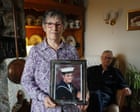
For four decades, Margaret Parkes has waited for a knock on the door that never comes, urging the primary suspect in her son’s disappearance—convicted serial killer Allan Grimson—to finally confess to the murder of 18-year-old Royal Navy rating Simon Parkes. Parkes vanished on December 12, 1986, while on shore leave in Gibraltar after his ship, the aircraft carrier HMS Illustrious, docked in the British Overseas Territory. Despite extensive excavations, international police cooperation, and multiple prison interviews with Grimson, his body has never been found, leaving a grieving mother trapped in a forty-year procedural void.
The facts of December 1986 are stark. Simon Parkes, a young radio operator from Bristol serving his country, went ashore with crewmates to enjoy a night out in Gibraltar. The ship was scheduled to return to Portsmouth just days later, right in time for Christmas. Parkes never made it back aboard.
Initially, the Royal Navy treated the absence as a routine case of a sailor going absent without leave. It was a bureaucratic assumption that cost investigators priceless hours. In the late 1980s, before ubiquitous CCTV networks or digital transaction trails, a young man missing a ship in a foreign port was often presumed to be nursing a hangover in a backstreet bar or chasing a local romance. By the time military and civilian authorities realized Parkes had not simply overslept, the trail had gone entirely cold.
The Shadow of HMS Illustrious
To understand why this case remains open forty years later, one must look at the man who shared a mess deck with Simon Parkes. Allan Grimson was a petty officer aboard HMS Illustrious at the exact time Parkes vanished. For years, Grimson operated beneath the radar, masked by the rigid hierarchy and transient nature of naval life.
His true nature only emerged over a decade later. In 2001, Grimson was convicted at Winchester Crown Court of the brutal murders of two young men, Nicholas Wright and Sion Jenkins, whom he had killed in 1997 and 1998. During the investigation into those crimes, detectives uncovered a chilling pattern. Grimson was a sexual predator who targeted young men, often using his rank or seniority to isolate them before subjecting them to extreme violence.
When investigators cross-referenced Grimson’s service record with unsolved disappearances, the 1986 Gibraltar docking jumped off the page. Grimson was there. He knew Parkes. And according to testimonies from former crewmates, Grimson’s behavior immediately following Parkes’s disappearance raised eyebrows, though nobody possessed the context to connect the dots at the time.
The Mechanics of a Cold Case Investigation
Investigating a suspected murder across four decades and two jurisdictions presents monumental logistical hurdles. Hampshire Constabulary, which leads the inquiry, alongside the Royal Gibraltar Police, has faced the erosion of physical evidence, the fading memories of aging witnesses, and the deliberate obfuscation of a calculating killer.
Cold case reviews rely heavily on re-evaluating historical witness statements against modern behavioral profiling. When detectives revisited the 1986 files after Grimson’s 2001 conviction, they were no longer looking for a lost teenager. They were hunting for the footprint of a serial offender.
This shift in perspective led to several high-profile searches on the Rock of Gibraltar. In 2019, and again in subsequent years, specialist teams excavated areas near the Trafalgar Cemetery and other sites around the territory. They used ground-penetrating radar, forensic archaeologists, and cadaver dogs. Every dig ended the same way. Nothing was found.
Why do these searches fail? Gibraltar is a dense, rocky peninsula with complex subterranean tunnel systems, steep cliffs, and deep surrounding waters. Disposing of a body there in 1986, without modern surveillance, offered numerous grim options. Without a confession, police are essentially searching a needle-strewn haystack in the dark.
The Psychology of the Silent Killer
Allan Grimson has been interviewed repeatedly by detectives from his prison cell. He has never been charged with Simon Parkes’s murder, largely due to the absence of a body or direct forensic links placing him with Parkes at the exact moment of death.
In the criminal justice system, corpus delicti—the principle that a crime must be proven to have occurred before a person can be convicted of committing it—creates an enormous barrier when a body vanishes entirely. While circumstantial evidence can occasionally secure a murder conviction without remains, the threshold is extraordinarily high.
Grimson understands this leverage. Control is the primary currency for predators of his type. Behind bars, stripped of his freedom and his naval authority, withholding the location of Simon Parkes’s remains is the final piece of power Grimson retains. By refusing to speak, he continues to dictate terms to the police and prolong the agony of the Parkes family.
Institutional Blind Spots in the 1980s
The disappearance of Simon Parkes also exposes uncomfortable truths about how military and civilian institutions handled missing personnel in the late twentieth century. In 1986, inter-agency communication between the Royal Navy's Special Investigation Branch and local territorial police forces was often clunky and defensive.
The military culture of the era prioritized discipline and operational readiness. When a rating failed to report for duty, the default mechanism was punitive rather than protective. A warrant for arrest as a deserter was issued, effectively framing the victim as a perpetrator of a military offense.
This framing had devastating consequences:
- Delayed Forensic Preservation: Scenes where Parkes was last seen were not secured because no crime was suspected.
- Witness Dispersal: The crew of HMS Illustrious sailed back to the UK, scattering hundreds of potential witnesses across the country before anyone thought to systematically interview them about Parkes’s final hours ashore.
- Lost Timeline: Vital hours between Parkes leaving a Gibraltar pub and the ship setting sail were never reconstructed while memories were fresh.
Had Simon Parkes been treated as a vulnerable missing person from hour one, the investigative outcome might have looked radically different. Instead, the administrative inertia of 1986 bought his killer forty years of impunity.
The Limits of Parole Board Leverage
In recent years, the legal landscape surrounding killers who refuse to disclose the location of their victims has shifted. The United Kingdom introduced Helen’s Law (the Prisoners (Disclosure of Information About Victims) Act 2020), which requires the Parole Board to take into account an offender's refusal to reveal the location of a victim's remains when considering them for release.
On paper, this legislation looks like a potent tool to force confessions. In practice, its application to a case like Simon Parkes’s is complicated. Grimson is serving a life sentence with a minimum tariff that has long since passed, yet he remains incarcerated because the Parole Board continues to deem him a high risk to the public.
Because Grimson has never been convicted of killing Parkes, Helen’s Law does not directly apply to Simon's case in the same clean legal manner it would if Grimson were a convicted murderer withholding the body of his known victim. Grimson simply denies involvement. You cannot legally penalize a prisoner for failing to reveal the location of a body he has not been proven to have hidden, even when the circumstantial shadow is overwhelming.
The Human Toll of Ambiguous Loss
Psychologists refer to the experience of families like Margaret and David Parkes as ambiguous loss. Unlike a conventional bereavement, where a funeral provides a definitive boundary between life and death, a disappearance freezes grief in permanent suspension.
For forty years, Margaret Parkes has existed in a state of suspended animation. Every bone fragment found in Gibraltar, every tip-off to a police hotline, every scheduled parole hearing triggers a fresh wave of trauma. The energy required to keep a cold case in the public eye for four decades is immense. Families must become reluctant media operators, repeating their worst nightmare to journalists year after year just to ensure the police file is not archived permanently.
Margaret’s latest public appeal for Grimson to confess is not born of naivety. After forty years, she knows the man she is dealing with. It is a pragmatic recognition that at this stage, only one person holds the map to her son's final resting place.
What Keeps the Investigation Alive
Despite the passage of time, Hampshire Constabulary has refused to close the book on Simon Parkes. Modern cold case units operate differently than the detective squads of the 1980s. They rely on fresh-eyes reviews, digital archiving that cross-references decades-old notebooks, and advancements in trace DNA recovery that could potentially extract profiles from items once thought useless.
Furthermore, allegiances change over forty years. Former sailors who were 19 years old in 1986 are now approaching retirement. Fear of military repercussions, peer pressure, or misplaced loyalty to a fellow serviceman often fades with age. Detectives routinely appeal to the conscience of former HMS Illustrious crewmates, hoping that someone who held back a seemingly insignificant detail in 1986 might finally step forward.
A single memory—a sighting near the dockyard gates, an overheard conversation in a mess deck, a sudden change in someone's demeanor—could be the catalyst needed to break the deadlock.
The Unfinished Reckoning
The case of Simon Parkes stands as a stark indictment of how easily a young man can vanish from the face of the earth, even while serving in one of the world's most disciplined armed forces. It highlights the fragility of early investigative assumptions and the enduring cruelty of offenders who weaponize silence.
Until Allan Grimson breaks his silence, or until a definitive breakthrough emerges from the rocky terrain of Gibraltar or the aging memories of former shipmates, a mother in her late seventies will continue to wake up every morning waiting for the basic human dignity of burying her son.