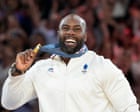
France is staring down the barrel of the 2027 presidential election, and the political establishment is completely broken. Enter Teddy Riner. The three-time individual Olympic heavyweight judo gold medalist and undisputed king of French sports has dropped a massive hint about trading his judogi for the Élysée Palace.
He didn't mince words. "I know what it's like to fight," Riner declared when discussing his political ambitions.
Coming from almost anyone else, that line would sound like cheap campaign rhetoric cooked up by an overpaid Parisian PR firm. Coming from a man who stands six-foot-eight, weighs over three hundred pounds, and dominated international judo for nearly two decades, it lands differently. People actually stop and listen.
Who Exactly Is Teddy Riner to the French Public
If you don't follow Olympic combat sports, it's hard to overstate just how massive Teddy Riner is in France. He isn't just an athlete. He's a national institution.
Born in Guadeloupe and raised in Paris, Riner has collected eleven World Championship gold medals alongside his Olympic hardware. He went unbeaten in 154 consecutive matches between 2010 and 2020. That's a decade of absolute physical supremacy on the world stage.
During the 2024 Paris Olympics, when French organizers needed two icons to light the Olympic cauldron, they picked Marie-José Pérec and Teddy Riner. That single image cemented his status. Polls consistently rank him among the most admired and trusted figures in the entire country, easily clearing the approval ratings of sitting ministers, party leaders, and billionaire media moguls.
French voters are exhausted by career politicians. They're tired of graduates from the elite École Nationale d'Administration speaking in circles while inflation bites and suburban tensions boil over. Riner represents the exact opposite of the Parisian technocrat. He built his reputation through sweat, discipline, and undeniable results.
The Real Meaning Behind His Fighting Spirit
When Riner says he knows how to fight, he's tapping into a very specific nerve in modern French politics. France is a country perpetually on strike, deeply polarized between the far right, the fractured center, and a combative left wing. Emmanuel Macron cannot run again in 2027 due to constitutional term limits, leaving a massive power vacuum.
Riner's message isn't really about throwing political opponents onto a tatami mat. It's about resilience and unity.
Think about what an elite judoka actually does. Judo translates to "the gentle way," though anyone who has been slammed into the canvas by Riner would violently disagree with that translation. The core philosophy relies on using an opponent's momentum against them rather than meeting brute force with blind stubbornness.
In interviews, Riner has emphasized that he hates seeing France divided. He grew up in a working-class neighborhood in Paris before reaching the pinnacle of global fame. He understands the friction between the banlieues and the French establishment because he's lived on both sides of that divide.
Can an Athlete Actually Win the French Presidency
History isn't exactly on Riner's side here. France loves its sports heroes, yet it rarely hands them the nuclear codes.
Look at the track record of French athletes entering politics:
- David Douillet, another heavyweight judo Olympic champion, served as Minister of Sports under Nicolas Sarkozy. He had a respectable cabinet run, yet he never came close to the top job.
- Laura Flessel, the fencing legend known as "The Wasp," became Sports Minister under Macron in 2017 before resigning a year later amid tax controversies.
- Guy Drut, the 1976 Olympic hurdles champion, held political office for years, though his career was tangled up in party financing scandals that required a presidential pardon from Jacques Chirac.
None of these figures ever mounted a credible presidential bid. Running a ministry is one thing. Navigating the brutal, five-hundred-signature endorsement requirement just to get on the French presidential ballot is an entirely different beast.
To qualify as a candidate in France, you need 500 parrainages—official sponsorships from elected officials like mayors, regional councilors, and members of parliament. You don't get those just by being famous on Instagram or winning gold medals. You need a ground game. You need local political machinery, or you need to hijack an existing party structure.
What Riner Brings That Career Politicians Lack
Still, dismissing Riner as a novelty candidate would be a massive mistake. The political rules that governed France twenty years ago are dead.
Look across the globe. George Weah, a Ballon d'Or-winning footballer, became the president of Liberia. Imran Khan captained Pakistan to a Cricket World Cup victory before becoming Prime Minister. Volodymyr Zelenskyy was a comedian playing a president on television before winning the real thing in Ukraine in a landslide.
Voters everywhere are craving authenticity over polish. Riner possesses natural charisma that you simply cannot teach in a political science seminar. When he walks into a room, he commands attention without raising his voice.
Beyond his physical presence, Riner isn't naive about business or media. He has managed a multi-million-euro personal brand for over fifteen years, negotiating complex sponsorship deals with corporate giants while maintaining a spotless public image. He knows how to manage a team, handle relentless media scrutiny, and perform under suffocating pressure. Remember the 2024 Paris final? The entire nation was watching, expecting gold, and he delivered with seconds left on the clock. That kind of mental fortitude is rare in any profession.
The Massive Obstacles Standing in His Way
Wanting to fight for France and actually governing France are two very different things. Once you step off the podium and onto a debate stage, popularity melts fast if you don't have answers.
French presidential debates are notoriously vicious. They last for hours and dive deep into arcane details of pension reform, European Union fiscal rules, nuclear energy policy, and healthcare deficits. If Marine Le Pen, Édouard Philippe, or Jean-Luc Mélenchon asks Riner how he plans to reduce France's ballooning public debt without triggering nationwide riots, a motivational speech about Olympic grit won't cut it.
Then there's the ideological question. Where does Teddy Riner actually stand?
Right now, he remains an appealing blank canvas. Voters on the left see a Black Frenchman from Guadeloupe who represents diversity, social mobility, and modern France. Voters on the center-right see a self-made champion who preaches hard work, patriotism, and respect for institutions.
The moment Riner takes a hard stance on immigration, taxes, or retirement ages, half of his fan club will turn on him overnight. That's the brutal reality of politics. In sports, everybody cheers when you win gold for the flag. In politics, fifty percent of the country hates your guts before you even finish your morning coffee.
Why This Matters Right Now
Even if Teddy Riner never makes it onto the final ballot in 2027, his willingness to speak up signals a massive shift in French public life. The traditional political class has lost its monopoly on leadership. When a beloved Olympic champion feels compelled to step forward and say he's ready to fight for the country's future, it's a glaring indictment of the professionals currently running the show.
Watch how the major French parties react over the coming months. Expect established politicians to immediately try co-opting him, offering him cabinet posts or ceremonial roles to neutralize him as an independent threat. If Riner is smart—and his tactical brilliance on the judo mat proves he is—he won't settle for being someone else's trophy endorsement. Keep a close eye on his public appearances outside of sports, his charitable foundation work, and who he surrounds himself with in Paris, because that's where a real campaign begins.