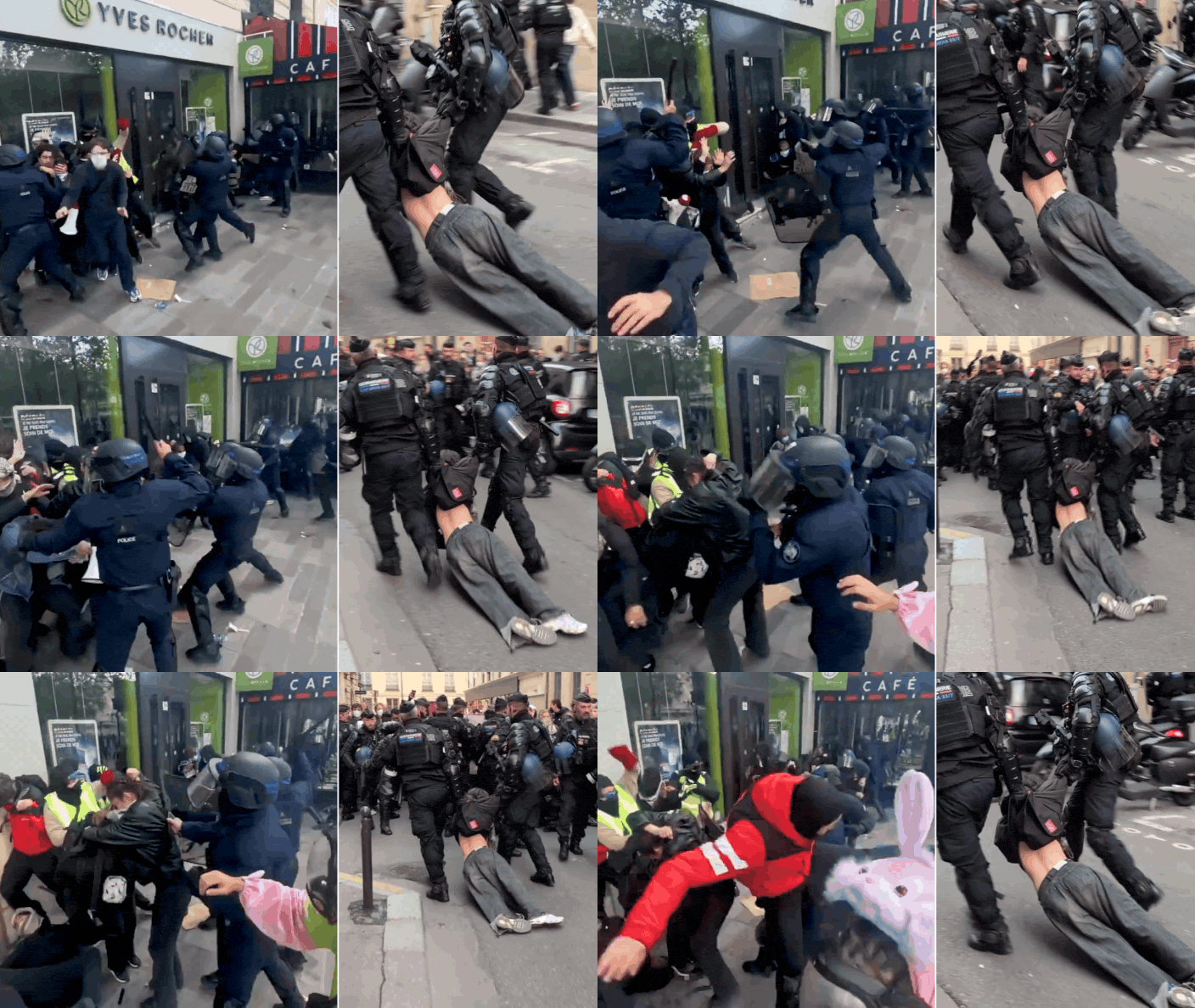
You have seen the viral clip. A wall of black-clad French riot police, shields locked and batons raised, sprints directly into a packed square of demonstrators. People are knocked to the pavement. Protesters are dragged away by their limbs. The internet immediately erupts into outrage, decrying the footage as unhinged state brutality and a total breakdown of crowd control.
That viral outrage relies on a complete misunderstanding of how modern public order policing actually works.
When outlets publish breathless headlines about police charging into crowds, they treat a calculated tactical maneuver like a barroom brawl. They assume that physical contact equals failure, and that passive containment equals peace. In reality, the exact opposite is true. Static police lines do not prevent violence; they incubate it.
The Myth of the Passive Perimeter
If you spend enough time analyzing post-incident reports from European interior ministries, you notice a pattern that never makes the evening news. The most catastrophic injuries, the highest property damage, and the deadliest crowd crushes happen when police stand still.
Consider the mechanics of a static perimeter. Police form a line. Protesters press against it. At first, it is a shouting match. Then, someone in the back throws a paving stone or a firework. Because the police line is stationary, the violent actors in the crowd face zero immediate consequences. They can retreat three rows deep, reload, and throw again. Meanwhile, the peaceful protesters trapped between the police shields and the violent agitators absorb all the blowback—literally and figuratively—when tear gas is deployed to push the line back.
I have reviewed dozens of European public order after-action reports over the last decade, and the data points to one uncomfortable truth: hesitation kills momentum, and lost momentum breeds chaos. When a police commander holds a static line for four hours under a hail of projectiles, discipline erodes on both sides. Exhausted officers eventually snap, leading to uncoordinated, retaliatory violence.
French doctrine, specifically the tactical evolution seen in the Brigades de Répression de l'Action Violente Motorisées (BRAV-M) and specialized Compagnies Républicaines de Sécurité (CRS) units, was built specifically to break this cycle.
Shock and Extraction Over Attrition
To understand why French police charge, you have to understand the operational difference between area denial and targeted extraction.
Traditional Anglo-American crowd control favors area denial. Police use heavy lines, horses, and massive volumes of chemical agents to slowly push an entire crowd from Point A to Point B. It looks orderly on a wide-angle news helicopter shot, right up until the moment a crowd gets bottlenecked into an alleyway and people start suffocating.
French tactical units increasingly reject slow pushes in favor of kinetic disruption. When you watch a video of officers sprinting into a crowd and dragging specific individuals out, you are not watching a random rampage. You are watching a surgical snatch-and-grab operation designed to remove the black bloc instigators—the core 2% of the crowd throwing Molotov cocktails or smashing storefronts—before the rest of the demonstration turns into a riot.
Here is how the mechanics actually work on the ground:
- Spotters Identify Agitators: Plainclothes intelligence officers embedded within the crowd identify the individuals coordinating attacks or distributing projectiles.
- The Wedge Formation: Uniformed units form a tight, forward-moving wedge rather than a flat wall. A wall pushes everyone back; a wedge parts the crowd like water around the bow of a ship.
- High-Speed Entry: Officers sprint. Speed is not used to maximize impact; speed is used to deny the agitators time to melt back into the peaceful majority.
- Immediate Extraction: Designated arrest teams grab the targeted individuals and pull them behind the police line in under fifteen seconds.
- Rapid Disengagement: Once the target is secured, the unit immediately retreats to its baseline, preventing a prolonged street fight.
Does it look terrifying on a smartphone screen? Yes. Someone standing in the path of a sprinting squad gets knocked down. Someone resisting extraction gets dragged across asphalt. Those clips are visceral, jarring, and tailor-made for social media outrage.
Yet, compare the injury metrics of a fifteen-second snatch operation against a four-hour tear gas standoff. A bruised knee from being knocked aside during a rapid extraction is vastly preferable to permanent eye damage from rubber bullets, severe respiratory trauma from prolonged CS gas exposure, or a fatal crowd crush.
What Criminologists and Crowd Psychologists Actually Say
Mainstream commentary treats crowds as monolithic blocks of peaceful citizens suddenly attacked by the state. Crowd science tells a different story.
Sociologist Gustave Le Bon famously—and inaccurately—argued in the nineteenth century that individuals lose all rational thought inside a crowd, merging into a single violent mind. Modern crowd psychologists, led by researchers like Clifford Stott and Stephen Reicher, dismantled Le Bon’s theory decades ago. Through their development of the Elaborated Social Identity Model (ESIM), they proved that crowds do not naturally descend into mindless violence. Instead, violence occurs when indiscriminate police action—like saturating an entire square with tear gas—convinces peaceful protesters that the police are their common enemy, uniting them with the violent extremists in their midst.
Look at how French rapid-charge tactics intersect with ESIM:
- Indiscriminate Force (Tear Gas / Water Cannons): Punishes everyone in the plaza equally. Peaceful families, elderly protesters, and violent anarchists all choke on the same gas. Result: The peaceful majority radicalizes and turns against the police.
- Discriminate Force (Targeted Charges): Isolates the violent actors while leaving the rest of the demonstration intact. While jarring to witness, it prevents the indiscriminate punishment of the wider crowd.
If police fail to isolate the violent fringe early, the entire protest gets shut down by force later. By aggressively removing the instigators early, police preserve the right of the remaining 98% to continue their march.
Why France Operates Differently Than Washington or London
You cannot copy-paste American policing standards onto the streets of Paris and expect the critique to hold up. The operational environment is entirely different.
In the United States, street protests rarely feature organized, paramilitary-style anarchist blocs armed with industrial-grade pyrotechnics, acid-filled bottles, and iron bars. In France, the black bloc phenomenon is a routine fixture of major labor and political demonstrations. These are not spontaneous protesters; they are disciplined tactical groups that study police formations, use encrypted communications, and actively seek to provoke lethal police responses for propaganda value.
French interior ministries learned the hard way during the Gilets Jaunes (Yellow Vests) movement of 2018 and 2019 that traditional, heavy-handed riot control was failing. Back then, police relied heavily on Lanceurs de Balles de Défense (LBD) launchers—40mm rubber bullet guns—to keep rioters at a distance. The result was a public relations and human rights disaster: dozens of protesters lost eyes or hands because officers were firing impact munitions into chaotic crowds from stationary positions.
The shift toward mobile, rapid-charge units like the BRAV-M was a direct response to the catastrophic injuries caused by distance weapons. If you take away distance munitions, officers have to close the gap physically to make arrests. You cannot have both zero distance weapons and zero physical contact when dealing with armed rioters.
The Real Danger Nobody Talks About
Admitting that rapid police charges serve a logical tactical purpose does not mean the tactic is flawless. In fact, the real danger of this strategy has nothing to do with the viral videos of people getting knocked down, and everything to do with accountability and sensory overload.
When you send a squad of twenty officers sprinting into a hostile crowd at full speed, you strip away their ability to maintain standard command-and-control oversight. Adrenaline spikes. Tunnel vision sets in. Under extreme physiological stress, an officer tasked with extracting a violent suspect can easily misidentify a bystander, a journalist, or a legal observer as a threat.
Furthermore, the visual optics of the tactic create a massive strategic vulnerability. In the information age, a street protest is fought on two fronts: the physical pavement and the digital timeline. A police force can win the tactical battle on the street—clearing the square, making targeted arrests, and preventing a riot—while losing the strategic war because a ten-second clip of an officer dragging a protester goes viral without context.
Once that clip hits the internet, public legitimacy collapses. And as every serious policing scholar from Sir Robert Peel onward has noted, police cannot function without public consent.
Stop Watching Ten-Second Clips
If you want to evaluate whether a police action was justified or abusive, stop relying on cropped vertical videos posted by partisan accounts on social media. Look at the timeline before and after the charge.
Ask the questions that viral headlines deliberately omit:
- Were projectiles being launched from that specific sector of the crowd prior to the charge?
- Did the police deploy indiscriminate chemical weapons, or did they execute a targeted extraction?
- Did the demonstration continue peacefully after the unit withdrew, or did the police shut down the entire event?
Treating every physical police intervention as unprovoked tyranny is intellectually lazy. It ignores the reality of organized street violence and forces police commanders back toward the very tactics—mass tear gas and distance munitions—that cause far greater harm to innocent bystanders.
The next time you see footage of riot police charging into a crowd, look past the chaos in the foreground. Look at the empty space they leave behind once they pull their targets out, and notice how the rest of the street keeps walking.