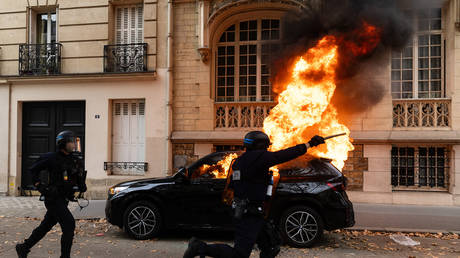
Acidity.
That is the first thing you taste when a canister of tear gas pops fifty yards downwind of a lycée gate on a damp autumn morning in France. Not smoke. Not fear, at least not yet. Just a sharp, metallic sting at the back of your throat that makes your eyes water before your brain has even registered the whistle of the launch tube.
I have stood on enough wet boulevards in Paris and Lyon over the years—breathing that same sharp air, watching teenagers in hoodies and soaked sneakers shove plastic recycling bins across tram tracks—to know that headlines rarely capture what is actually happening in those moments. A wire story will tell you that a fifth wave of French student protests has erupted into clashes. It will tally the broken bus shelters, the sirens, the arrests, and the viral clips shared on social media.
Clips.
Everyone loves a clip of a clash. A shattered window looks dramatic on a phone screen at midnight. A line of riot police advancing in black armor looks like cinema. Yet if you treat a fifth round of student demonstrations like a fight scene in an action movie, you miss the entire plot—and you miss the quiet, grinding exhaustion that brought eighteen-year-olds into the cold rain five times in a row.
To see what is really at stake, I want to walk you through a hypothetical scenario based on patterns I have witnessed repeatedly across French secondary schools and university campuses. Think of it as a composite sketch rather than a single biography: a seventeen-year-old named Camille in a crowded suburban lycée outside Paris, and a fifty-four-year-old physics teacher named Marc who has spent twenty-eight years watching chalk dust turn into bureaucracy.
When a Classroom Stops Feeling Like a Ladder
For generations, the French republic made a bargain with its young people. You sat in straight rows. You endured grueling exams, endless essays, and cold hallways in winter. In return, the state promised a clear rung on the social ladder—a degree with real weight, a public school system that treated every child as a citizen of the republic regardless of their parents' bank balance.
Walk through a crowded lycée today, and you can feel that bargain fraying at the edges.
In our hypothetical example, Camille arrives at school at 7:50 a.m. to find thirty-five desks crammed into a room built for twenty-eight. Last week, the history teacher was out sick for three days; no substitute arrived. Next month looms the baccalauréat, the grueling rite of passage that still casts a long shadow over a student's future, yet half the class feels as though they are trying to build a house while someone keeps moving the lumber.
When students walk out of those buildings—not once, not twice, but for a fifth time—they are rarely acting on a whim. Skipping class in France is not a casual afternoon off when a movement reaches its fifth round. By the fifth mobilization, the novelty is long gone. Your shoes are wet. Your parents are arguing at the kitchen table. Your own exam dates are creeping closer on the calendar.
So why go back out?
Because standing behind a barricade of overturned bins feels, for a few hours, like the only place where anyone is listening.
A fifth round of protests is rarely the spark. It is the sound of a pressure valve rattling after four earlier warnings went unanswered.
Consider what happens next when frustration meets a street that has hosted protest for a century. In France, street protest is not an aberration tucked into the margins of politics; it is part of the civic vocabulary. Students watch older siblings, parents, and union workers march for pensions, wages, and dignity. When young people feel their own future is being squeezed—by rising living costs, housing shortages in university towns, crowded classrooms, or reform plans they feel were handed down from above without real consultation—they reach for the tool they know best.
The Anatomy of a Clash
If you have ever wondered how a morning blockade turns into a chaotic afternoon standoff, the answer is usually less ideological than people assume.
Most student walkouts do not begin with Molotov cocktails or pitched battles. They begin with noise, chants, and a blockade meant to stop traffic and force a conversation. High schoolers link arms or stack metal barriers outside a school entrance. University students gather in courtyards, arguing over slogans, megaphones, and whether to march toward a central square.
Then comes friction.
Picture the street as a narrow funnel. On one end stand teenagers—some politically seasoned, some just following friends, some filming everything for their feeds. On the other end stand police units tasked with keeping intersections open and preventing property damage. Add a few dozen agitators looking for chaos rather than policy change, narrow sidewalks, flying projectiles, flash-balls or tear gas canisters, and a crowd suddenly surging backward into traffic.
Within ten minutes, a protest about classrooms and futures looks like a street riot.
Anyone who has covered or lived through these afternoons knows the eerie split-screen effect. Three blocks away from a cloud of tear gas, a bakery is selling almond croissants and commuters are reading paperbacks on the metro. Two streets over, a sixteen-year-old is coughing on a curb while a friend pours water over stinging eyes, and a shopkeeper is pulling down a metal shutter with a hollow clang.
You might ask yourself: If clashes keep happening, doesn't the violence destroy the students' message?
Honestly, it often does. That is the tragic paradox of street escalation. When images of burning trash or broken glass dominate the evening news, sympathetic parents grow anxious, moderate allies pull back, and government officials can pivot from answering grievances to talking strictly about law and order. The original reason Camille walked out of physics class gets buried under footage of a scuffle outside a bank window.
Yet dismissing an entire movement because a fraction of a crowd clashes is its own kind of blindness. A crowd is not a single mind. In any gathering of thousands of young people, there are organizers with printed flyers, nervous first-timers holding cardboard signs, onlookers with cameras, and troublemakers chasing adrenaline. Treating them all as one monolith makes good television and terrible analysis.
What the Older Generation Sees
To understand why these clashes cut so deeply into French public life, we have to look past the teenagers to the adults watching from the windows.
Let's return to Marc, our hypothetical physics teacher. He has seen reform after reform arrive in his inbox—new curricula, shifting admission algorithms, promises of modernization that somehow still leave him teaching with flickering projector bulbs and thin budgets. Like many teachers, Marc feels torn in two. He wants order. He hates seeing school property trashed or young people put in harm's way. At the same time, when he looks at the exhaustion in his students' eyes, he knows their anger did not come out of nowhere.
To make sense of the tension between institutions and youth, I sometimes think of a house with old plumbing. (This is a metaphor, of course—a school system isn't a copper pipe—but stick with me for a moment.) When pressure builds inside aging pipes, water doesn't politely wait for a licensed plumber to schedule an appointment next month. It finds the weakest joint and sprays.
For decades, French education has been asked to do almost impossible work: equalize deep social divides, prepare students for a fast-changing economy, adapt to digital life, and uphold rigorous academic standards—all while contending with uneven funding and sharp regional inequalities. When students take to the streets for a fifth time, they are pointing at those leaky joints.
And yet, there is a hard truth that students sometimes collide with, too: anger alone does not write a workable budget or build a new lecture hall overnight. Passion can force an issue onto the front page. It can rattle ministers and fill squares with tens of thousands of voices. Turning that energy into lasting reform requires slow, unglamorous work—negotiation, compromise, clear demands, and electoral staying power—that feels painfully slow when you are eighteen and your future feels urgent right now.
Why It Matters Beyond France
You do not need to speak French or know the layout of Paris to recognize what is happening here.
Across Europe and North America, young people are asking a remarkably similar set of questions: Will my education actually pay off? Can I afford a place to live when I finish school? Does anyone in power genuinely hear what my generation is up against?
When student protests hit a fifth round in France, the country's long tradition of public demonstration simply brings those questions into high relief. France tends to do its arguments loudly, publicly, and in the streets. Other places bottle the same frustrations up until they show up as burnout, cynicism, or political whiplash at the ballot box.
Watching from afar, it is easy to feel detached—to scroll past a headline about clashes, shake your head, and move on to the next notification.
Pause for a second and imagine what it feels like to be young in a moment when the future feels narrower than the one your parents knew. Imagine standing in cold rain because sitting quietly in a crowded room feels like accepting a smaller life. Even if you disagree with the tactics, even if you cringe at the clashes, the underlying ache is human and unmistakable.
A fifth protest is rarely a triumph. Usually, by the fifth time, everyone is tired—the students, the teachers, the police, the families waiting at home for a text message saying I'm okay, heading back now.
Still, long after the tear gas clears and the street sweepers wash the boulevards clean before dawn, a question lingers in the wet air: not just how the clashes started, or who threw what, or how many arrests were made—but what will finally change inside those classrooms so no one feels forced to bleed on the pavement just to be heard.


