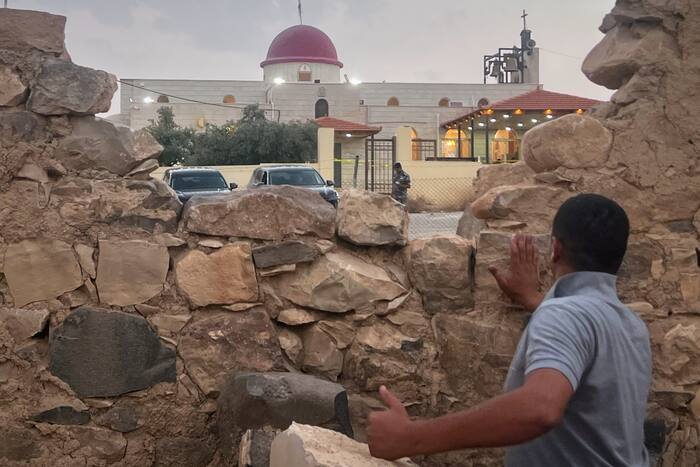
Seven dead. Thirty-four wounded. Gunfire tearing through a grieving congregation in Jordan.
Predictable headlines follow predictable scripts. Within hours, standard reporting settles into the same comforting clichés. Isolated lone wolves. Sudden security lapses. Fragile borders straining under regional pressure. For a more detailed analysis into similar topics, we suggest: this related article.
That lazy consensus is a sedative. It lets audiences look away while misdiagnosing the actual mechanics of violence in the Levant.
When gunmen open fire at a church during a funeral in Jordan, the shock comes from the setting. A house of mourning. A minority community. A country widely treated as a calm island in a turbulent neighborhood. Yet treating an attack like this as a random bolt from the blue misses how asymmetric violence actually operates in fragile states and contested borders. To get more context on this issue, extensive analysis can be read at Reuters.
I have spent years analyzing security failures, intelligence blind spots, and crisis response across high-risk environments. I have watched institutions pour vast sums into visible hardware—metal detectors, perimeter walls, armed checkpoints—while ignoring the quiet social and informational fractures where plots mature. Hardware deters amateurs. It rarely stops determined attackers who study routines, exploit blind spots, and pick soft targets during moments of high emotion and predictable movement.
A funeral is the opposite of a hardened fortress. It is scheduled. It is public. It draws crowds into tight spaces while attention is turned inward toward grief rather than outward toward threat detection.
To understand what really happens in these moments, we first have to strip away sloppy terminology. Security analysts and casual commentators frequently mash together distinct categories of violence: spontaneous street crime, organized insurgency, state-backed sabotage, and ideologically motivated mass shootings. Each follows different logistics. Conflating them produces terrible policy and worse public understanding.
Consider the difference between a tactical raid and a mass-casualty attack on civilians. A raid seeks to seize ground, hold leverage, or degrade a specific capability. An attack on mourners at a church seeks psychological shock, communal fear, and narrative disruption. The target selection is rarely accidental. Attacking a religious gathering during a funeral maximizes emotional trauma and tests state credibility in front of domestic minorities and international observers alike.
The Myth of the "Sudden" Security Failure
Whenever a high-profile attack hits a place known for relative stability, the immediate reflex is to ask how intelligence missed it or how perimeter guards failed.
That question usually starts from a flawed premise. It assumes security agencies can achieve zero-failure visibility across millions of people, porous terrain, and shifting militant networks. They cannot. No intelligence service on earth catches every cell or every radicalized actor before shots are fired.
Real-world security is a probability game played under severe resource constraints. Agencies prioritize high-value infrastructure, border crossings, diplomatic compounds, and known threat actors. When pressure squeezes established networks or smuggling corridors, attackers adapt. They shift from hard targets to soft ones. They trade complex multi-cell operations for simpler, faster, deadlier strikes against vulnerable gatherings.
Historically, scholars of asymmetric conflict and counterterrorism—figures like Bruce Hoffman, Audrey Kurth Cronin, and Marc Sageman—have documented how militant and violent actors evolve when direct confrontation with security forces becomes costly. Displacement is a constant pattern. When one avenue closes, pressure builds elsewhere. Calling an attack "unprecedented" or purely "out of nowhere" often reflects short memory rather than analytical rigor.
Imagine a scenario where a security service successfully disrupts three smuggling routes and arrests dozens of operatives over six months. On paper, that looks like total dominance. In reality, surviving cells or lone actors may conclude that high-profile, low-cost soft-target attacks yield maximum media impact with minimal logistical overhead. Stopping ninety-five percent of threats does not erase the catastrophic cost of the five percent that get through.
Why "People Also Ask" Questions Miss the Real Danger
Search engines fill up with the same predictable questions after an attack like this: Why do gunmen target churches and funerals? Is Jordan safe to visit? How do security forces respond to mass shootings?
Each of those questions has a kernel of urgency, and each can steer you straight into a trap if answered superficially.
Why target a church during a funeral? Because funerals concentrate people who already share deep bonds, creating instant ripple effects across families and communities. Targeting a minority religious site adds another layer: it signals that no sanctuary is untouchable and tests the social contract between the state and minority citizens. Anyone reducing that choice to pure madness ignores cold strategic calculation behind cruelty.
Is Jordan safe to visit? Binary answers—yes or no—are useless here. Risk is uneven across geography, time, and context. A tragedy in one location does not mean uniform danger across an entire country overnight, nor does a calm reputation guarantee immunity anywhere. Travelers and residents need situational awareness grounded in current advisories and local conditions, not gut-level panic or complacent denial.
How do security forces respond? Usually in two phases: an immediate kinetic and investigative surge to neutralize threats and trace logistics, followed by political reassurance aimed at calming public nerves. The first phase is visible and urgent. The second is where governments often stumble if they offer platitudes instead of honest accountability and structural reform.
What Conventional Crisis Playbooks Get Wrong
Watch how standard crisis management plays out after a mass shooting. Officials rush to microphones. Spokespeople promise exhaustive investigations. Commentators debate whether the perpetrator acted alone or had outside backing.
None of that is inherently wrong, yet much of it is theater.
First, obsession with whether a shooter is a "lone wolf" often creates a false comfort. Even an attacker who pulls the trigger alone rarely exists in a vacuum. Ideas, grievances, weapons access, safe routes, or tacit local tolerance usually sit somewhere in the ecosystem. Calling someone a lone wolf can become a convenient way to avoid asking uncomfortable questions about oversight or social tension.
Second, reactive security crackdowns frequently overreach in the wrong places. Sweeping checkpoints and heavy-handed patrols make citizens feel watched without always fixing underlying vulnerabilities—like local tip-offs that went unheeded, communication gaps between units, or community alienation that dries up early warning signs.
I have seen organizations and security teams repeat this exact mistake during crises: they add friction for everyone while leaving the real blind spot untouched. True resilience requires sharper signal detection, faster local coordination, and candid post-incident reviews—not just louder displays of force.
The Cost of My Own Contrarian Take
Pushing back against standard narratives carries real risks, and I will not pretend otherwise.
Contrarian analysis can easily slide into cynicism. When you point out structural incentives and strategic calculation behind atrocities, you risk sounding detached from human grief. Seven people lost their lives. Thirty-four more were wounded. Families are burying loved ones. Cold analysis must never become an excuse to minimize human loss or excuse murderers.
There is also the risk of over-interpreting limited early facts. In the immediate aftermath of an attack, details shift, claims conflict, and rushing to grand structural conclusions before verified facts emerge can lead an analyst astray. Nuance requires discipline: holding firm to verified principles while refusing to invent motives or connections not supported by evidence.
Practical Steps That Actually Matter
If you are trying to make sense of events like a church funeral shooting—or protect people, teams, or operations in volatile regions—stop consuming headline outrage as a substitute for clear thinking.
- Separate emotion from assessment. Grief belongs to the victims and their communities; analytical clarity belongs to anyone trying to understand risk. Keep those lanes distinct so anger does not cloud judgment.
- Track patterns, not single headlines. One horrific incident tells you something about vulnerability and tactics; a multi-month pattern tells you where pressure is building and how threat actors are adapting.
- Verify primary reporting and official updates. Early rumors after a mass casualty event are notoriously noisy. Wait for corroborated facts before repeating claims about motives, numbers, or affiliations.
- Audit soft-target routines, not just guard posts. In any environment where crowds gather predictably—places of worship, ceremonies, public events—look at access points, crowd flow, emergency exits, and calm communication plans rather than relying solely on visible armed presence.
Comforting myths keep people calm until the next shock hits. Hard truths make people uncomfortable right now—and far harder to blindside later.