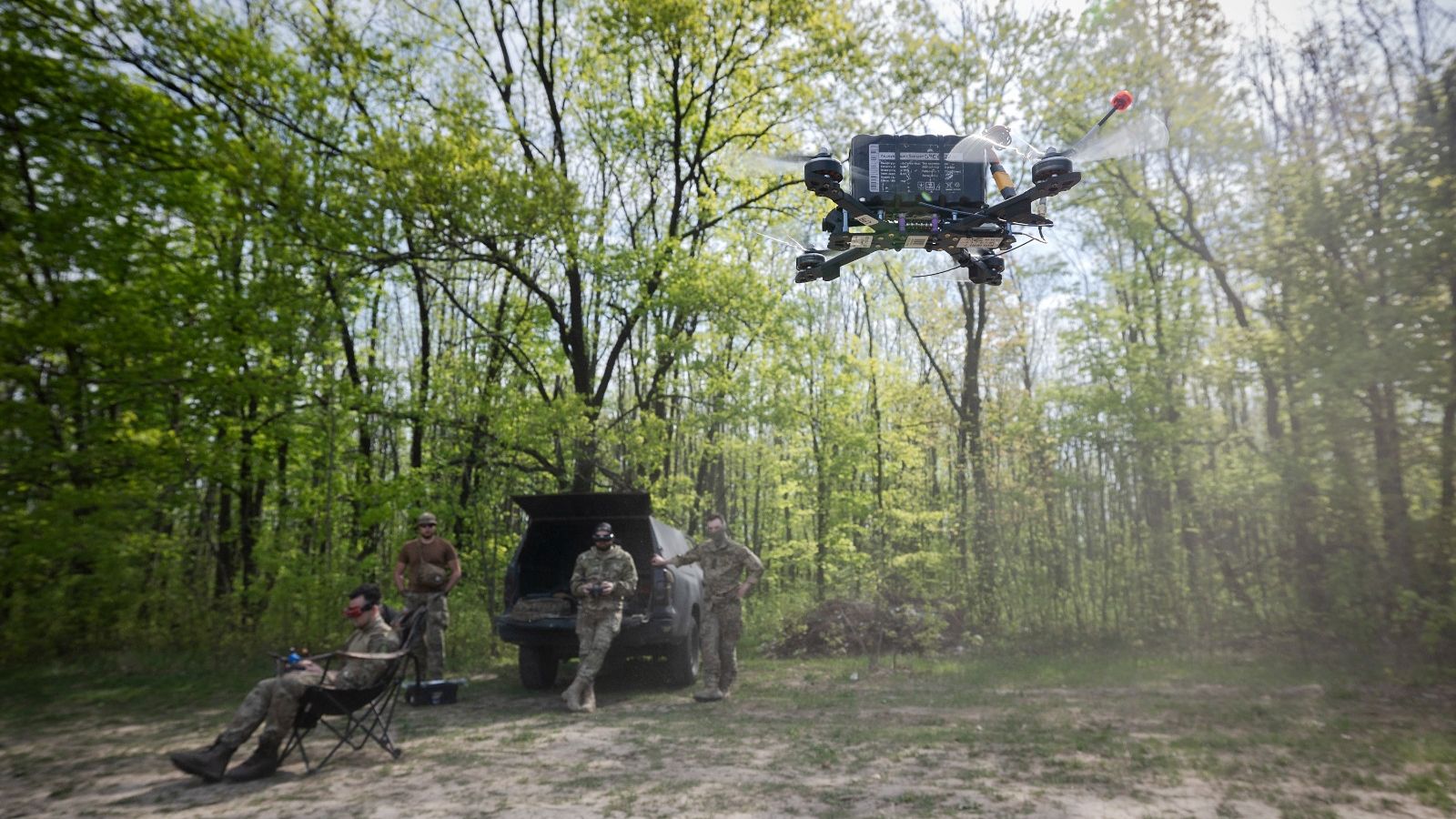
The screen flickers with a grainy, high-altitude perspective of a treeline in Eastern Ukraine. It is silent. There is no sound of wind, no rattle of gunfire, only the steady, mechanical breathing of a battery-powered motor. To a human observer, the image is a landscape of tragedy and tactical significance. To a computer, it is a mathematical problem involving 8.3 million pixels updated sixty times per second.
Ukraine is now preparing to hand over the keys to that mathematical problem. By opening up its massive archives of drone combat footage to private AI developers, the Ministry of Digital Transformation isn't just sharing data. It is sharing the visceral, terrifying reality of modern survival to teach machines how to see.
The Hunter and the Pixel
Consider a young programmer in a quiet office in Kyiv or Lviv. He is not holding a rifle. He is holding a coffee. On his dual-monitor setup, he watches a loop of a thermal signature moving through a destroyed village. His task is simple but heavy: he must tell the algorithm that the heat blooming from a cellar is a human being, while the heat reflecting off a rusted piece of sheet metal is an illusion.
This is the process of data labeling. It is tedious. It is repetitive. It is the foundational labor of the twenty-first century.
Until now, the greatest barrier to autonomous defense systems has been the "noise" of the real world. Lab conditions are easy. A drone can recognize a tank on a sunny day in a grassy field with 99 percent accuracy. But war does not happen in lab conditions. It happens in the mud. It happens during the "golden hour" when long shadows stretch across the earth, mimicking the shape of trenches. It happens when smoke from a burning haystack obscures the infrared spectrum.
By releasing this footage, the Ukrainian government is providing the "gold standard" of training material. This is not simulated data. These are thousands of hours of life and death captured in 4K resolution. The machines are about to get a masterclass in the chaos of the physical world.
The Algorithm of Survival
When we talk about artificial intelligence in a vacuum, we often use sterile language. We discuss "neural networks" and "optimization." But on the front lines, these abstract terms translate into seconds of reaction time.
Imagine a pilot named Serhiy. He has been flying for fourteen hours straight. His eyes are stinging from the blue light of his tablet. His hands are shaking from too much caffeine and not enough sleep. In this state, Serhiy might miss a camouflaged vehicle tucked under a pine canopy. He might blink at the exact moment a threat emerges from a treeline.
An AI model trained on the newly released footage doesn't blink. It doesn't get tired. It doesn't have a family back in Poltava to worry about.
The goal of this initiative is to create a digital co-pilot that can say, "Wait, there's a 93 percent chance that what you think is a shadow is actually a T-90 tank." By feeding these AI models the reality of the front, Ukraine is trying to close the gap between human exhaustion and machine precision.
This is a massive shift in how we think about "training data." In the tech world, data is often seen as an asset to be guarded. Here, it is a shared resource for survival. The Ukrainian Ministry is inviting local and international developers to use this data to build "computer vision" that can navigate through electronic jamming, dense fog, and the deliberate decoys of an adversary.
The Heavy Weight of the Digital Witness
When a human watches these hours of footage, they carry it home. They dream about the pixels. They see the heat of a human body fading after a strike. This is the psychological toll of the digital observer.
But for the machine, there is no empathy. There is only a weight adjustment in a mathematical layer. This is the uncomfortable truth of the program. To make these drones more effective, we must teach them to see humanity as a set of features to be identified, tracked, and—ultimately—targeted or protected.
The process is a cold exchange. We give the computer our most traumatic visual memories so that it may spare us from future ones.
By opening these data silos, Ukraine is also addressing a critical bottleneck in the global AI race. Data is the fuel of the industry. Usually, this fuel is refined from social media posts, street view cameras, and stock photos. But none of those can prepare a system for the reality of a modern battlefield.
Beyond the Screen
This is more than a technical upgrade. This is the birth of a new kind of institutional memory. In the past, soldiers wrote letters and generals wrote memoirs to pass on the lessons of conflict. Today, those lessons are being encoded into the weights and biases of a deep learning model.
The story of this data is not one of Silicon Valley polish. It is a story of cracked screens in muddy trenches. It is a story of cheap, commercial drones being re-engineered by hand in a garage to carry a payload they were never meant for. And now, those drones are becoming the teachers.
They are teaching us that the future of defense is not just in the hardware, but in the software's ability to interpret the world. A drone is just a flying camera until you give it a brain that understands what it's looking at.
The images are still flickering on the screen. The treeline is still silent. But the machine is starting to understand. It is learning the difference between a shadow and a man. It is learning the geometry of a trench. It is learning the rhythm of the modern world, one pixel at a time.