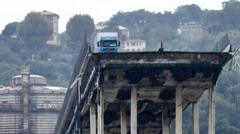
On August 14, 2018, a torrential summer storm battered the Italian port city of Genoa. On the eve of a major national holiday, a massive 200-meter section of the Morandi Bridge suddenly gave way. Dozens of cars and trucks plummeted 45 meters into the dry riverbed, railway tracks, and industrial buildings below.
The disaster claimed 43 lives, shattered a major European transport artery, and exposed a terrifying truth about the state of our public infrastructure.
Now, after nearly eight years of waiting, 284 grueling hearings, and massive public anger, a Genoa court is finally set to deliver its first-instance verdict. Fifty-seven defendants—ranging from high-level corporate executives to government regulators—are facing serious criminal charges.
This isn't just another local court ruling. It's a landmark trial on corporate accountability, privatized infrastructure, and the true cost of cutting corners on public safety.
What the Families of the Victims Are Demanding
For the relatives of the 43 victims, the trial has been a long, painful search for accountability. They have had to endure years of complex legal jargon, finger-pointing, and technical excuses.
Egle Possetti lost her sister, brother-in-law, and two young niblings when pillar 9 of the bridge collapsed. As the head of the victims' relatives committee, she has spent years fighting to keep the tragedy in the public eye.
"We hope they will be convicted, but clearly the most important thing for the victims is that the truth finally comes out," Possetti said.
The families argue that the tragedy wasn't an unpredictable natural disaster or a simple twist of fate. To them, it was the logical result of systemic greed and administrative neglect. Prosecutors seem to agree, famously describing the Morandi Bridge during the trial as a "ticking time bomb" where "you could hear the ticking, but you didn't know when it was going to explode."
The Defendants and the Mind-Boggling Charges
The sheer scale of this trial is staggering. Genoa prosecutors have requested jail sentences totaling more than 400 years across the 57 defendants. The charges include:
- Manslaughter
- Endangering transport safety
- Falsifying official documents
At the center of the prosecution's crosshairs is Giovanni Castellucci, the former CEO of Autostrade per l'Italia (ASPI)—the private company that managed Italy’s motorways—and its parent company Atlantia, which was controlled by the billionaire Benetton family. Castellucci, who faces up to 18 years in prison if convicted, has denied all wrongdoing. His defense team claims he is a "scapegoat" and argues that the collapse was caused by a hidden, original construction defect rather than negligent maintenance.
But the magistrates’ investigation paints a damning picture. Investigators found that between the bridge's inauguration in 1967 and its collapse 51 years later, "not even minimal maintenance work was carried out to reinforce the stays of pillar number 9." While work had been done on other pillars, the critical ninth pillar was left to decay under heavy traffic and coastal salt air.
The Toxic Marriage of Private Profit and Public Duty
The Morandi Bridge disaster exposed the deep flaws in Italy's highway concession system. ASPI was responsible for monitoring and maintaining the bridge. Yet, its engineering sibling, Spea, was the company tasked with inspecting those very same structures. Essentially, the operator was grading its own homework.
The prosecution argued that this corporate setup incentivized executives to slash maintenance budgets to maximize payouts for private shareholders. The numbers back up this theory. Internal reports dating back to 2011 showed that the company was well aware of the bridge’s decaying state, even noting that a collapse was possible within a decade. Yet, the warning signs were filed away, and no real physical action was taken.
While individual executives face prison time, the corporations themselves have largely bought their way out of the criminal proceedings. In 2022, ASPI and Spea reached an out-of-court financial settlement with the public prosecutor's office, paying 29 million euros (around $30 million) to the state to exit the trial. For companies of their size, that's practically a slap on the wrist.
Meanwhile, only two families of the 43 victims refused to accept the corporate compensation packages offered by Autostrade, choosing instead to hold out for judicial justice.
A Warning for Ageing Infrastructure Everywhere
If you think this is just an Italian problem, you're missing the bigger picture.
Bridges, tunnels, and highways built during the post-war boom of the 1950s, 60s, and 70s are reaching the end of their design lives all across Europe and North America. Many of these critical structures are managed through public-private partnerships or private concessions.
When public infrastructure is treated as a cash cow for private equity, safety becomes a cost center to be minimized. The Genoa verdict will establish a crucial legal precedent. It will test whether corporate executives can hide behind "technical complexity" to shield themselves from criminal liability, or if they will finally be held personally responsible for the deadly consequences of neglect.
No matter the outcome on Thursday, the first-instance verdict won't be the end of the road. Under Italy's notoriously slow legal system, appeals are virtually guaranteed, and the process could drag on for several more years. But for the families who have spent nearly eight years waiting in the shadow of a tragedy, it represents the first real chance at holding power to account.