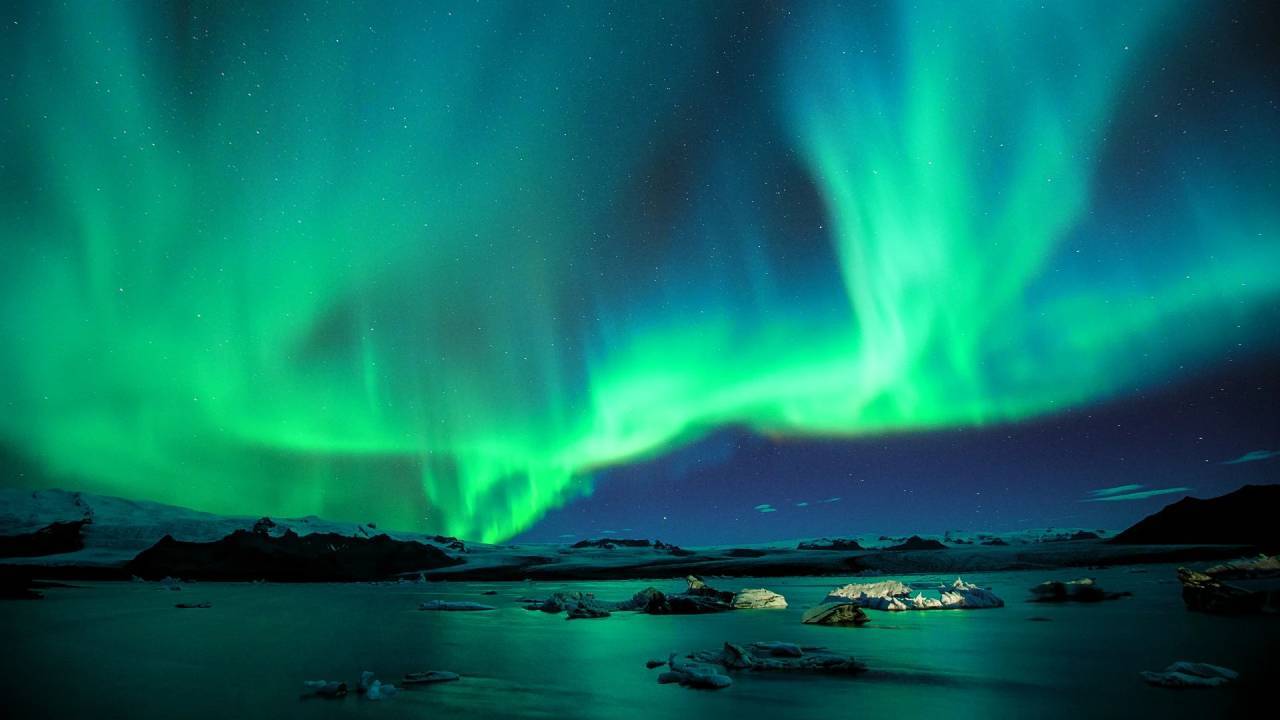
Predicting the terrestrial visibility of the aurora borealis is fundamentally an exercise in managing systemic uncertainty. When solar activity ejects mass and energy into the interplanetary medium, institutional forecasters issue geomagnetic storm watches based on velocity and density models. However, a significant disconnect persists between theoretical models like the WSA-ENLIL solar wind simulation and the empirical reality experienced by field observers. Understanding why an expected auroral display materializes as a vibrant sub-pixel camera capture or vanishes entirely requires deconstructing the physical variables governing solar-terrestrial coupling.
The Kinematics of Coronal Mass Ejections
The chain of events begins in active magnetic regions on the solar surface. When complex sunspot groups undergo magnetic reconnection, they release immense radiative and kinetic energy. Coronal mass ejections represent billions of tons of magnetized plasma hurled into space at velocities ranging from 300 to over 2,000 kilometers per second.
The primary variable governing potential terrestrial impact is transit time, which is inversely proportional to ejection velocity. However, velocity alone does not dictate geomagnetic intensity. The structural orientation of the interplanetary magnetic field carried within the advancing plasma cloud determines its coupling efficiency with Earth's magnetosphere.
If the magnetic field vector points southward (designated as a negative Bz component), it connects directly with Earth's northward-facing magnetic field lines through magnetic reconnection. This process strips away field lines on the dayside and accumulates magnetic stress on the nightside, driving the substorm currents that energize the auroral oval. When the Bz vector remains stubbornly northward, even high-speed plasma deflects harmlessly around the magnetopause, yielding minimal auroral activity regardless of plasma density or storm scale classification.
Classifying Geomagnetic Stress via the Planetary K Index
The National Oceanic and Atmospheric Administration relies on the planetary K index to quantify geomagnetic disturbance on a logarithmic scale from G1 minor to G5 extreme. Each threshold dictates the spatial expansion of the auroral oval toward lower magnetic latitudes.
During G1 minor conditions, auroral activity remains largely confined to high-latitude jurisdictions such as central Alaska and northern Canada. A escalation to G2 moderate conditions shifts the equatorward boundary of the auroral oval, pushing visibility limits down toward border states including parts of New York, Idaho, and Michigan.
Yet, treating these indices as deterministic schedules introduces systemic error. The spatial reach of an aurora depends heavily on local magnetic coordinates rather than geographic latitude. Furthermore, K-index measurements aggregate data across global magnetometer networks averaged over three-hour intervals, masking rapid transient spikes that occur during the peak phase of a substorm.
Environmental Variables Dictated by Ground-Level Constraints
Even when space weather parameters align perfectly, terrestrial observation is bounded by strict environmental friction. Observers frequently miscalculate the compounding drag coefficients imposed by local atmospheric conditions.
The first major variable is tropospheric opacity. Cloud cover acts as an absolute physical barrier to photon transmission in the visible spectrum. Thick stratiform or cumuliform clouds reflect and scatter auroral emissions, reducing surface lux to unobservable thresholds.
The second variable is anthropogenic light pollution. The human eye operates via scotopic vision in low-light environments, relying heavily on rod cells which are acutely sensitive to monochromatic green wavelengths but insensitive to the faint pinks and purples produced by high-altitude nitrogen ionization. Urban light domes elevate the ambient background luminance, washing out low-intensity photon emissions from G1 and G2 events.
The third variable is lunar phase interference. A high-illumination moon acts as an optical noise generator, increasing sky brightness and obliterating low-contrast structures in the upper atmosphere.
Operational Strategy for Field Observation
To maximize observation yield under uncertain geomagnetic forecasts, operators must transition from passive anticipation to active telemetry monitoring. Relying on generalized multi-day alerts introduces excessive false-positive exposure.
Monitor real-time data feeds from the Deep Space Climate Observatory or the Advanced Composition Explorer spacecraft situated at the L1 Lagrange point approximately 1.5 million kilometers sunward from Earth. These probes measure real-time solar wind plasma speed, density, and immediate interplanetary magnetic field orientation roughly 30 to 60 minutes before plasma interactions reach the magnetosphere. A sharp downward deflection in the Bz component combined with a density spike serves as the primary operational trigger for immediate deployment. Utilize wide-aperture digital sensors configured with extended exposure times to capture photonic wavelengths beneath human optical thresholds before environmental degradation alters local visibility windows.
This video provides visual context on solar dynamics and the mechanics of coronal mass ejections that dictate aurora forecasting models.