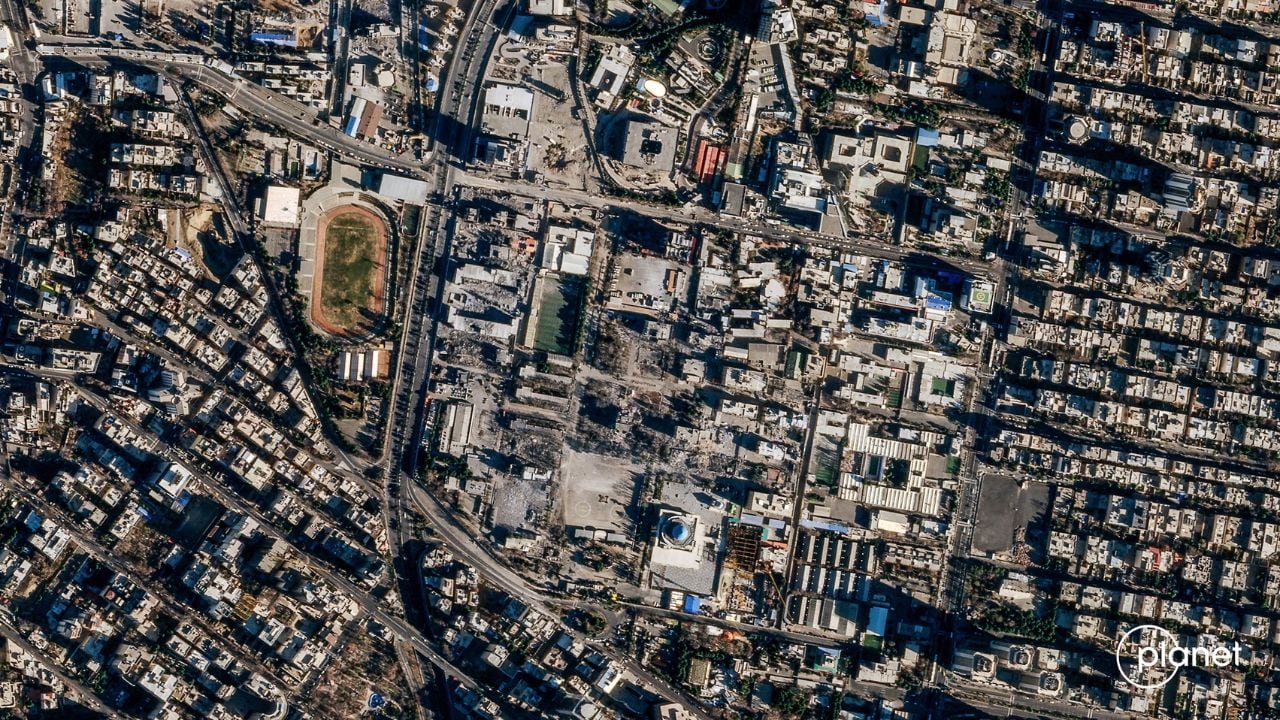
The decision by Planet Labs to indefinitely withhold high-resolution satellite imagery of conflict zones involving Iran represents a fundamental shift in the democratization of intelligence. This is not merely a corporate policy change; it is the re-centralization of global oversight. When a private entity controlling the largest constellation of Earth-observation satellites restricts data, it alters the cost-benefit analysis of state-level military maneuvers by reintroducing the "fog of war" that commercial transparency had begun to dissipate.
The Triad of Commercial Geospatial Control
To understand the impact of image withholding, one must categorize the operational levers Planet Labs and its competitors utilize. The availability of satellite data is governed by three primary variables: temporal resolution, spatial resolution, and distribution parity.
- Temporal Resolution (Revisit Rate): Planet Labs operates a "line scanner" for the planet, capturing the entire Earth's landmass daily. By withholding imagery, they degrade the ability of third-party analysts to establish a baseline of "normal" activity, making it impossible to detect subtle "pattern-of-life" anomalies that precede kinetic military action.
- Spatial Resolution (Granularity): While Dove satellites provide 3-meter resolution, the SkySat fleet offers sub-50cm capabilities. The restriction of high-resolution data specifically targets the identification of hardware—distinguishing between a transport vehicle and a mobile missile launcher—thereby protecting the tactical ambiguity of the actor on the ground.
- Distribution Parity: In a standard market, data is available to any paying customer. By creating a data vacuum for specific geographic coordinates, Planet Labs creates an information asymmetry where only sovereign intelligence agencies with their own classified constellations (such as the NRO in the United States) possess the ground truth.
The Mechanism of Voluntary Shutter Control
Commercial satellite firms operate under "shutter control" regulations, which allow governments to legally mandate the cessation of image collection or distribution during national security crises. However, the current Iran-related blackout appears to be a proactive, voluntary application of these principles. This creates a "shadow regulatory" environment where corporate ESG (Environmental, Social, and Governance) or risk-mitigation strategies bypass public legal frameworks.
The logic of voluntary withholding is driven by a specific risk-calculation matrix:
- Kinetic Risk to Assets: Ground-based anti-satellite (ASAT) capabilities or directed-energy weapons (lasers) owned by state actors pose a physical threat to low-earth orbit (LEO) constellations.
- Regulatory Pre-emption: By self-regulating, firms avoid heavier, more restrictive legislation that could permanently hamper their global business model.
- Contractual Alignment: If a significant portion of revenue is derived from defense and intelligence contracts (e.g., the National Geospatial-Intelligence Agency), the firm must align its public-facing data releases with the strategic interests of its primary benefactor.
The Information Gap and Verification Failure
The withdrawal of commercial imagery eliminates the "Open Source Intelligence" (OSINT) buffer. In previous decades, the public relied entirely on government-vetted "declassified" imagery to justify or decry military interventions. The rise of Planet Labs, Maxar, and BlackSky created a secondary, independent verification layer.
Removing this layer creates a structural bottleneck in international diplomacy. When a state actor is accused of a violation—such as a missile test or a breach of a nuclear facility—the absence of independent satellite evidence forces the international community back into a "trust-based" model of intelligence. This model is historically prone to manipulation or "cherry-picking" of data to suit a specific geopolitical narrative.
Structural Incentives for Concealment
The cessation of imagery distribution incentivizes specific behaviors from regional actors. When a state actor knows that commercial eyes are "closed," the cost of rapid mobilization drops significantly.
- The Deception Value: Actors can move assets under the cover of the commercial blackout, knowing that while "Big Bird" (government) satellites see them, the "Global Crowd" (NGOs, journalists, researchers) does not.
- Signal Noise: Without a consistent stream of daily imagery, analysts lose the ability to perform change detection via machine learning. AI models require high-frequency data to train and detect "out-of-distribution" events. A gap of even one week can reset the baseline, making new construction or movement appear as if it had always been there.
The Economic Consequences of Data Redlining
From a business strategy perspective, the decision to withhold data introduces "sovereign risk" into the commercial data market. Global clients—ranging from agricultural firms to hedge funds—now must account for the possibility that their data stream could be severed if their area of interest intersects with a geopolitical flashpoint.
This creates a market opportunity for non-Western satellite providers. As Western firms like Planet Labs align more closely with NATO-centric security protocols, actors in the Global South or non-aligned regions may pivot toward Chinese or Russian commercial providers (such as the SuperView or Gaofen constellations). This fragmentation of the LEO data market leads to a "bipolar" view of the Earth, where different regions see different versions of reality based on which satellite provider they use.
The Operational Bottleneck of Human Review
A hidden factor in the "indefinite withholding" is the sheer volume of data. To ensure that "sensitive" imagery does not leak, firms often move from automated pipelines to manual review. This creates a latency bottleneck.
- Ingestion: Raw telemetry is received at ground stations.
- Filter Trigger: Geographic "geo-fences" flag all imagery within the Iran-conflict corridor.
- Sensitivity Assessment: Human analysts must determine if an image contains "actionable" military intelligence or benign civilian activity.
- Censorship or Release: Most firms choose the "Safe Route"—blanket suppression—because the cost of a false negative (accidentally releasing a sensitive image) far outweighs the lost revenue of a single suppressed frame.
The Strategic Pivot to Synthetic Aperture Radar (SAR)
While Planet Labs focuses on optical imagery—which is limited by night and cloud cover—the industry is shifting toward Synthetic Aperture Radar (SAR). Companies like ICEYE and Capella Space provide imagery that can "see" through clouds and smoke.
The decision by optical providers to withhold data makes SAR data exponentially more valuable. SAR is inherently more difficult for the layperson to interpret, requiring specialized signal processing. By suppressing optical data, the ability to monitor conflict is shifted away from the general public and toward those with the capital and technical expertise to process radar returns. This further gatekeeps the "ground truth" of global events.
Institutional Fragility in Open Source Intelligence
The reliance of the news media and humanitarian organizations on a few centralized LEO providers has created an institutional fragility. There is no "Public LEO" equivalent to the public road system. All imagery is private property.
The "Terms of Service" of these companies are now effectively the "Rules of Engagement" for global transparency. If a company can unilaterally decide to go dark on a nation-state, they possess the power to facilitate or obscure human rights violations, troop movements, and environmental disasters without oversight. This power is currently being exercised without a standardized ethical framework or a right-to-access appeal process.
Strategic Recommendation for Independent Verification
Organizations currently dependent on commercial optical imagery must diversify their intelligence gathering to mitigate the risk of corporate shutter control. The strategic play is to move toward a "multimodal" monitoring approach that does not rely on a single LEO provider's benevolence.
- Investment in High-Altitude Pseudo-Satellites (HAPS): Utilizing solar-powered drones or balloons that operate above commercial airspace but below LEO provides a localized, persistent eye that is not subject to the same global "shutter control" mandates as satellite constellations.
- SAR Integration: Non-governmental organizations must develop the internal capacity to process and analyze SAR data, which remains less regulated and more resilient to visual-spectrum suppression tactics.
- Cross-Jurisdictional Sourcing: Procuring data from a mix of providers headquartered in diverse legal jurisdictions (e.g., European, Indian, and South American firms) reduces the likelihood of a synchronized global blackout.
The era of "total transparency" is being replaced by "selective visibility." In this new environment, the most critical intelligence is no longer the image itself, but the knowledge of exactly what is being hidden and why. The move by Planet Labs signals that LEO is no longer a neutral observation post, but a contested domain of information warfare.