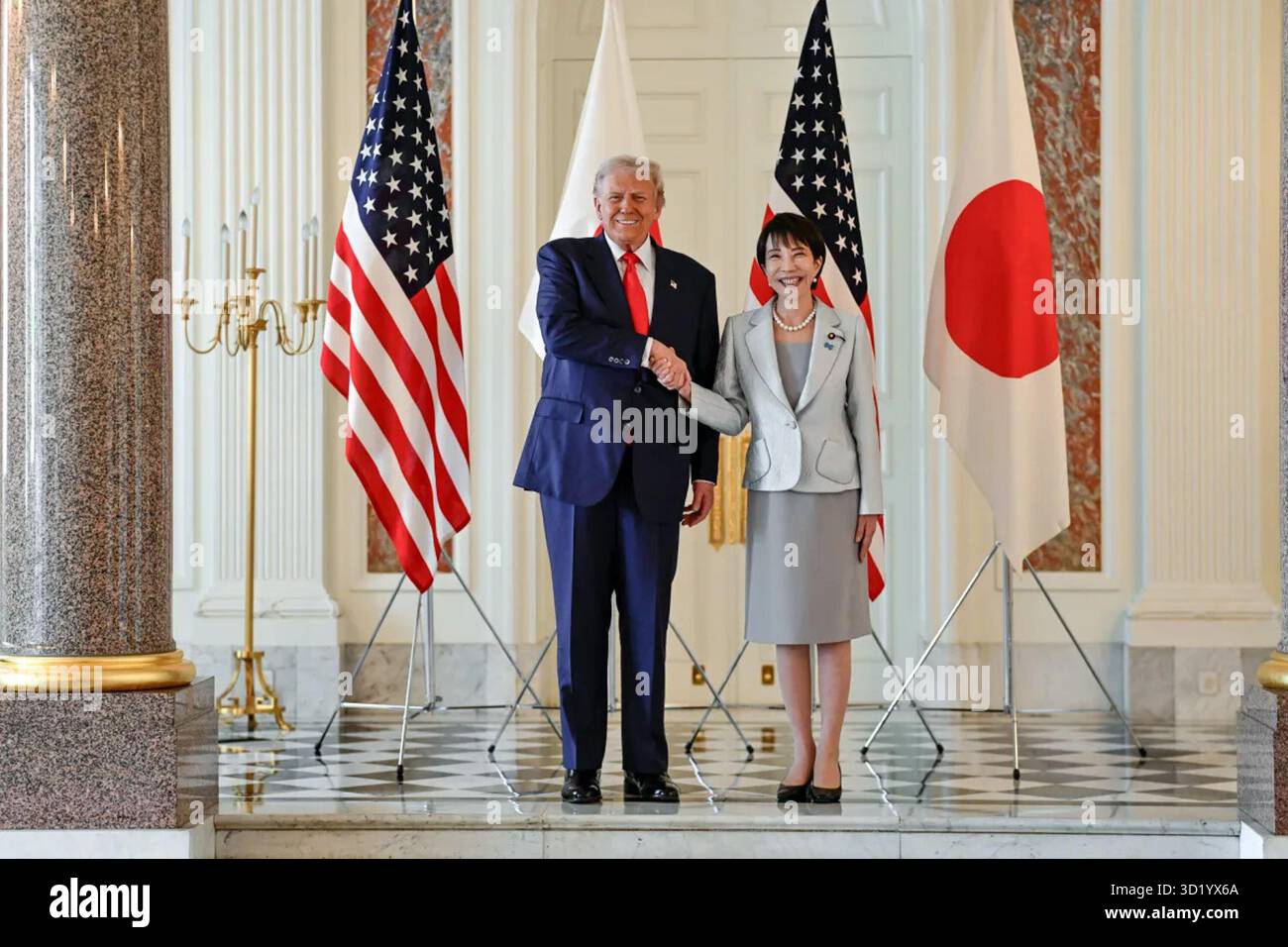
The rhetorical framework governing United States foreign policy toward the Taiwan Strait has shifted from institutional preservation to transactional stabilization. Following high-level bilateral talks in Beijing between US President Donald Trump and Chinese President Xi Jinping, Washington’s public signaling—articulated by Secretary of State Marco Rubio—emphasizes an adherence to the cross-strait status quo. This baseline policy, traditionally managed through diplomatic omission and strategic ambiguity, operates not as an ideological commitment to regional governance, but as a calculated mechanism to preserve macroeconomic liquidity and supply-chain insulation.
The strategic equilibrium of the Taiwan Strait is governed by a tripartite structural tension: Washington's legislative mandate to provide defensive capabilities, Beijing's existential requirement to prevent formal Taiwanese independence, and Taipei's reliance on integrated global economic dependencies. When the executive branch affirms the status quo within this matrix, it is executing an optimization strategy designed to minimize immediate transactional friction with a primary trading partner while deferring high-leverage defense capital allocations.
The Tripartite Matrix of Cross-Strait Equilibrium
To evaluate the mechanical reality of current US policy, the geopolitical environment must be disaggregated into three independent variables. Each participant operates under a distinct utility function, where unilateral alterations by any single actor trigger severe systemic costs for the remaining two.
                  [Beijing: Sovereignty & Reunification Mandate]
                                     /  \
                                    /    \
                                   /      \
                                  /        \
                                 /   Cost   \
                                /  Function  \
                               /              \
                              /                \
                             /                  \
[Taipei: Asymmetric Defense &]------------------[Washington: Supply Chain Insulation]
[Semiconductor Monopolization]                  [& Strategic Ambiguity Policy]
1. The Domestic Political Mandate of the PRC
For Beijing, the status quo is tolerated exclusively as long as the probability of permanent Taiwanese autonomy remains below a critical threshold. The Chinese Communist Party views the cross-strait relationship through the prism of territorial sovereignty and domestic political legitimacy. Unilateral actions by Taipei toward formal legal independence, or an explicit military alliance between Washington and Taipei, violate the baseline conditions established under Beijing's 2005 Anti-Secession Law. This legislative trigger legally obligates the state to employ non-peaceful means to protect its territorial integrity.
2. The Asymmetric Deterrence Strategy of Taiwan
Taipei’s survival strategy relies on maintaining an asymmetric capability cost for any potential invader. This is achieved via two distinct mechanisms:
- The Silicon Shield: Taiwan commands over 90% of the global manufacturing capacity for leading-edge semiconductors (sub-3-nanometer nodes). This extreme concentration of critical technological infrastructure ensures that a kinetic conflict would immediately halt global advanced computing supply chains, imposing an unacceptable economic cost on both the United States and China.
- The Porcupine Strategy: Transitioning defense procurement away from legacy capital-intensive platforms (large naval vessels, conventional fighter aircraft) and toward highly distributed, mobile, and survivable asymmetric assets. These include sea-denial anti-ship missiles, man-portable air-defense systems, and automated smart mines designed to exploit the geographic vulnerability of the 100-mile Taiwan Strait.
3. The Ambiguity Architecture of the United States
The foundational framework of US engagement remains anchored in the Taiwan Relations Act of 1979, the three US-China Joint Communiqués, and the Six Assurances. This legal and diplomatic architecture mandates that Washington provide Taipei with defensive articles sufficient to maintain a self-defense capability, without explicitly guaranteeing American military intervention in the event of an amphibious assault by the People's Liberation Army. This deliberate ambiguity deters Taipei from declaring de jure independence while simultaneously deterring Beijing from executing a unilateral invasion.
The Strategic Cost Function of Tactical Omission
The structural execution of the Beijing summit reveals a deliberate decoupling of public economic negotiations from foundational security frictions. While Chinese state media reported that President Xi characterized Taiwan as the single most critical friction point in bilateral relations, the official White House readout omitted any direct reference to the island.
This asymmetry in communication indicates a shift toward a transactional foreign policy model where geopolitical issues are leveraged to secure immediate economic concessions. By maintaining public silence on Taiwan while verifying "business as usual" through secondary diplomatic channels, Washington seeks to lower the geopolitical risk premium currently impacting international markets.
The mathematical reality of a cross-strait conflict dictates this diplomatic caution. A systemic disruption to the Taiwan Strait introduces an immediate, non-linear shock to the global macroeconomic framework:
- Global GDP Contraction: Quantitative modeling by Bloomberg Economics estimates the global economic cost of a kinetic conflict and subsequent blockades at $10 trillion, equivalent to approximately 10% of global GDP.
- Semiconductor Deprivation: An immediate cessation of advanced logic chip exports from Taiwan semiconductor foundries would freeze global electronics manufacturing, halting production lines across the automotive, aerospace, consumer technology, and defense industrial bases.
- Maritime Logistics Interdiction: The Taiwan Strait serves as a primary maritime artery for container ships transiting from Northeast Asia to markets in Europe and the Americas. Forcing the rerouting of global shipping lanes around the Philippine Sea adds significant fuel, labor, and time overhead, compounding inflationary pressures within Western economies.
Transactional Deterrence and Weapon Procurement Logistics
A critical indicator of the shifting operational relationship between Washington and Taipei is the executive branch's hesitation regarding defense capital allocations. Following the Beijing summit, the administration indicated that it remains undecided on whether to permit the progression of major scheduled arms sales to Taiwan.
This hesitation exposes the structural trade-off between trade normalization with Beijing and the execution of the Taiwan Relations Act. The delay in finalizing defense packages—which historically include high-mobility artillery rocket systems, anti-tank missiles, and tactical air-defense platforms—serves as a high-value bargaining chip in ongoing bilateral trade and tariff negotiations.
This transactional posture introduces specific operational vulnerabilities into the cross-strait deterrence model:
- The Deterrence Degradation Rate: Defensive capabilities deteriorate over time without continuous modernization, spare parts integration, and joint doctrinal training. Delays in weapon system deliveries extend the window of vulnerability for Taiwan as China continues its rapid naval expansion and modernization program.
- The Defense Budget Funding Dilemma: The current US policy framework increasingly conditions security cooperation on Taiwan’s willingness to escalate its domestic defense expenditure. While Taipei has raised its defense spending to approximately 2.5% of its GDP, Washington’s transactional signaling implies that the baseline for American security guarantees may require a capital commitment matching or exceeding 3% to 5% of GDP. This adjustment would require significant internal budget reallocations away from social infrastructure and economic development programs.
The Operational Limits of Selective Multilateralism
The administration's approach to international institutions adds another layer of complexity to regional stabilization efforts. While the executive branch actively seeks to restructure United Nations humanitarian funding and demand deep operational reforms within multilateral bodies, it simultaneously bypasses these institutions to conduct direct, bilateral summitry with great-power competitors.
This dual-track strategy reveals the inherent limitations of relying on global bodies to manage acute security flashpoints. The United Nations Security Council, neutralized by the veto architecture held by its permanent members, is structurally incapable of enforcing or arbitrating disputes involving Chinese sovereign claims over Taiwan.
Consequently, Washington's insistence on the status quo is executed through direct bilateral leverage rather than multilateral alignment. The stabilization achieved in Beijing represents a temporary alignment of state interests: the United States secures a volatile truce to focus on domestic economic restructuring and tariff enforcement, while China secures a pause in geopolitical pressure to manage internal debt cycles and structural economic transitions.
This equilibrium remains highly sensitive to minor policy adjustments. Any unilateral reinterpretation of economic parameters—such as the unilateral imposition of sweeping tariffs on Taiwanese technology exports or the deployment of advanced semiconductor manufacturing equipment sales authorizations to mainland firms—directly threatens the viability of the current status quo.
The strategic framework has moved past institutional norms; it is now defined by continuous, data-driven assessments of the immediate costs and benefits of escalation versus containment. The primary risk of this approach is the potential for a miscalculation of the opponent's critical thresholds, where a tactical move intended to secure a trade concession inadvertently triggers a structural security breakdown in the Indo-Pacific theater.