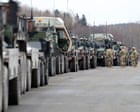
The decision to reduce U.S. permanent troop presence in Germany represents a shift from a post-WWII containment model to a transactional security framework. This maneuver is not a simple budgetary adjustment; it is an exercise in power projection elasticity. By decoupling military presence from historical inertia, the United States is attempting to recalibrate the North Atlantic Treaty Organization (NATO) burden-sharing ratio, effectively demanding that European sovereignty be financed by European capital rather than American human and financial resources.
The Tri-Axis Logic of U.S. Force Posture
To understand the implications of a troop withdrawal, one must analyze the three distinct functional axes that these forces serve. The competitor narrative often collapses these into a single "defense" category, but the strategic reality is more granular.
1. The Logistics and Medical Hub Function
Germany, specifically the Ramstein Air Base and Landstuhl Regional Medical Center, serves as the central nervous system for U.S. operations across Africa and the Middle East. Reducing numbers here does not just impact German defense; it creates a latency effect in the U.S. ability to respond to crises in the Global South.
- Sustained Throughput: Landstuhl is the only Level I trauma center outside the United States capable of handling mass casualty events from CENTCOM and AFRICOM.
- Ammunition and Pre-positioned Stock: The 405th Army Field Support Brigade manages massive stockpiles of combat-ready equipment. Relocating these assets incurs a "Transition Friction Cost" that can be measured in billions of dollars and months of operational downtime.
2. The Deterrence and Signaling Function
Military presence is a physical manifestation of a "tripwire" strategy. Under the traditional NATO framework, U.S. troops in Germany act as a guarantee that any conflict in Europe involves the U.S. immediately. Removing 9,500 to 12,000 troops—roughly a third of the permanent force—alters the psychological calculus for regional adversaries.
3. The Burden-Sharing Lever
The 2% of GDP defense spending target, established at the 2014 Wales Summit, is the primary friction point. From a strategy consultant’s perspective, the U.S. is applying "negative reinforcement" to its largest European partner. Germany’s failure to meet the 2% threshold is viewed as a market inefficiency where the U.S. provides a "security subsidy" that allows Germany to divert capital toward domestic social programs and industrial subsidies, gaining a competitive economic advantage.
Quantifying the Economic Ripple Effect
A common misconception is that troop withdrawals save the U.S. money immediately. In reality, the short-term cost function is convex.
Base Closure and Relocation Expenses
The Department of Defense (DoD) must account for:
- MILCON (Military Construction): Building new barracks, hangars, and command centers in alternative locations (likely Poland or the U.S. domestic soil).
- PCS (Permanent Change of Station) Costs: Moving thousands of personnel and their families across continents is a logistical undertaking that consumes significant O&M (Operations and Maintenance) budgets.
- Infrastructure Write-offs: Billions of dollars in existing U.S.-funded infrastructure in Germany would be abandoned, representing a massive loss on long-term capital investment.
Local Economic Impacts as a Negotiating Tool
U.S. bases contribute an estimated €1 billion to €2 billion annually to local German economies through employment and local procurement. By threatening withdrawal, the U.S. is targeting the German political structure at a regional level, forcing local leaders to pressure the federal government in Berlin to increase defense spending to keep the Americans—and their dollars—in place.
The Poland-Germany Security Arbitrage
The pivot toward Poland represents a strategic arbitrage. Poland views the U.S. presence not as a historical relic, but as an existential necessity.
The Suwalki Gap Vulnerability
Military planners focus heavily on the Suwalki Gap, a 60-mile strip of land along the Polish-Lithuanian border that separates the Russian exclave of Kaliningrad from Belarus.
- Strategic Proximity: Forces based in Poland have a significantly shorter "Time-to-Target" for reinforcing the Baltics compared to forces based in Stuttgart or Kaiserslautern.
- Host Nation Support: Poland has signaled a willingness to contribute up to $2 billion toward the "Fort Trump" concept, effectively buying down the U.S. cost of deployment. This shifts the financial model from a U.S.-funded subsidy to a co-investment model.
Operational Constraints of Rotational vs. Permanent Forces
The U.S. is increasingly favoring rotational deployments over permanent basing. While rotational forces are more agile and prevent personnel from becoming "settled" (and thus more politically sensitive to move), they lack the deep institutional knowledge and community ties that permanent forces provide. The cost-per-soldier for rotational deployment is often higher due to the constant churn of logistics and transport.
Structural Fault Lines in NATO Cohesion
The threat of withdrawal exposes a fundamental disagreement on the nature of modern threats. Germany’s strategic culture is rooted in Wandel durch Handel (change through trade), viewing economic interdependence as the primary security mechanism. The U.S. strategy has pivoted back to hard-power realism.
The Nord Stream 2 Variable
One cannot analyze troop reductions without referencing the energy sector. The U.S. views Germany’s reliance on Russian gas via the Nord Stream 2 pipeline as a strategic liability that undermines NATO’s collective defense. The troop reduction threat functions as a "bundled negotiation" tactic: the U.S. seeks concessions on energy policy and defense spending simultaneously.
The Credibility Gap
When security guarantees are used as bargaining chips, the "Certainty Premium" of the alliance decreases. Other NATO members may begin to hedge their bets, seeking bilateral security arrangements or pursuing "European Strategic Autonomy." This fragmentation creates a more complex, less predictable multi-polar environment.
Logistics of Force Realignment
If the reduction proceeds, the U.S. European Command (EUCOM) must manage a high-stakes shell game.
- Redeployment to the U.S.: Units returning to domestic bases like Fort Bragg or Fort Hood increase the domestic economic benefit for U.S. states but decrease the "Ready-to-Fight" capability in the European theater.
- Redeployment to Poland/Baltics: Enhances deterrence on the eastern flank but risks violating the 1997 NATO-Russia Founding Act, which limits "substantial combat forces" permanently stationed in former Eastern Bloc countries.
- Redeployment to Italy/Belgium: Relocating headquarters (like U.S. Africa Command) to other Western European hubs maintains the footprint but does little to satisfy the "burden-sharing" grievance, as these nations also frequently fall short of the 2% target.
Strategic Forecast: The Shift to Variable-Geometry Alliances
The era of static, multi-decade troop deployments in Western Europe is ending. We are entering a period of "variable-geometry" defense where the U.S. presence is contingent, mobile, and tied to specific performance metrics from host nations.
Germany will likely respond with incremental increases in defense spending, but not enough to reach the 2% target in the immediate term. Berlin's strategy will be to "out-wait" the current U.S. administration, betting that the high logistical cost and pushback from the U.S. Congress (which often views these bases as essential to U.S. power projection) will stall the withdrawal.
For the U.S. Department of Defense, the tactical play is to utilize the threat of withdrawal as the primary instrument of change rather than the withdrawal itself. The goal is to reach a "New Equilibrium" where the U.S. maintains its critical hubs in Germany—Ramstein and Landstuhl—while moving combat-heavy units eastward into co-funded facilities. This maximizes deterrence efficiency while minimizing the American taxpayer's share of European regional security costs.
The ultimate risk remains the "decoupling" of American and European security interests. If the U.S. reduces its footprint too rapidly, it loses its seat at the table for European trade and regulatory decisions. Security is the currency the U.S. uses to buy influence in Europe; devaluing that currency through mass withdrawals may lead to a loss of geopolitical market share that exceeds the budgetary savings of the troop reduction.