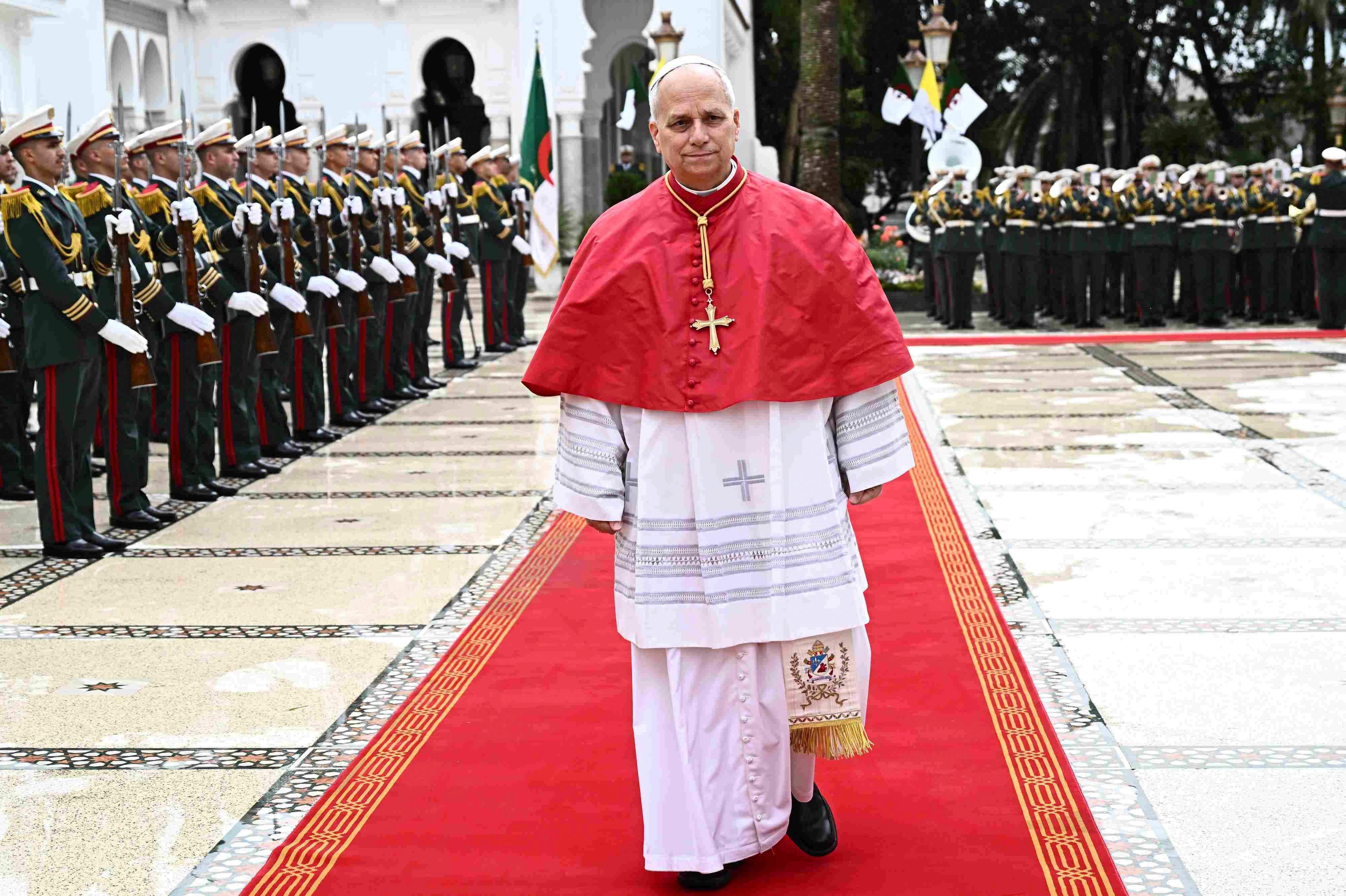
The confrontation between Pope Leo XIV and the Trump administration regarding potential military engagement in Iran represents a collision between two incompatible systems of power: moral-normative authority and tactical-realist nationalism. While surface-level analysis treats this as a personal feud, the structural reality is a conflict of long-term institutional preservation. The Vatican operates on a civilizational timescale, prioritizing the stability of global Catholic populations and the prevention of total regional collapse, while the executive branch of the United States operates on a four-year electoral cycle driven by immediate deterrence and domestic political signaling.
The tension rests on three distinct pillars of disagreement: the definition of "just war," the protection of religious minorities in the Levant, and the mechanics of international law as a constraint on sovereign action.
The Doctrine of Proportionality and Preemption
The Holy See’s opposition to a conflict with Iran is rooted in the "Just War" theory, a framework that has governed Catholic geopolitical ethics for centuries. In this specific context, the disagreement centers on the concept of Preemptive Strike versus Defensive Necessity.
The U.S. strategy under Trump frequently utilizes "maximum pressure," which includes the threat of kinetic action to force diplomatic concessions. From a rigorous theological and legal standpoint, the Vatican views this as a violation of the principle of Ultima Ratio—the requirement that war must be the absolute last resort.
- The Legitimacy Gap: The Vatican argues that unless an imminent attack is evidenced with absolute certainty, a first strike lacks moral legitimacy.
- The Escalation Ladder: Leo XIV’s advisors view the Iranian theater not as a vacuum, but as a series of interconnected nodes. A strike on Iranian soil triggers asymmetric responses across the "Shiite Crescent," including Lebanon, Iraq, and Yemen.
- The Proportionality Constraint: Standard military doctrine calculates success by the destruction of enemy assets. The Vatican’s cost function includes the long-term displacement of civilian populations and the permanent destruction of social infrastructure, which they argue outweighs any short-term tactical gain.
The Demographic Risk to Eastern Christianity
A primary driver of the Pope’s defiance is the protection of the dwindling Christian presence in the Middle East. History shows that Western military interventions in the region—specifically the 2003 invasion of Iraq—result in the catastrophic displacement of indigenous Christian communities.
When a secular power like the United States engages in regional warfare, the local Christian population is often targeted as a proxy for the West. This creates a demographic death spiral. The Vatican views another large-scale war in the Middle East as the final blow to the 2,000-year-old presence of Christians in the region.
The strategy of the Holy See is therefore one of Structural Neutrality. By publicly distancing the Church from American military objectives, Leo XIV attempts to decouple the identity of the global Church from the foreign policy of the United States. This is a survival mechanism designed to ensure that Catholic and Orthodox communities in Tehran, Isfahan, and Baghdad are not viewed as fifth columns for a Western invader.
The Collapse of Multilateralism as a Strategic Threat
The Vatican is one of the world's oldest practitioners of multilateral diplomacy. Its influence is maximized when international norms, such as those established by the United Nations and the Holy See’s own diplomatic corps, are respected.
The Trump administration’s preference for bilateralism and transactional foreign policy directly undermines the Vatican's soft power. If the United States ignores the Joint Comprehensive Plan of Action (JCPOA) or bypasses the UN Security Council to initiate hostilities, it establishes a precedent where raw power supercedes the "Rule of Law."
- The Institutional Risk: For the Holy See, the erosion of international treaties is a systemic risk. If the world returns to a state of unmitigated Westphalian sovereignty, the Church loses its ability to intervene as a mediator on the global stage.
- The Moral Hazard: Leo XIV identifies a moral hazard in the "America First" policy. If the world’s primary superpower operates outside of collective security frameworks, other regional powers will follow suit, leading to a fragmented and volatile global order.
The Mechanics of Public Defiance
The statement that the Pope "does not fear" a feud with the American President is a calculated use of Moral Asymmetry. Unlike a head of state, the Pope cannot be sanctioned, voted out of office, or militarily intimidated without significant blowback from the global Catholic electorate, which includes roughly 70 million Americans.
This creates a "rhetorical shield." By framing his opposition in terms of courage and faith, Leo XIV forces the Trump administration into a difficult position. If the administration attacks the Pope directly, they risk alienating a critical segment of their own voting base—specifically conservative Catholics and moderate Christians who view the Papacy as an ultimate moral authority, even if they disagree with its specific political stances.
The "feud" is therefore a high-stakes game of Perception Management.
- Vatican Objective: To position the Church as the global conscience, standing above the fray of nationalistic interests.
- U.S. Executive Objective: To project strength and ensure that no entity, religious or secular, appears to have a veto over American national security decisions.
The Disconnect in Risk Assessment
The fundamental friction arises from a difference in how "risk" is measured.
The U.S. administration calculates the risk of inaction—the possibility that Iran develops a nuclear weapon or expands its regional hegemony if not checked by force. This is a quantitative, materialist risk assessment.
The Vatican calculates the risk of disruption—the possibility that a war creates a power vacuum, leads to a new wave of radicalization, and further destabilizes the global migration crisis. This is a qualitative, systemic risk assessment.
The Pope's refusal to back down suggests that the Holy See has determined the risk of silence is greater than the risk of a political rift with Washington. In their view, the fallout of a war in Iran would be a permanent stain on the 21st century, whereas a political spat with a single administration is a temporary, manageable friction.
The Diplomatic Bottleneck
Currently, there is no effective mediator between these two poles. Traditionally, European powers might bridge the gap, but the current fracturing of the EU has left the Vatican as the sole "Western" entity with the moral standing to challenge U.S. hegemony on humanitarian grounds.
This creates a bottleneck in the peace process. If the White House views the Pope's intervention as an annoyance rather than a strategic data point, they miss the reality that the Vatican often serves as a silent channel for communication with regimes that are otherwise closed to the West. By alienating the Holy See, the U.S. risks losing one of the few diplomatic backchannels remaining in the Middle East.
Strategic Forecast and Implementation
The standoff will likely intensify as the election cycle nears its peak. The Trump administration will continue to use the threat of force as a leverage tool, while Leo XIV will likely escalate his rhetoric, potentially involving more direct appeals to the American Catholic clergy and the laity.
To navigate this, the U.S. State Department must shift from a posture of dismissal to one of Tactical Integration.
- Acknowledge the Humanitarian Framework: Instead of viewing the Pope's statements as a challenge to sovereignty, the administration should frame its security goals as being in service of the long-term stability the Pope seeks.
- Utilize Vatican Intelligence: The Holy See possesses one of the most sophisticated ground-level intelligence networks in the world through its dioceses and missions. Engaging with the Vatican's "Secretariat of State" on the specific ground-level consequences of conflict could refine U.S. targeting and strategy to minimize the humanitarian blowback that the Pope fears.
- Formalize the Backchannel: Use the Holy See as a neutral party to facilitate a "Track II" diplomacy with Iranian leadership. This allows the U.S. to maintain its public stance of strength while exploring de-escalation routes through a trusted, non-state actor.
The failure to reconcile these two power structures increases the probability of a "Gray Zone" conflict where the lack of moral and diplomatic consensus leads to a messy, protracted engagement with no clear exit strategy. The Pope is not just "not fearing" Trump; he is signaling that the Vatican is prepared to act as a permanent opposition to any policy it deems a threat to the global social fabric.