Every autumn since 1992, the United Nations General Assembly convenes to vote on a resolution demanding the end of the United States economic, commercial, and financial embargo against Cuba. While the numerical outcome of this vote is a statistical certainty—routinely passing with overwhelming majorities exceeding 180 member states—the diplomatic friction surrounding the debate serves as a critical barometer for hemispheric alliances, international legal norms, and domestic political constraints in Washington. Understanding this annual event requires looking past the predictable tally and analyzing the asymmetric legal, economic, and diplomatic mechanisms operating beneath the floor of the General Assembly.
The Institutional Asymmetry of General Assembly Resolutions
To evaluate the impact of the annual vote, analysts must distinguish between the political authority of the United Nations General Assembly (UNGA) and the binding enforcement power of the United Nations Security Council (UNSC). Under the UN Charter, General Assembly resolutions are non-binding recommendations. They carry significant normative and diplomatic weight, establishing a baseline of international consensus, yet they possess zero direct legal authority to compel a sovereign nation to alter its domestic statutory framework.
In the case of the United States embargo—known in Cuba as el bloqueo (the blockade)—the executive branch of the U.S. government does not hold unilateral authority to dismantle the sanctions regime, even if an administration wished to respond to international pressure. The embargo is codified into U.S. federal law through a layered architecture of statutes:
- The Trading with the Enemy Act of 1917: Originally enacted during World War I, this statute provides the foundational authority for the U.S. President to restrict trade with designated nations during times of war or national emergency, forming the basis of the initial 1962 Cuban Assets Control Regulations.
- The Foreign Assistance Act of 1961: This legislation explicitly mandated the establishment of a total embargo on all trade between the United States and Cuba and prohibited foreign aid to the Cuban government.
- The Cuban Democracy Act of 1992 (Torricelli Act): Passed following the collapse of the Soviet Union, this law tightened restrictions by prohibiting foreign subsidiaries of U.S. companies from trading with Cuba and barring ships that dock in Cuban ports from entering U.S. ports for 180 days.
- The Cuban Liberty and Democratic Solidarity Act of 1996 (Helms-Burton Act): This is the primary structural bottleneck preventing executive repeal. By codifying the embargo into permanent statute, Congress stripped the President of the ability to lift the sanctions via executive order until specific democratic and property-restitution benchmarks are met in Havana.
Because the embargo is locked behind statutory requirements that only an act of the U.S. Congress can overturn, the annual UNGA resolution operates in a state of structural disconnect. The international community votes on a diplomatic demand directed at the U.S. Executive Branch, while the legal keys to the policy remain distributed across a polarized U.S. legislature.
The Three Pillars of the Diplomatic Confrontation
When tensions spill into the public debate on the General Assembly floor, the rhetoric from both Havana and Washington follows predictable, deeply entrenched strategic frameworks. Diplomatic historians and international relations scholars categorize these arguments into three distinct pillars: extraterritoriality, human rights conditionality, and humanitarian exemptions.
1. Extraterritoriality and Third-Party Compliance
The central legal argument advanced by Cuba and supported by traditional U.S. allies—including the European Union, Canada, and Latin American nations—centers on the concept of extraterritorial jurisdiction. Under customary international law, a state’s regulatory authority is generally confined to its own territory and citizens. Critics argue that U.S. sanctions violate this principle by penalizing non-U.S. entities for conducting lawful business with Cuba.
This friction is most acute regarding Title III of the Helms-Burton Act, which allows U.S. nationals to sue foreign companies in U.S. federal courts if those companies "traffic" in property confiscated by the Cuban government after the 1959 revolution. Furthermore, because the U.S. dollar serves as the primary reserve currency for global trade, international banks routinely refuse to process Cuban transactions—even those involving entirely non-U.S. parties—to avoid losing access to the U.S. financial system or incurring severe fines from the Office of Foreign Assets Control (OFAC). In the UN debate, allied nations routinely state that while they share U.S. concerns regarding governance in Cuba, they reject the imposition of unilateral coercive measures that infringe upon their own sovereign right to trade.
2. Human Rights and Democratic Conditionality
The U.S. delegation frames the embargo not as an act of economic aggression, but as a legitimate foreign policy tool designed to promote democratic governance, human rights, and fundamental freedoms. According to statements from the U.S. Department of State, the sanctions are calibrated to deny the Cuban military and intelligence apparatus—specifically conglomerates like GAESA (Grupo de Administración Empresarial S.A.)—the hard currency needed to maintain state control and suppress political dissent.
During the General Assembly debates, U.S. representatives systematically highlight domestic conditions within Cuba, pointing to the detention of political prisoners, restrictions on freedom of assembly and expression, and the lack of multi-party elections. From Washington’s perspective, lifting the embargo without reciprocal political concessions from Havana would enrich state-run enterprises without guaranteeing economic relief or political liberty for the Cuban populace.
3. Humanitarian Exemptions and Supply Chain Friction
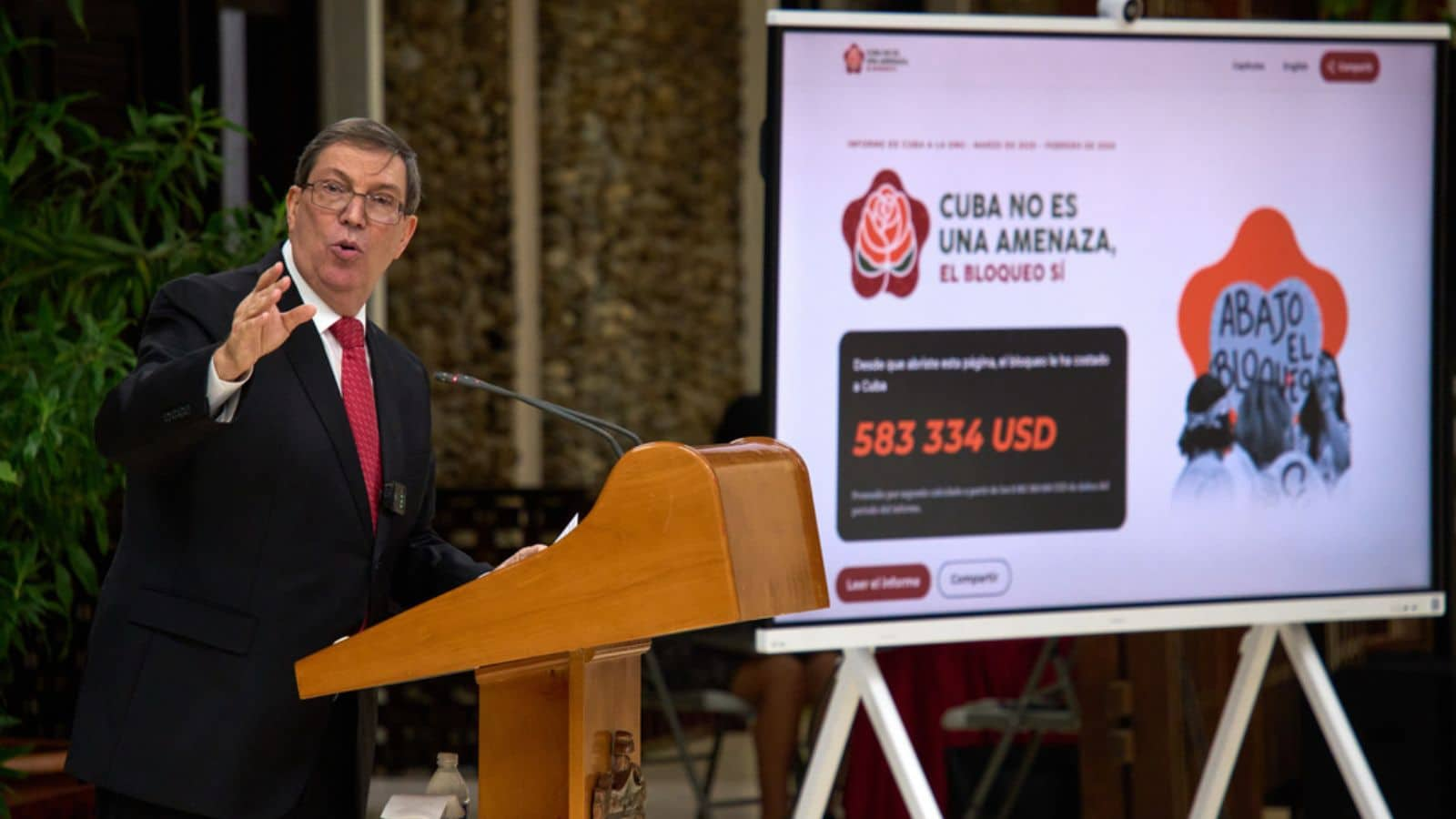
A recurring point of contention in the public exchanges involves the attribution of economic hardship. Cuban officials present an annual accounting to the UN estimating billions of dollars in cumulative economic damages, arguing that the embargo restricts access to essential medicines, medical equipment, agricultural inputs, and infrastructure financing.
The United States counters this narrative by citing explicit statutory exemptions built into the sanctions regime. Under the Trade Sanctions Reform and Export Enhancement Act of 2000 (TSREEA), the export of U.S. agricultural commodities, food, medicine, and medical devices to Cuba is legally permitted. In fact, the United States remains one of Cuba's top suppliers of poultry and agricultural products. However, economic analysts note a critical operational bottleneck: TSREEA mandates that all purchases must be conducted on a cash-in-advance basis or financed through third-country banks, prohibiting U.S. institutions from extending credit. Consequently, while legal pathways exist for humanitarian trade, severe liquidity shortages in Havana and risk-averse compliance departments at international banks create high friction costs that effectively throttle supply chains.
The Domestic Economic Reality in Cuba
While the UN debate focuses externally on U.S. policy, economists examining the Cuban economy emphasize that external sanctions interact with—and are compounded by—internal structural rigidities. Understanding the economic distress driving migration and public discontent on the island requires separating exogenous shocks from endogenous policy choices.
Cuba operates a centrally planned economy characterized by heavy state intervention, a dual-currency legacy that caused severe inflationary distortions following the 2021 monetary unification (Tarea Ordenamiento), and chronic underinvestment in core infrastructure, particularly the national electrical grid. The island's tourism sector, a primary generator of foreign exchange, has struggled to recover to pre-pandemic baselines, further constrained by U.S. restrictions on travel and the designation of Cuba on the U.S. State Sponsors of Terrorism (SSOT) list.
The SSOT designation represents one of the most consequential points of friction in the modern debate. Placed back on the list in January 2021, Cuba faces heightened scrutiny from global financial institutions. For compliance officers at European or Asian banks, the reputational and legal risk of processing a transaction linked to a designated state sponsor of terrorism vastly outweighs the minimal profit margin of Cuban trade. As a result, the SSOT designation acts as a force multiplier on the statutory embargo, isolating the island from international credit markets and complicating remittances and foreign direct investment.
Shifting Geopolitical Alignments in the Western Hemisphere
The annual UN vote does not occur in a diplomatic vacuum; it reflects broader shifts in hemispheric power dynamics. Over the past decade, the geopolitical landscape in Latin America and the Caribbean has fractured, reducing Washington's ability to build unified regional coalitions on issues concerning Havana.
- Regional Integration vs. Isolation: Latin American nations, spanning both left-leaning and centrist administrations, view the exclusion or isolation of Cuba as counterproductive to regional stability. Leaders across the region argue that economic collapse in Cuba triggers secondary crises—most notably irregular migration flows moving through Central America and Mexico toward the southern border of the United States.
- Great Power Competition: As U.S.-Cuba relations remain deadlocked, rival global powers have expanded their diplomatic and economic footprints in the Caribbean. China has become one of Cuba’s largest trading partners and creditors, restructuring debt and investing in telecommunications and energy infrastructure. Simultaneously, Russia has deepened political and security ties with Havana, utilizing high-level diplomatic visits and symbolic naval deployments to project influence in the Western Hemisphere.
- The Global South Narrative: Within the UN General Assembly, the Group of 77 (G77) and China frequently utilize the Cuba resolution to advance a broader critique of Western financial dominance and unilateral sanctions. For many developing nations, voting against the U.S. embargo is a low-cost mechanism to signal solidarity with the principle of non-interference and to register opposition to the weaponization of the U.S. dollar in international diplomacy.
The Strategic Trajectory of the Diplomatic Deadlock
The public clashes at the United Nations illustrate a fundamental misalignment of incentives that ensures the continuation of the status quo. For the Cuban government, the annual UNGA victory is a vital domestic and international propaganda asset. It allows Havana to externalize the blame for severe economic mismanagement, blackouts, and shortages onto a foreign adversary while demonstrating that the United States is diplomatically isolated on the issue.
For the United States, enduring an annual diplomatic defeat in New York is viewed as an acceptable cost compared to the domestic political repercussions of altering Cuba policy. In a closely divided U.S. electorate, particularly within key political constituencies in states like Florida and New Jersey, any unilateral concession to Havana without verifiable democratic reforms carries high electoral risk for the sitting administration and members of Congress.
Breaking this multi-decade impasse requires moving beyond the binary framework of the UN resolution. Diplomatic practitioners suggest that incremental progress depends on targeted, transactional diplomacy rather than sweeping legislative overhauls. Potential pathways include decoupling humanitarian and private-sector support from state-controlled enterprises—such as expanding banking channels specifically for Cuba's emerging micro, small, and medium-sized private enterprises (mipymes)—and negotiating bilateral cooperation on shared transnational threats, including counternarcotics, maritime safety, and orderly migration management. Until both capitals identify overlapping security or economic interests that outweigh the domestic utility of confrontation, the annual General Assembly vote will remain a predictable theater of geopolitical friction rather than a catalyst for structural change.