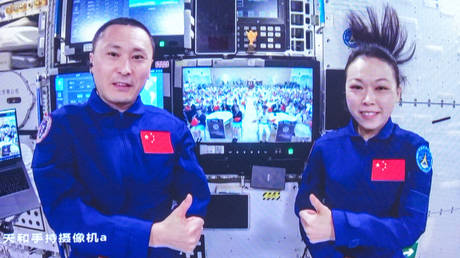
China’s decision to integrate foreign astronauts into its Tiangong space station operations is not a routine diplomatic gesture; it is the deployment of a calculated soft-power asset designed to fracture the historical Western monopoly on Low Earth Orbit (LEO). While mainstream reporting treats the arrival of non-Chinese crew members as a symbolic milestone of international cooperation, operational and strategic analysis reveals a structured effort to build an alternative aerospace bloc. By opening its orbital infrastructure to international payload specialists and mission crew, the China Manned Space Agency (CMSA) is executing a classic platform strategy—converting high-capital hardware into geopolitical influence, technical standardization, and long-term economic dependency among emerging spacefaring nations.
To understand the mechanics of this shift, one must separate diplomatic optics from orbital engineering realities. Operating a multi-modular space station requires absolute standardization across life support, docking protocols, telemetry, and crew training. When a foreign space agency commits an astronaut to a Tiangong mission, that agency is not merely buying a seat on a Shenzhou spacecraft; it is integrating its human capital and scientific payloads into the Chinese aerospace ecosystem. This creates structural path dependency. Once a nation’s researchers design experiments for Tiangong’s standardized payload racks and train their personnel in Mandarin-based command protocols at the Astronaut Center of China in Beijing, the switching costs to Western platforms like the International Space Station (ISS) or its commercial successors rise dramatically.
The Three Pillars of China’s Orbital Diplomacy
The integration of foreign crew members rests on three distinct strategic pillars: cost amortization, technical standard-setting, and geopolitical alignment. Each pillar solves a specific operational or strategic bottleneck for Beijing’s long-term space ambitions, particularly its planned International Lunar Research Station (ILRS).
1. Capital Amortization and Operational Scaling
Building and maintaining a permanent presence in LEO imposes a relentless burn rate on national budgets. While China’s state-funded model shields the CMSA from the quarterly commercial pressures faced by Western contractors, the marginal cost of adding international payloads and crew members is significantly lower than the fixed cost of launching and sustaining the core Tianhe, Wentian, and Mengtian modules. By offering flight opportunities—often subsidized or structured through bilateral resource-sharing agreements—China extracts geopolitical capital from sunken infrastructure costs.
The mechanism operates through payload-for-access swaps. Partner nations rarely pay direct cash sums comparable to commercial seat prices on SpaceX’s Crew Dragon. Instead, they contribute specialized scientific instruments, ground-station tracking support in strategic geographic locations (such as South America or Africa), or raw scientific data. This expands the scientific output of Tiangong without requiring the CMSA to fund the entire research and development pipeline for every experiment onboard.
2. Standardization as a Lock-In Mechanism
In aerospace engineering, standards dictate supply chains. For decades, the International Docking System Standard (IDSS) and NASA-derived environmental control architectures defined human spaceflight. Tiangong operates on an independent technical baseline, utilizing Chinese-designed docking mechanisms, proprietary avionics, and distinct life-support parameters.
Training foreign astronauts in China forces partner agencies to adapt to these specifications. This process involves:
- Linguistic and Procedural Assimilation: Foreign candidates must achieve operational fluency in Mandarin, as all cockpit displays, emergency checklists, and ground-control communications are conducted in Chinese. Unlike the ISS, which relies on a bilingual English-Russian operational model, Tiangong enforces a single-language command structure.
- Hardware Compatibility: Foreign scientific payloads must conform to Tiangong’s specific electrical, thermal, and data-bus interfaces. Engineers in partner countries must learn Chinese aerospace manufacturing tolerances and testing protocols to certify their hardware for flight.
- Training Pipeline Integration: Foreign crew members undergo years of centrifuge, neutral buoyancy, and survival training alongside People’s Liberation Army Astronaut Corps (PLAAC) personnel. This builds institutional trust and interpersonal networks between foreign space agencies and China’s military-industrial complex.
3. The Diplomatic Counterweight to the Wolf Amendment
The immediate catalyst for China’s independent orbital architecture was the 2011 Wolf Amendment, a U.S. legislative measure prohibiting NASA from using federal funds for bilateral cooperation with China or Chinese-owned companies. Excluded from the ISS partnership, Beijing constructed a parallel system. Welcoming foreign astronauts directly undermines the isolation intended by U.S. policy.
When astronauts from European nations, developing economies, or BRICS-aligned states fly aboard Chinese spacecraft, it normalizes China as a premier provider of human spaceflight capabilities. This creates a diplomatic wedge. European Space Agency (ESA) astronauts, for example, previously trained alongside Chinese counterparts in sea-survival exercises, signaling initial Western interest before geopolitical friction and budget constraints cooled formal ESA-CMSA crewed flight plans. As Western participation stalled, China pivoted rapidly toward developing nations—such as Pakistan, which signed formal agreements to select and train astronauts for Tiangong missions—effectively positioning itself as the primary gateway to space for the Global South.
Operational Realities and Engineering Bottlenecks
Integrating a foreign national into a closed-loop orbital habitat introduces non-trivial engineering and operational friction. Media narratives often gloss over the rigorous selection and integration phases, treating astronaut training as a formality. In practice, placing an international crew member inside a Shenzhou capsule requires solving several acute constraints.
The primary constraint is anthropometric and life-support calibration. The Shenzhou spacecraft, while derived conceptually from the Soviet Soyuz architecture, is sized and calibrated specifically for Chinese astronaut cohorts. Seat liners, pressure suits (the Feitian extravehicular suit and intravehicular pressure garments), and nutritional allocations must be custom-engineered for foreign crew members whose physical dimensions and metabolic baselines may differ significantly from domestic averages. Manufacturing custom pressure suits and shock-absorbing seat liners requires precise biometric mapping years in advance of launch, locking in flight manifests long before public announcements occur.
A second bottleneck involves data security and compartmentalization. Tiangong is managed by the China Manned Space Engineering Office, which operates under the direct purview of the People’s Liberation Army Strategic Support Force (and its successor aerospace branches). Hosting foreign nationals aboard a dual-use state asset requires strict physical and digital compartmentalization.
To manage this risk without compromising mission safety, the CMSA restricts foreign astronauts primarily to the role of payload specialist rather than command pilot or flight engineer. A payload specialist manages specific scientific experiments and routine station maintenance but does not hold command authority over the spacecraft’s navigation, propulsion, or primary life-support systems. This division of labor mirrors early NASA Space Shuttle missions involving international guests, ensuring that core operational control remains exclusively in domestic hands while granting the partner nation full public-relations credit for putting a citizen in orbit.
The Economic and Strategic Calculus for Partner Nations
For a non-spacefaring or emerging space nation, securing a flight slot on Tiangong represents a massive shortcut in capability development. Building an indigenous human spaceflight program requires tens of billions of dollars and decades of iterative failure. By partnering with China, a nation bypasses the launch-vehicle and life-support development phases entirely, moving straight to orbital experimentation and national prestige.
However, this access carries distinct strategic trade-offs that partner governments must weigh:
- Technology Transfer Asymmetry: While partner nations gain flight heritage for their experiments, China retains strict control over the core transportation and habitat technologies. Partner agencies learn how to build payloads for Tiangong, not how to build Tiangong itself.
- Western Export Control Friction: Nations that send astronauts or hardware to China risk triggering U.S. International Traffic in Arms Regulations (ITAR) restrictions. If a partner nation’s satellite or aerospace sector relies on American components, collaborating too closely with the CMSA can result in sanctions or the revocation of export licenses, effectively forcing the nation to choose between Western and Chinese supply chains.
- Intellectual Property Governance: Data generated aboard Tiangong is subject to bilateral agreements that frequently mandate data sharing with Chinese research institutions. For commercial entities or state labs developing proprietary pharmaceuticals, alloys, or biotechnology in microgravity, this creates significant intellectual property exposure.
The Shift from LEO to Lunar Infrastructure
The integration of foreign astronauts on Tiangong is a proving ground for a much larger strategic objective: the International Lunar Research Station (ILRS). Set to be constructed in the 2030s, the ILRS is China’s direct competitor to the U.S.-led Artemis Accords.
Tiangong serves as the operational testbed for the governance, legal, and technical frameworks required to run a multinational lunar base. Every foreign astronaut who flies to Tiangong validates the CMSA’s international management protocols—from liability waivers and medical emergencies in microgravity to customs clearance for international payloads and intellectual property dispute resolution. By refining these mechanisms in Low Earth Orbit, China is eliminating institutional friction ahead of deep-space operations.
The hypothesis that Tiangong will eventually replace the ISS as the sole permanent human outpost in LEO—should the ISS deorbit around 2030 before commercial replacements like Axiom Station or Orbital Reef achieve continuous operational capability—gives China a temporary monopoly window. If a gap emerges in Western LEO presence, any nation, university, or corporation seeking uninterrupted microgravity research will face a binary choice: pause human-tended orbital research or negotiate access through Beijing.
Strategic Positioning for Aerospace Stakeholders
The arrival of foreign astronauts on Tiangong signals that the bifurcation of global space infrastructure is permanent. Aerospace executives, policymakers, and research directors must adjust their long-term planning to account for two distinct, non-interoperable orbital ecosystems.
- For Emerging Space Agencies: Utilize Tiangong’s open-access payload programs to build domestic engineering heritage and train flight controllers, but maintain strict ITAR firewalls between Chinese-facing projects and Western-sourced aerospace hardware to avoid supply-chain isolation.
- For Western Commercial Space Operators: Accelerate the deployment of commercial LEO destinations (CLDs) to prevent a post-ISS operational gap. If commercial stations fail to come online before the ISS retires, China will capture the international sovereign astronaut market by default, locking in a generation of foreign scientists and flight engineers to Chinese technical standards.
- For Sovereign Policymakers: Recognize that human spaceflight seats are now primary instruments of foreign policy. Countering China’s orbital diplomacy requires offering competitive, subsidized flight opportunities and accessible payload integration pathways to developing nations, rather than relying solely on export controls and legislative restrictions to contain Beijing’s aerospace expansion.