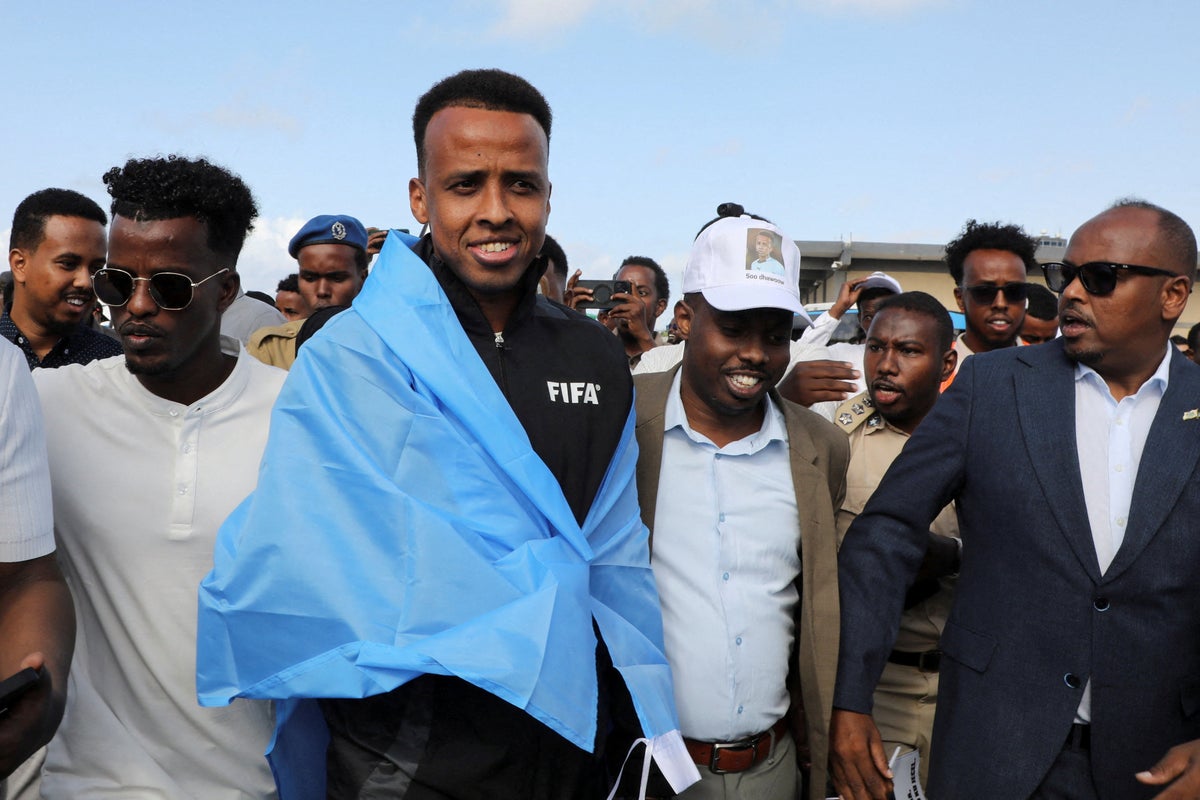
The intersection of international sports governance and sovereign border enforcement exposes a critical vulnerability in global athletic mobility: the high-reliance on individual visa security for talent originating from high-risk or politically complex jurisdictions. When a FIFA-accredited Somali World Cup referee is detained for 11 hours by United States border authorities, the incident cannot be dismissed as an isolated administrative friction. It represents a systemic breakdown at the nexus of immigration compliance, national security protocols, and international sports diplomacy.
To understand the mechanics of this operational failure—and to build a blueprint for mitigation—we must deconstruct the event through three distinct analytical lenses: the operational friction of border enforcement protocols, the geopolitical signaling of national reintegration, and the risk management framework required by international sporting bodies to safeguard their human capital.
The Operational Mechanics of High-Risk Border Enforcement
Immigration enforcement frameworks in Western nations, particularly the United States, operate on binary algorithmic and discretionary risk-scoring systems. For an international sports official holding citizenship from a nation subject to heightened security scrutiny, the entry process is governed by a strict hierarchy of compliance checkpoints. The 11-hour detention window indicates a transition from automated primary inspection to intensive secondary and tertiary evaluation.
The friction in this specific case occurs due to a mismatch between two competing institutional frameworks:
- The Athletic Mobility Framework: Driven by international governing bodies (such as FIFA or CAF), this framework treats accredited officials as neutral, global actors possessing elite institutional credentials that should theoretically expedite cross-border transit.
- The Sovereign Security Framework: Driven by national law enforcement (such as U.S. Customs and Border Protection), this framework evaluates entrants based on passport strength, country of origin risk profiles, travel history data, and biometric verification, irrespective of institutional prestige.
When these frameworks collide, the sovereign security framework invariably overrides athletic credentials. The 11-hour administrative hold serves as the baseline period required for manual interagency verification, database reconciliation, and credential authentication. This delay introduces severe operational risks for sports tournament organizers, who operate on rigid, non-negotiable event timelines. A delay of this magnitude can disrupt officiating schedules, compromise referee rotation strategies, and introduce psychological variables that affect on-field performance.
The Reintegration Mechanism and Cultural Capital Asymmetry
The post-detention phase reveals a stark asymmetry between the international perception of border friction and the domestic reception within the official's home country. The "hero's welcome" documented upon the referee's return to Somalia is not merely an emotional response; it is a calculated deployment of cultural capital and state-level signaling.
In fragile or developing states, elite sports officials function as high-value ambassadors of national capability. When such an individual faces prolonged detention by a Western superpower, the domestic political apparatus rapidly recontextualizes the incident. The homecoming event serves two strategic functions:
- Geopolitical Counter-Signaling: The state leverages the return to project resilience and national dignity, transforming an administrative degradation into a narrative of endurance and defiance against discriminatory global mobility structures.
- Institutional Validation: By officially receiving the referee, domestic sports authorities and government representatives reinforce the individual's status, neutralizing the negative stigma often associated with international deportation or extended detention.
The referee’s subsequent vow to return to international duties demonstrates the high risk-tolerance required by sports professionals from developing nations. For these individuals, the economic and professional utility of operating within the global sports market outweighs the acute personal and administrative risks of border enforcement systems.
Quantifying the Institutional Risk Matrix for Sports Governing Bodies
International sports federations currently lack a structured risk-mitigation framework for officials navigating volatile immigration landscapes. To prevent operational bottlenecks and safeguard the integrity of international competitions, organizations must transition from a reactive posture to a predictive risk management model.
The probability of border detention or entry denial can be modeled as a function of specific, quantifiable variables:
Risk Score = (Passport Tier Factor) * (Geopolitical Friction Index) + (Event Jurisdiction Complexity) - (Institutional Leverage Factor)
The components of this risk equation dictate the probability of operational disruption:
- Passport Tier Factor: The baseline mobility score assigned to the official's nationality, determined by visa-free access metrics and historical visa refusal rates.
- Geopolitical Friction Index: The real-time diplomatic tension levels between the official’s home country and the host nation, including active travel bans, sanctions, or heightened surveillance protocols.
- Event Jurisdiction Complexity: The specific legal and immigration frameworks of the host country, factoring in whether the state offers expedited sports-specific visas (e.g., P-visas in the U.S.) or relies on standard visitor classifications.
- Institutional Leverage Factor: The willingness and capacity of the governing body (e.g., FIFA) to deploy legal resources, diplomatic channels, and advance government liaison protocols to guarantee entry.
The historical reliance on the Institutional Leverage Factor has proven insufficient. As demonstrated by the 11-hour detention, even high-level athletic accreditation fails to bypass the automated and discretionary layers of modern border security when the Passport Tier Factor and Geopolitical Friction Index are highly unfavorable.
Strategic Protocols for Global Talent Preservation
To insulate international sports infrastructure from sovereign border disruptions, governing bodies must execute an immediate structural overhaul of their mobility logistics. The current laissez-faire approach, which places the burden of immigration compliance primarily on the individual official or local associations, introduces unacceptable operational vulnerability.
First, federations must establish a centralized, proactive Global Mobility and Diplomatic Liaison Unit. This unit must operate independently of standard event logistics, focusing exclusively on the pre-clearance of athletes and officials originating from high-friction jurisdictions. The unit's primary directive is to secure legally binding, pre-vetted entry guarantees from host country ministries of interior or homeland security departments at least 90 days prior to tournament commencement.
Second, sports organizations must implement a Jurisdictional Contingency Protocol. If an official's risk profile exceeds a specific threshold based on the risk score model, the organization must embed a pre-authenticated backup official from a low-friction jurisdiction into the travel itinerary. This creates a redundant operational buffer, ensuring that an 11-hour border delay does not result in a failure to field a qualified officiating crew.
Third, international sports governance must leverage its massive economic and media footprint to negotiate standardized Global Athletic Transit Credentials with major economic blocs (such as the G20 or the Schengen Area). These credentials, backed by comprehensive biometric data and institutional financial guarantees from the federations themselves, would legally bind host nations to expedited processing streams, effectively decoupling elite athletic mobility from arbitrary geopolitical fluctuations.
The alternative to these structural reforms is the progressive balkanization of international sports officiating. If the administrative cost and psychological toll of cross-border travel remain unchecked, elite talent from marginalized nations will be systematically excluded from the global stage, not due to a lack of merit, but due to the unmitigated friction of their passports. The execution of these protocols is a requirement to maintain the global legitimacy and operational continuity of international sport.