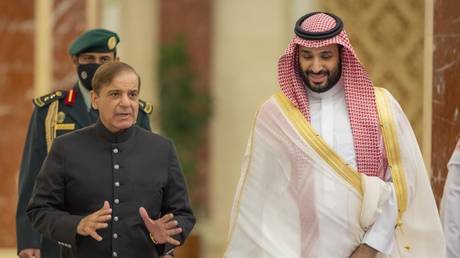
The $3 billion pledge from Saudi Arabia to Pakistan functions not as a traditional development grant, but as a sophisticated liquidity instrument designed to prevent a sovereign default while maintaining regional stability. For a nation like Pakistan, grappling with a chronic balance-of-payments crisis, these funds serve as an essential lifeline to stabilize foreign exchange reserves. However, the recurring nature of these "bailouts" signals a deeper systemic failure in domestic fiscal policy and export competitiveness. To understand the impact of this $3 billion, one must move beyond the headline figure and analyze the capital flow through three distinct analytical lenses: the Liquidity Bridge, the Geopolitical Risk Premium, and the Structural Adjustment Trap.
The Liquidity Bridge Mechanics of the Deposit
The primary function of the $3 billion infusion is the immediate fortification of the State Bank of Pakistan’s (SBP) foreign exchange reserves. This is not capital intended for infrastructure or social programs; it is a "deposit" that sits on the central bank's balance sheet to provide a psychological and financial buffer for the Pakistani Rupee (PKR).
Reserve Adequacy and Import Cover
A nation’s financial health is often measured by its import cover—the number of months it can continue to import essential goods (fuel, medicine, food) using its existing foreign currency. When reserves drop below the three-month threshold, the risk of a currency run increases exponentially.
- Exchange Rate Volatility: The deposit reduces the immediate pressure on the PKR by signaling to markets that the central bank has the "firepower" to defend the currency.
- Credit Rating Stabilization: International rating agencies (Moody’s, Fitch, S&P) view these bilateral deposits as a mitigating factor against short-term default, potentially lowering the cost of future commercial borrowing.
- IMF Signaling: Saudi Arabia’s commitment often acts as a precursor or a condition for International Monetary Fund (IMF) programs. The IMF requires "assurances" from bilateral partners that a funding gap is fully bridged before releasing its own tranches.
The Geopolitical Risk Premium
Capital in the Middle East and South Asia is rarely decoupled from strategic interests. Saudi Arabia’s willingness to provide $3 billion is a calculated investment in regional security. A total economic collapse in Pakistan—a nuclear-armed state with a population exceeding 240 million—would create a vacuum of instability that neither Riyadh nor the global community can afford.
The Security-Economy Nexus
Pakistan provides a level of military and strategic depth to the Saudi Kingdom that is difficult to quantify but essential to maintain. The "risk premium" paid by Saudi Arabia ensures that Pakistan remains aligned with Saudi interests in the Islamic world and provides a counterweight to competing regional influences. This creates a dependency loop where the lender provides just enough capital to prevent a collapse, but not enough to catalyze total financial independence, thereby maintaining leverage.
The Structural Adjustment Trap
While $3 billion sounds substantial, it is a microscopic fix for a $340 billion economy with massive external debt obligations. The fundamental problem is the gap between what Pakistan earns through exports and remittances and what it spends on imports and debt servicing.
The Debt-to-GDP Correlation
Pakistan’s external debt often exceeds 30% of its GDP. When a country relies on borrowed deposits to pay interest on previous loans, it enters a "debt treadmill."
- Productivity Deficit: The capital is used for consumption (defending the currency) rather than production (building factories or technology sectors).
- Tax Base Limitations: Without widening the tax net, the government cannot generate the internal revenue needed to buy back the foreign currency required to repay the Saudi deposit.
- Inflationary Pressures: To meet IMF conditions that often accompany these bilateral deals, Pakistan must frequently raise energy prices and taxes, which dampens domestic industrial growth.
The Mechanism of the "Rollover"
A critical detail often missed in mainstream reporting is the "rollover" mechanism. This $3 billion is rarely repaid on the initial due date. Instead, it is usually extended for another year, effectively becoming a permanent fixture of the central bank's liabilities. The "cost" of this capital is not just the interest rate—which is typically slightly above market rates for such risky deposits—but the loss of sovereign fiscal autonomy.
The Opportunity Cost of Non-Reform
The recurring availability of Saudi capital creates a "moral hazard" for Pakistani policymakers. Because there is a historical precedent for Riyadh stepping in during a crisis, there is less immediate pressure to implement the painful structural reforms required for long-term solvency. These reforms include:
- Privatization of State-Owned Enterprises (SOEs): Loss-making entities like Pakistan International Airlines (PIA) drain billions of rupees from the national budget annually.
- Energy Sector Circular Debt: The "circular debt" in the power sector—caused by inefficient transmission and low recovery of bills—acts as a black hole for government subsidies.
- Export Diversification: Pakistan remains heavily reliant on low-value-added textiles, failing to move up the value chain into technology or complex manufacturing.
The Quantitative Reality of the $3 Billion
To put the $3 billion in perspective, Pakistan’s annual external financing needs often fluctuate between $25 billion and $30 billion. The Saudi deposit covers roughly 10% to 12% of a single year’s requirement. It is a tactical maneuver, not a strategic solution.
The success of this capital infusion depends entirely on the "multiplier effect" of the confidence it generates. If the deposit leads to a successful IMF review, which in turn unlocks funding from the World Bank, Asian Development Bank, and private markets, the $3 billion acts as a catalyst for a total package of $10 billion to $15 billion. If the government fails to use this breathing room to implement reforms, the $3 billion will be evaporated within months by the trade deficit.
Strategic Path Toward Solvency
The only viable path forward involves transitioning from a "deposit-based" relationship to an "investment-based" relationship. Recent shifts indicate that Saudi Arabia is moving toward this model through the Special Investment Facilitation Council (SIFC) in Pakistan.
Future capital flows must be directed toward equity stakes in mines, refineries, and agricultural projects rather than central bank deposits. This shifts the risk-sharing mechanism: Saudi Arabia gains assets with long-term upside, and Pakistan receives capital that does not add to its debt stock. Until this transition is complete, the $3 billion pledge remains a temporary bandage on a systemic wound, buying time but not buying a future.