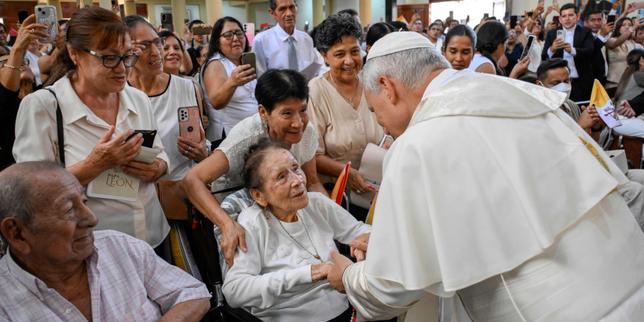
The triumphant reception of Pope Leo XIV in the Diocese of Chiclayo, Peru, is not a sentimental footnote in a standard apostolic journey. It is a calculated deployment of institutional capital designed to stabilize the Catholic Church in Latin America. While mainstream coverage frames the event around the local sentiment that the pontiff is "coming home," an operational analysis reveals a deliberate three-part strategy: consolidating regional legitimacy, deploying localized pastoral familiarity to bypass bureaucratic friction, and re-anchoring Vatican influence in a territory facing rapid demographic and ideological shifts.
Understanding this visit requires stripping away ceremonial reporting and examining the structural mechanics of the modern papacy. Robert Francis Prevost, elevated to the Chair of Saint Peter as Pope Leo XIV after serving as Bishop of Chiclayo from 2015 to 2023 and subsequently leading the Dicastery for Bishops, possesses a rare dual-identity asset. He combines Roman curial authority with authentic, ground-level Peruvian episcopal credibility. Returning to northern Peru transforms a personal biography into an institutional instrument.
The Architecture of Localized Legitimacy
In global organizations, leadership legitimacy often suffers from distance decay. Directives issued from a central headquarters lose operational force as they travel toward peripheral territories. The Catholic Church experiences this friction acutely across Latin America, where secularization, the rise of Pentecostal movements, and internal ideological polarization have eroded historical monopolies on religious adherence.
Pope Leo XIV's return to Chiclayo directly counters distance decay through what organizational theorists term embedded authority. Unlike previous papal visits that relied entirely on the abstract prestige of the office, this homecoming activates pre-existing relational networks.
- Biographical Verification: The population of the Lambayeque region does not view Leo XIV solely through the lens of Vatican media. They remember his direct administration during crises, including the 2017 El Niño Costero floods and the COVID-19 pandemic.
- Linguistic and Cultural Fluency: Operating in Spanish with northern Peruvian vernacular eliminates the diplomatic buffer that typically separates a pontiff from local congregations.
- Institutional Continuity: By validating his former diocese as a primary stop, the Pope signals that peripheral dioceses are not merely administrative outposts, but foundational centers of Church governance.
This mechanism produces an immediate asymmetric advantage. Where a standard papal visit requires months of artificial mobilization to generate enthusiasm, Chiclayo functions as a self-activating base. The "coming home" narrative observed by reporters is the visible output of eight years of prior administrative investment.
The Three Pillars of the Chiclayo Operational Model
To understand why the Vatican prioritized this specific location, one must deconstruct the pastoral and administrative methods Leo XIV established during his tenure as Bishop of Chiclayo, which he is now scaling to a global level.
1. Decentralized Episcopal Governance
During his leadership of the Dicastery for Bishops prior to his election, Prevost championed a selection profile favoring pastors with direct missionary experience over career diplomats. Returning to Chiclayo serves as a live demonstration of this standard. The diocese acts as a physical proof-of-concept for synodal governance—a model emphasizing consultation, shared responsibility, and listening at the local level before centralizing decisions in Rome. By elevating Chiclayo onto the global stage, the pontiff visually defines the exact episcopal behavior he expects from bishops worldwide.
2. Crisis-Tested Social Infrastructure
Northern Peru is structurally vulnerable to climate shocks and economic volatility. Between 2015 and 2023, the Diocese of Chiclayo operated not merely as a liturgical center, but as a critical logistics hub for humanitarian relief, oxygen distribution during health emergencies, and migrant support along the Pan-American Highway corridor. Highlighting this region allows the papacy to emphasize practical social doctrine over abstract theological debates. It shifts the institutional focus toward measurable material aid and community resilience.
3. The Augustinian Synthesis
As a former Prior General of the Order of Saint Augustine, Leo XIV brings a specific organizational philosophy rooted in communal life and intellectual rigor. In Chiclayo, this manifested as a deliberate balancing act between traditional Marian piety—deeply ingrained in northern Peruvian culture through devotions like the Cruz de Motupe—and modern social engagement. The homecoming reinforces a theological middle ground: preserving popular religious traditions while steering the institutional Church toward structural reform.
Managing the Friction of Familiar Territory
High-visibility homecomings carry inherent operational risks that standard diplomatic coverage routinely overlooks. When a global leader returns to a former local post, expectations distort normal institutional boundaries.
The primary risk is localized clientelism. Local civic leaders, regional politicians, and diocesan factions inevitably attempt to convert personal proximity to the Pope into political currency or preferential treatment. Peru's chronic political instability—characterized by rapid presidential turnovers, institutional distrust, and regional fragmentation—amplifies this hazard. Any perceived endorsement of local political actors threatens to entangle the Holy See in domestic Peruvian governance disputes.
The second limitation involves administrative overshadowing. A sitting Bishop of Chiclayo must govern the diocese long after the papal aircraft departs. A triumphant return by a beloved predecessor can inadvertently undermine the current ordinary's authority, creating a shadow hierarchy where local clergy and laity benchmark every current decision against the memory of the pontiff's previous tenure.
To mitigate these risks, Vatican protocol relies on strict liturgical framing. By anchoring public appearances in universal Catholic rituals rather than civic ceremonies, the papal entourage converts personal nostalgia into collective religious identity. The emotional energy of the crowd is deliberately redirected from the individual biography of Robert Prevost to the universal office of Leo XIV.
The Strategic Calculus for Latin American Catholicism
The broader objective of the Chiclayo visit extends well beyond Peru's borders. Latin America remains the demographic center of gravity for the global Catholic Church, yet it is also the region experiencing the fastest rate of religious switching.
- Countering Institutional Attrition: Protestant evangelical and Pentecostal churches succeed in Latin America largely because their leadership is intensely local, accessible, and culturally indistinguishable from their congregations. A Pope who is a naturalized Peruvian citizen and former diocesan bishop directly neutralizes the critique that the Catholic Church is a distant, European-dominated bureaucracy.
- Stabilizing the Peruvian Episcopate: The Catholic Church in Peru has endured severe internal fractures over the past decade, including high-profile scandals involving lay movements such as the Sodalitium Christianae Vitae, which required direct Vatican intervention and eventual suppression. Leo XIV was intimately involved in managing these crises during his time in Peru and Rome. His authoritative presence in Chiclayo projects absolute clarity regarding canon law, accountability, and the restoration of ecclesiastical discipline.
- Recalibrating the Social Doctrine: Rather than engaging in partisan ideological battles, the Chiclayo framework prioritizes foundational human security: clean water, disaster preparedness, healthcare access, and educational continuity. This pragmatic orientation appeals to working-class populations alienated by polarized political rhetoric.
Known Facts Versus Analytical Projections
Distinguishing between verified events and strategic projections is essential when evaluating papal diplomacy.
Verified Operational Facts:
- Pope Leo XIV possesses both U.S. birthright citizenship and naturalized Peruvian citizenship, having spent decades in Peru as a missionary, seminary educator, and bishop.
- His appointment to lead the Dicastery for Bishops in 2023 placed him in direct control of global episcopal nominations immediately prior to his election to the papacy.
- The Diocese of Chiclayo encompasses a demographically diverse coastal and Andean territory that serves as an economic and migratory crossroads in northern Peru.
Strategic Hypotheses:
- The selection of Chiclayo as an early destination signals an intent to accelerate the appointment of missionary-background bishops across the Global South.
- The Vatican is utilizing the Peruvian model of Church-state cooperation—specifically regarding disaster relief and social services—as a template for other developing nations facing climate-induced displacement.
- The emotional resonance of the homecoming is being leveraged internally within the Roman Curia to demonstrate popular mandate support for ongoing governance reforms.
The Strategic Play for Institutional Leadership
The events in Chiclayo offer a definitive blueprint for any global institution attempting to arrest peripheral decline and restore central authority. Relying on top-down mandates or abstract branding campaigns fails when local populations feel disconnected from decision-making centers.
Institutional leaders must execute three specific maneuvers to replicate this stabilizing effect:
- Promote From the Periphery: Elevate leaders who have successfully managed complex, resource-constrained regional operations rather than those whose careers were built exclusively within central headquarters. Operational credibility cannot be manufactured after appointment; it must be imported from the field.
- Convert Personal Trust into Institutional Capital: When a leader possesses deep regional loyalty, structure public engagements to transfer that trust onto the broader organization and its current local managers, strictly insulating the institution from regional political co-optation.
- Anchor Messaging in Material Utility: Replace abstract institutional rhetoric with visible alignment around crisis response, infrastructure resilience, and practical community support. Legitimacy in volatile territories is secured through demonstrated operational utility, not ceremonial presence.