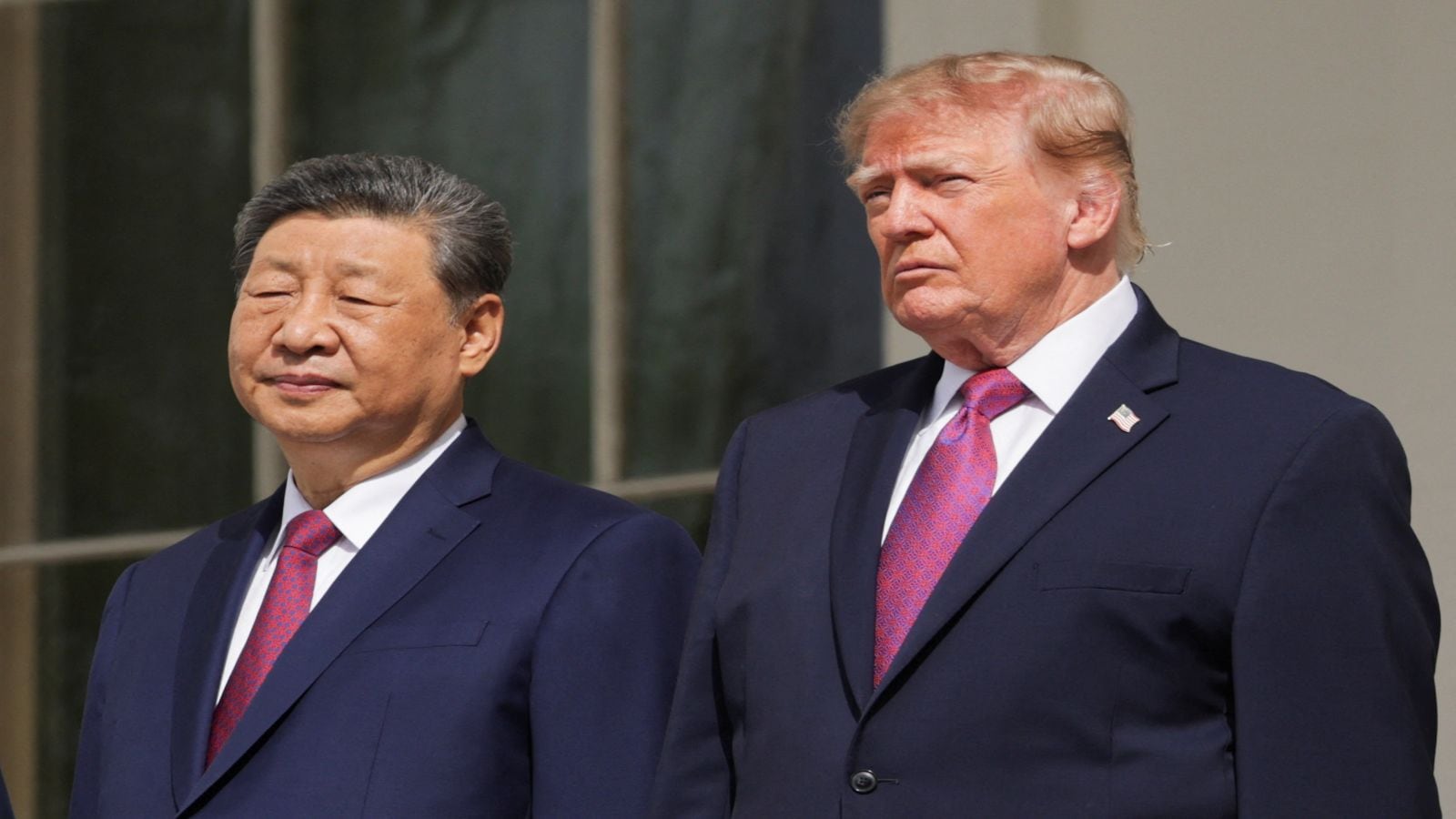
Beijing's directive to invite 50,000 young Americans to China over a five-year window represents a calculated deployment of soft power designed to counter structural decoupling in US-China bilateral relations. Announced by Chinese President Xi Jinping during the November 2023 APEC summit in San Francisco, this initiative—frequently reported in South Asian media as "1 lakh" (100,000) due to metric translation errors or conflations with broader global youth targets, though the official bilateral target for the United States is strictly 50,000—functions as a long-term human capital investment. Rather than relying solely on state-to-state negotiations, which remain deadlocked over trade tariffs, semiconductor export controls, and security competition in the Indo-Pacific, Beijing is attempting to build a future cohort of American professionals, policymakers, and business leaders with direct, favorable exposure to Chinese society.
The Structural Deficit in Bilateral Human Capital
To understand the mechanics of this initiative, one must first examine the baseline collapse in educational and cultural exchanges between Washington and Beijing. During the 2018–2019 academic year, roughly 11,600 American students studied in China. By 2023, following three years of strict zero-COVID border closures and escalating geopolitical friction, that number had plummeted to fewer than 800. Meanwhile, approximately 290,000 Chinese students remained enrolled at American universities. For a deeper dive into this area, we recommend: this related article.
This extreme asymmetry creates a strategic vulnerability for Beijing. When American students, researchers, and early-career professionals stop traveling to China, the pipeline of "China hands"—individuals within the US private sector, academia, and government who possess nuanced, firsthand operational knowledge of the country—dries up. Without this cohort, American institutional decision-making becomes increasingly driven by threat-centric security frameworks rather than commercial or diplomatic pragmatism.
Beijing's 50,000-student target is an attempt to artificially restart this pipeline. By subsidizing travel, tuition, and cultural programming, the Chinese state lowers the financial and logistical barriers to entry that currently deter American youth. For additional details on this issue, comprehensive reporting can be read on Reuters.
The Three Pillars of Beijing's Exchange Architecture
The execution of this initiative relies on three distinct operational mechanisms, moving away from traditional, multi-year university degree programs toward high-volume, short-duration exposure.
1. Short-Term Immersion and Study Tours
Because convincing American undergraduates to commit to full-year or multi-year degree programs in China faces high friction—driven by parental safety concerns, US State Department travel advisories, and credit-transfer hurdles—Beijing has shifted the core metric of the 50,000 target toward short-term visits. Programs such as the "Young Envoys Scholarship" (YES) focus on one-to-four-week summer camps, athletic exchanges, and cultural tours. This high-throughput model allows Chinese institutions to process thousands of participants annually while maintaining strict curation over itineraries, ensuring visitors experience China's modern infrastructure, high-speed rail, and urban safety without encountering domestic political sensitivities.
2. Sub-National and Institutional Pairing
Recognizing that federal-level diplomatic channels in Washington are heavily policed by bipartisan hawkishness, the exchange strategy routes around the US federal government. Chinese provincial governments, municipal authorities, and state-backed associations (such as the Chinese People's Association for Friendship with Foreign Countries) are paired directly with American high schools, community colleges, state universities, and local youth sports organizations. By anchoring exchanges at the sub-national level, Beijing reduces the political visibility of the programs while embedding goodwill within local American communities.
3. Targeted STEM and Innovation Exposure
While cultural diplomacy forms the broad base of the funnel, a narrower track targets university students in science, technology, engineering, and mathematics (STEM). By inviting American engineering and business cohorts to visit Chinese tech hubs like Shenzhen, Hangzhou, and Shanghai, Beijing aims to counter the narrative of a stagnating Chinese economy. Demonstrating supply-chain dominance in electric vehicles, green energy, and consumer electronics serves to convince future American innovators that decoupling from China carries a high opportunity cost.
Friction Points and Execution Bottlenecks
Despite strong state backing and significant financial subsidies, the initiative faces severe structural headwinds that limit its conversion rate from raw attendance to long-term diplomatic influence.
- The Information Environment Mismatch: American students accustomed to an open internet encounter immediate friction upon arriving in China due to the Great Firewall. While universities and tour organizers frequently provide workarounds or restricted access, the stark contrast in digital governance and speech norms often reinforces, rather than softens, American skepticism toward the Chinese political system.
- US Regulatory and Security Pushback: In the United States, academic engagement with China is increasingly viewed through a counterintelligence lens. Federal funding restrictions, heightened scrutiny of foreign gifts to American universities, and congressional investigations into Confucius Institutes have made US university administrators risk-averse. Many institutions hesitate to sign formal memoranda of understanding with Chinese counterparts out of fear of losing federal research grants.
- The Travel Advisory Constraint: The US Department of State's travel advisories for mainland China—which highlight the risk of arbitrary enforcement of local laws and exit bans—create substantial liability concerns for American educational institutions. University legal counsel and insurance providers frequently block or restrict institutional sponsorship of student travel, forcing Chinese organizers to recruit individuals or smaller, independent cohorts rather than entire university departments.
- Asymmetric Reciprocity: Critics in Washington point out that while Beijing actively courts American youth to build soft power in the US, foreign journalists, non-governmental organizations, and independent researchers face severe operational restrictions inside China. This lack of reciprocity fuels domestic political backlash in the US, framing the exchanges as one-sided influence operations rather than mutual scholarly inquiry.
Strategic Implications for Bilateral Relations
The 50,000-youth exchange program will not alter the structural drivers of US-China strategic competition; it will not resolve disputes over the Taiwan Strait, the South China Sea, or advanced semiconductor manufacturing. Those domains are governed by hard power balances and core national security interests.
Instead, the program operates as a long-term hedging strategy. Beijing is betting that even if only 5 to 10 percent of the 50,000 participants develop a sustained professional interest in China—entering careers in cross-border trade, international law, finance, or diplomacy—that cohort will act as a stabilizing ballast in future bilateral crises. For American institutions and policymakers, the optimal response is neither blanket prohibition nor uncritical participation. US universities and civic organizations should engage with these exchanges to rebuild America's depleted pool of China-literate specialists, while establishing clear institutional guardrails regarding funding transparency, academic freedom, and data security to ensure that educational access does not compromise institutional independence.