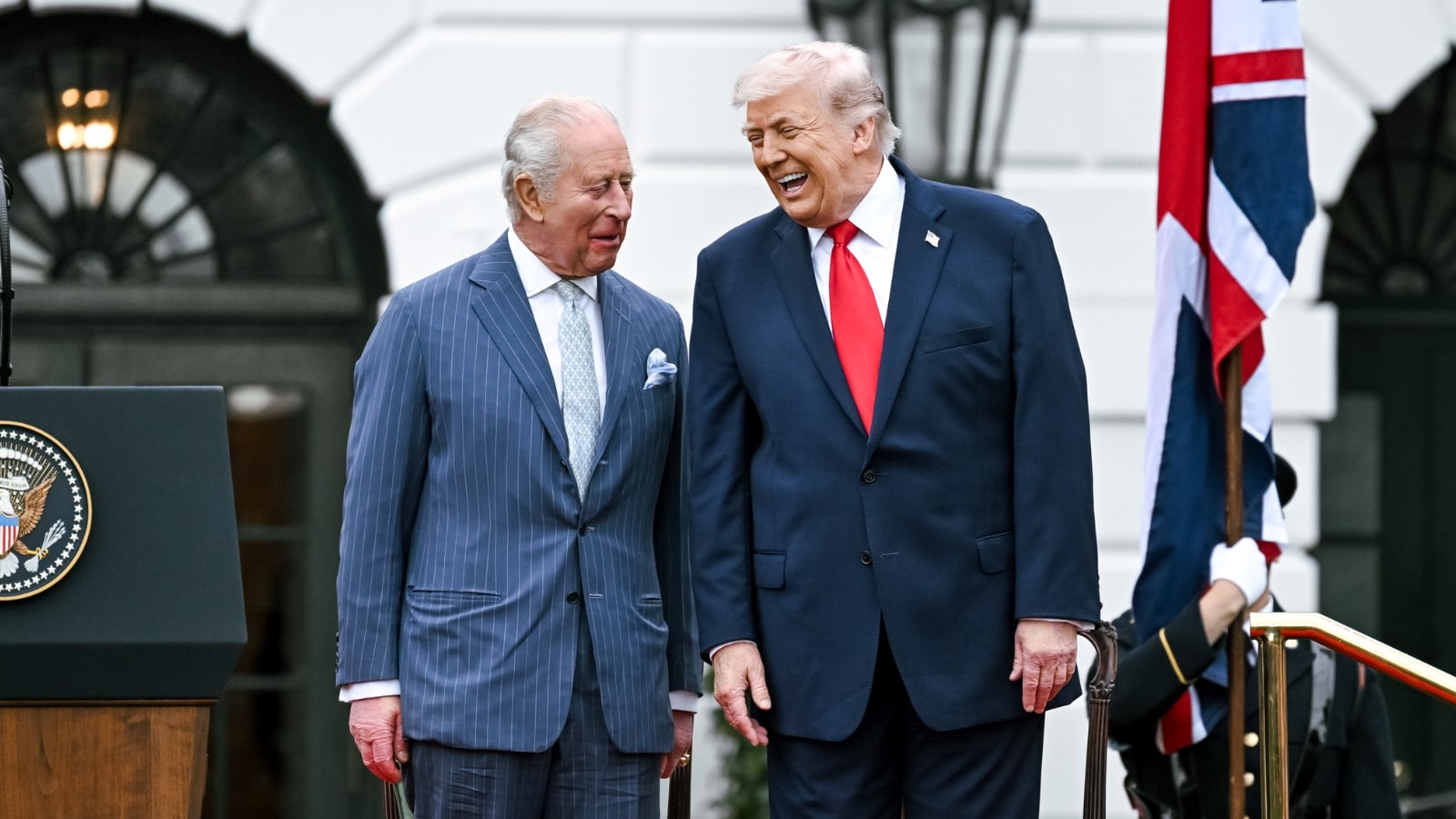
The convergence of a British monarchical state visit and a U.S. presidential transition creates a rare intersection of constitutional symbolism and raw political theater. When King Charles III engages with both a sitting administration and a former president—labeled by some as a meeting of "Two Kings"—the event moves beyond mere ceremony into a high-stakes negotiation of soft power. The strategic objective for the United Kingdom is the maintenance of the "Special Relationship" across volatile electoral cycles, while the U.S. actors use the monarch as a validator of their own legitimacy.
The Triangulation of Diplomatic Capital
The visit operates within a three-party framework where each entity seeks to maximize distinct forms of influence.
- The Crown's Neutrality Mandate: For King Charles, the primary constraint is the constitutional requirement for non-partisanship. Any interaction with Donald Trump must be calibrated to avoid the appearance of endorsing a specific American political movement, yet ignoring a leading political figure (and former president) risks alienating a potential future administration.
- The White House Continuity Strategy: The Biden-Harris administration utilizes the "Two Kings" rhetoric as a tactical maneuver. By framing the meeting in terms of historical grandeur and state-level dignity, they attempt to co-opt the prestige of the monarchy to bolster their own standing as the "adults in the room" of global diplomacy.
- The Trump Validation Loop: For Donald Trump, the meeting serves as a visual proof-of-concept for his "America First" diplomacy. By positioning himself alongside a monarch, he signals to his base that he remains a global peer to traditional centers of power, bypassing standard State Department channels.
The Mechanics of Symbolic Validation
Monarchical visits are not merely social calls; they are deployments of a specific asset class: Sovereign Legitimacy. Unlike political power, which is contingent and ephemeral, sovereign power is rooted in continuity. When a U.S. political figure stands next to the King, they are attempting to "borrow" that continuity.
The "Two Kings" descriptor used by White House insiders is a linguistic tool designed to equate the democratic executive with the hereditary sovereign. This creates a psychological parity. However, the risk for the British side is "Legitimacy Dilution." If the King is seen as a prop for domestic U.S. political campaigning, the value of the British Crown as a neutral diplomatic tool is compromised.
The Friction of Protocol vs. Populism
The protocol governing a royal visit is rigid, governed by the "Precedence of States." Conversely, modern U.S. politics is increasingly defined by "Disruptive Engagement."
- Standard Protocol: Interaction is filtered through the Foreign, Commonwealth & Development Office (FCDO).
- Disruptive Reality: Direct communication between the Trump camp and the Palace creates a secondary, unofficial diplomatic track.
This dual-track system produces a "Signal Noise" problem. The official state dinner communicates one message (stability and alliance), while a private meeting at Mar-a-Lago or a neutral site communicates another (alignment with nationalist-populist movements). This creates a bottleneck for UK diplomats who must ensure that the King’s presence does not inadvertently influence U.S. voter perception or violate the Logan Act implications for the American side.
The Economic and Environmental Subtext
Beyond the optics, the visit focuses on the "Carbon Diplomacy" framework. King Charles has spent decades building a brand around environmental stewardship. This creates a specific point of tension with the Trump platform, which has historically prioritized deregulation and fossil fuel expansion.
The interaction is therefore a test of Ideological Hedging.
The King's team must decide whether to:
- Pivot to Universalism: Stick to broad themes of "shared history" and "cultural ties" to avoid policy friction.
- Engage in "Soft Persuasion": Use the King's personal relationship with Trump to advocate for specific environmental targets, treating the monarch as a high-level lobbyist for global climate goals.
The data suggests that the latter is more risky but provides a higher return on influence. If the King can secure a rhetorical commitment to conservation from a climate-skeptic leader, it proves the utility of the monarchy in the 21st century.
Analyzing the "Two Kings" Narrative
The phrase "Two Kings" is an oxymoron in the context of American democracy. The United States was founded on the rejection of kingship. For a White House to use this terminology suggests a shift toward a "Great Man" theory of history, where the personal rapport between leaders supersedes institutional agreements.
This shift has profound implications for the UK-US trade relationship. If diplomatic progress becomes dependent on the personal "vibe" between a King and a President, the institutional safeguards of the Civil Service and the State Department are weakened.
The Cost-Benefit of Royal Presence
| Variable | Benefit to UK | Benefit to US (Admin) | Benefit to US (Opposition) |
|---|---|---|---|
| Visibility | High: Reaffirms global relevance post-Brexit. | Moderate: Diverts news cycle from domestic woes. | High: Provides "Presidential" imagery. |
| Trade Leverage | Low: Monarchs do not negotiate tariffs. | Low: Purely symbolic. | N/A |
| Soft Power | Maximum: The "Royal Brand" remains the UK's top export. | Moderate: Associations with "class" and "history." | Maximum: Validates their standing as a peer. |
The Strategic Recommendation for the Palace
The Palace must execute a "Functional Decoupling." They should treat the official White House engagement as the legal visit and any engagement with Trump as a historical courtesy.
To maintain the integrity of the Crown, the King’s advisors should prioritize "Thematic Consistency" over "Political Accommodation." The King should lead with his signature issues—sustainability, youth opportunity, and urban planning—regardless of the political leanings of his host. By doing so, he remains a constant variable in a sea of political fluctuations.
The ultimate play for the British government is to use this visit to secure a "Transatlantic Continuity Memorandum." While not a formal treaty, the visibility of the King with both sides of the American political divide forces a public recommitment to the alliance. In an era of isolationism, the King is the only figure capable of making "Internationalism" look like a tradition rather than a policy choice.
The success of this visit will not be measured in headlines, but in the lack of diplomatic fallout. If King Charles departs the U.S. without being branded as "pro-Trump" or "pro-Biden," he will have successfully preserved the Crown's utility as the ultimate tool of British statecraft. The "Two Kings" moniker should be treated as a warning: when the line between sovereign and politician blurs, the sovereign loses their most valuable asset—their permanence.