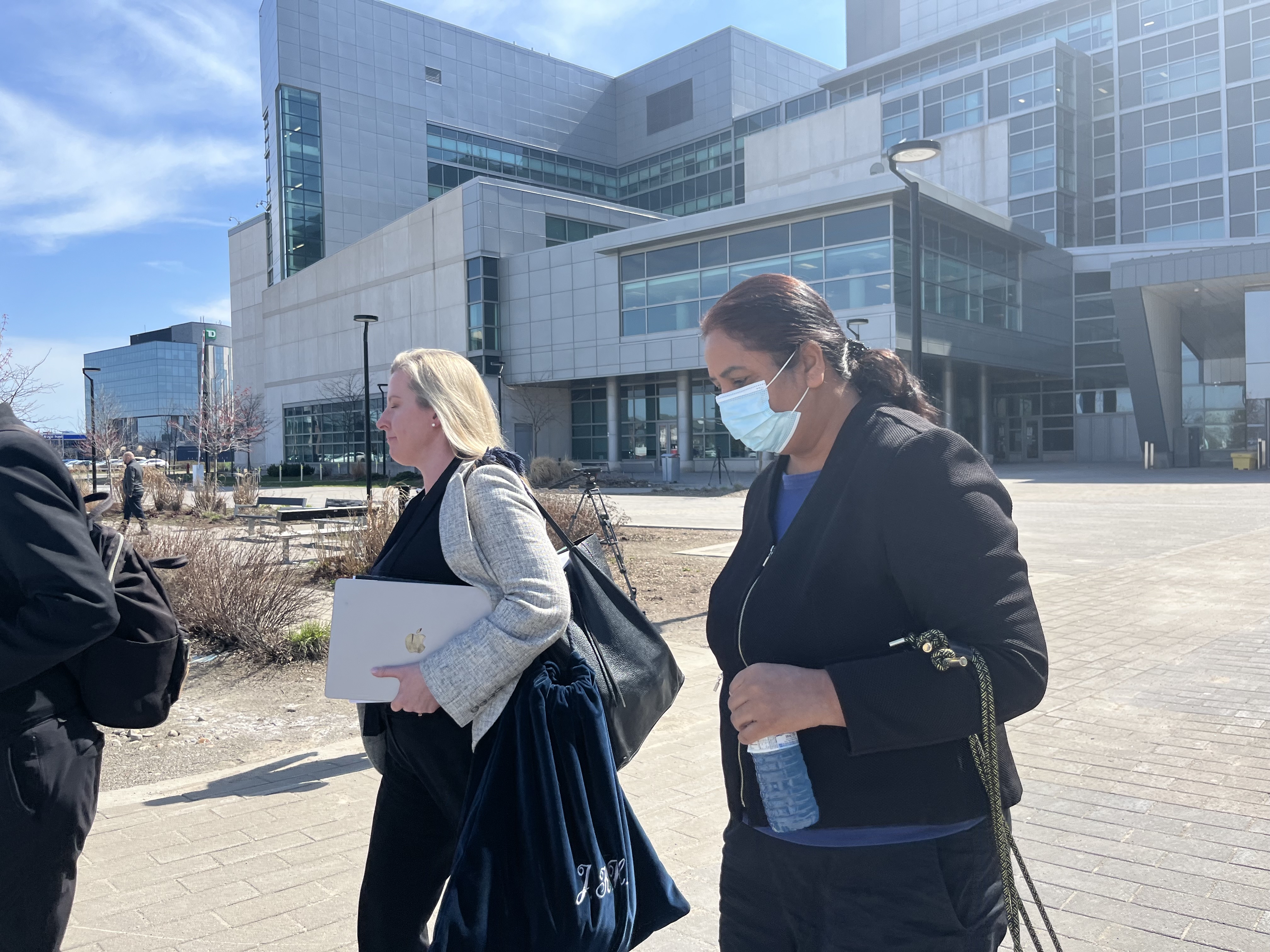
The courtroom in Brampton smells of floor wax and stale coffee, a sterile backdrop for a story about metal, momentum, and the terrifying fragility of a second. At the center of the room sits a bus driver. To the crown, she is a vessel of negligence. To the defense, she is a victim of a machine that betrayed its master. But to the families who watched a MiWay bus plow into a line of stopped cars on a clear June afternoon in Mississauga, she is the face of an afternoon that never ended.
It happened at 11:00 AM. The sun was out. The asphalt was dry. There was no ice, no blinding rain, no sudden deer darting across Derry Road. There was only a massive white-and-green transit bus that refused to stop. It didn't just clip the cars ahead; it swallowed them. By the time the dust settled, one woman was dead, and eight others were left picking glass out of their skin.
Now, the lawyers are finishing their work. They are weaving two entirely different realities out of the same wreckage. One reality blames a foot that pressed the wrong pedal. The other blames a mechanical ghost.
The Weight of Eight Tons
To understand the trial, you have to understand the physics of a city bus. These are not cars. They are kinetic battering rams. When a driver sits behind that oversized wheel, they aren't just navigating traffic; they are managing a massive amount of potential energy.
The prosecution’s case is built on a simple, devastating theory: human error. They argue that the driver, perhaps distracted or momentarily confused, hit the gas when she meant to hit the brake. It is a mistake we have all nearly made in a parking lot, that sudden jolt of adrenaline when the car lunges forward instead of slowing down. But in a parking lot, you hit a shopping cart. On Derry Road, you hit a line of people waiting for a red light.
The crown pointed to the data. Modern buses are rolling black boxes. They record every input, every flick of a switch, every dip of a pedal. According to the telemetry presented in court, there was no record of the brake being applied in those final, horrific seconds. Instead, the sensors registered a wide-open throttle. The bus did exactly what it was told to do. It accelerated.
The Mechanic’s Nightmare
Then the defense stood up, and the narrative shifted from a story of a careless driver to a story of a failing machine.
They spoke of "intermittent faults." They spoke of the way a heavy-duty air brake system can feel under a foot when something goes wrong deep inside the pneumatic lines. If you have ever felt a brake pedal go soft or "vibrate" in a way that suggests the car is thinking for itself, you know the cold spike of fear that follows.
The defense argues that the driver was pumping the brakes, desperate to find a bite that wasn't there. They suggest that the bus's computer system—the very thing the crown relies on for "truth"—might have been the one lying. Imagine standing on a platform, screaming for help, while a machine calmly records that you are silent. That is the haunting image the defense wants the jury to take home. They brought in experts to talk about mechanical failures that don't always leave a trail in the digital logs. They want us to believe in the possibility of a "glitch" that is more powerful than a human will.
The Woman in the Middle
Strip away the talk of telemetry and tread depth, and you are left with a human being whose life changed in a heartbeat. The driver has spent the trial watching videos of her own bus becoming a weapon. In the footage, there is no screech of tires. There is no swerve. There is only a steady, relentless march into the back of a red Hyundai.
The driver testified that she did everything she could. She remembers the panic. She remembers the feeling of the bus surging. In her mind, she is not a killer; she is a survivor of a mechanical betrayal.
But the prosecution doesn't deal in memories. They deal in the cold, hard geometry of the crash. They showed the court how the bus didn't just roll; it accelerated. If the brakes had failed, why did the engine roar? To believe the driver, you have to believe that the bus suffered two simultaneous, catastrophic, and nearly impossible failures: the brakes vanished, and the throttle stuck open, all while leaving no electronic footprint of the struggle.
The Invisible Stakes of the Commute
We trust our lives to strangers every morning. We sit on those plastic bus seats, scrolling through our phones, never looking at the person in the high-backed seat at the front. We assume the systems are robust. We assume the training is flawless.
This trial isn't just about one crash in Mississauga. It’s about the terrifying realization that our safety is a thin veil. We are either at the mercy of a human mind that can snap or drift at the worst possible moment, or we are at the mercy of complex machines that we don't fully understand.
The families of the victims sat in the gallery, day after day. For them, the technicalities of air brake lag or pedal misapplication are secondary to the hole left in their lives. They are looking for an answer that makes sense of the senseless. They want to know if the woman behind the wheel was careless, or if the city that sent her out in that bus failed them all.
The Final Seconds
The closing arguments are over. The jury has been given two maps. One leads to a verdict of criminal negligence, a statement that a human failed her duty of care. The other leads to an acquittal, a statement that we live in a world where machines can fail in ways we can’t prove.
Think about the last time you sat at a red light. You probably didn't look in your rearview mirror. You probably felt safe because the world was functioning as it should. The cars were stopped. The light was red. The rules were being followed.
Then, the sound of an engine revving.
The bus is still there in the impound lot, a mangled heap of steel and shattered glass. It holds its secrets tight. Whether it was a foot that slipped or a computer that blinked, the result remains the same. A woman who was just driving home is gone, and a driver is left waiting for twelve strangers to tell her who she really is: a criminal, or a witness to a ghost in the machine.
The jury walked out of the room, leaving a heavy, expectant silence behind. In that silence, the only thing that remains clear is that on a sunny morning in June, the safety we take for granted vanished in the time it takes to blink.