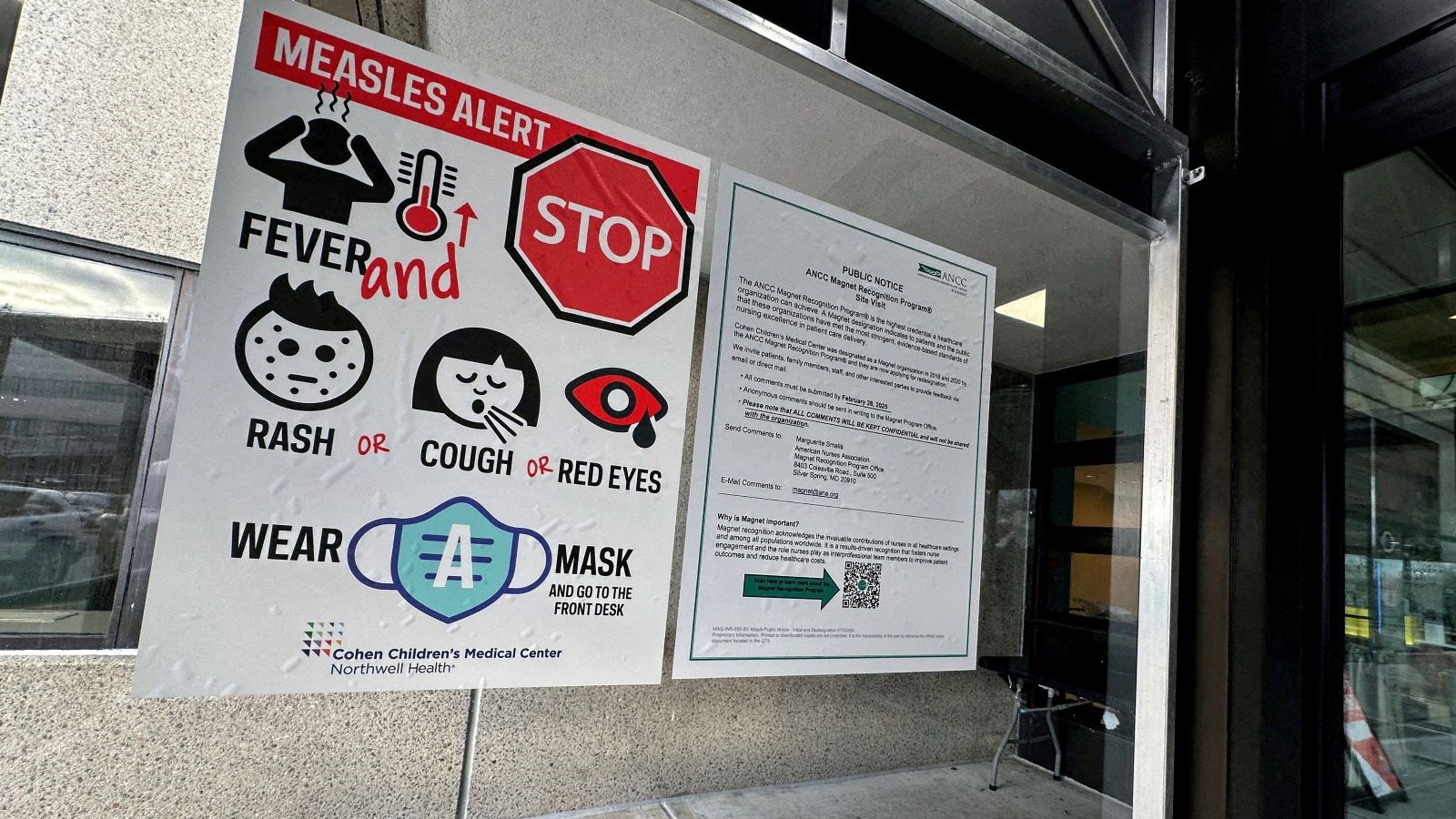
The waiting room smells like lemon floor cleaner and wet wool. It is a Tuesday morning in late autumn, and a woman named Elena—let’s call her Elena, though she is sitting in a dozen pediatric clinics across the Midwest right now—is holding a seven-month-old boy who feels like a radiator wrapped in a fleece blanket.
He is too young for the shot. That is the detail that turns a routine fever into a slow-motion terror. Under the standard schedule, a child does not receive their first dose of the measles, mumps, and rubella vaccine until their first birthday. For twelve months, an infant moves through grocery aisles, airport terminals, and library story hours entirely unarmored, relying on an invisible agreement made by every stranger breathing the same air.
For twenty-six years, that agreement held.
In the year 2000, the United States achieved something that previous generations would have considered a miracle on par with landing on the moon: the official elimination of measles. Elimination does not mean the virus vanished from the earth. It means the chain of transmission was broken within our borders. A traveler might carry the infection home from abroad, spark a brief flare-up, and watch it sputter out against a wall of immunity before twelve months could pass. A quarter-century of quiet. A quarter-century in which most American doctors went their entire careers without ever seeing the signature brick-red rash blooming behind a child’s ears, or the tiny white Koplik spots inside a cheek that look like grains of salt thrown onto red velvet.
Then, recently, the quiet broke. Sustained transmission returned, stretching past the twelve-month threshold, stripping the United States of its measles-free status after twenty-six years.
To understand what was lost, you have to stop looking at public health charts and start looking at the air in Elena’s waiting room.
The Physics of an Invisible Room
Most people think of contagion like a spilled drink. You touch a contaminated doorknob, rub your eye, and catch a cold. Measles does not play by those rules. Measles is an airborne ghost.
Imagine a smoker standing in the center of a closed room, exhaling a single, thick cloud of smoke. Now imagine that even after the smoker walks out the door, locks it, and drives across town, that smoke stays suspended in the air—potent, active, and waiting—for up to two hours. If you walk into that empty room ninety minutes later and take a single breath, you inhale it.
Epidemiologists measure contagiousness using a metric called the basic reproduction number, or R0. Seasonal flu hovers around 1 or 2. COVID-19, in its early variants, sat near 3. Measles sits between 12 and 18. If one infected person walks into a room of unprotected people, up to eighteen of them will walk out carrying the virus. Nine out of ten susceptible people who share airspace with an infected person will catch it. There is no partial exposure. There is no "mild brush" with the mechanics of transmission.
I remember the first time I truly understood what that number meant in practice. Years ago, during a localized outbreak, I sat across from a pediatric infectious disease specialist who had spent three weeks tracing a single exposure path through a suburban urgent care clinic. She spread a hand-drawn floor plan across her desk—exam rooms, hallways, the reception desk, the checkout counter—and marked the timeline with red highlighter. A child had coughed in the lobby at 10:15 AM. By 11:40 AM, a toddler who never came within thirty feet of that child, who arrived an hour after the first family had already driven home, breathed in the lingering air near the magazine rack. Twelve days later, that toddler was in intensive care with viral pneumonia.
"People think immunity is a personal raincoat," she told me, tapping the red ink on the paper. "It isn't. It’s a roof over the whole house. When enough shingles go missing, it doesn't just rain on the people who pulled them off. It rains on the crib in the corner."
How a Roof Loses Its Shingles
Herd immunity is not an abstract mathematical theory; it is a physical threshold. Because measles spreads with such terrifying efficiency, roughly 95 percent of a community must be immune to keep the virus from finding new hosts. At 95 percent, the virus hits dead ends faster than it can jump. Drop below that line—even to 91 or 92 percent—and the math flips. Pockets of vulnerability connect like dry kindling across a forest floor.
Over the past several years, national kindergarten vaccination rates for MMR slipped below that 95 percent guardrail, dipping closer to 93 percent nationwide, and plunging far lower in specific counties, school districts, and social networks. On a spreadsheet, a two-percentage-point drop looks like a rounding error. In a school gymnasium, it is the difference between a contained spark and a wildfire.
Why did the numbers fall? The easy answer—and the lazy one—is to blame a single villain or a loud fringe. The truth is messier, quieter, and far more human.
Part of it is the paradox of success. When a vaccine works well for a generation, the disease disappears from living memory. Grandparents who watched siblings suffocate from measles-induced pneumonia or lose their hearing to secondary ear infections pass away. Their children grow up seeing only the vaccine, never the plague. Without the visceral terror of the illness, the tiny, theoretical risks of a medical intervention begin to loom larger in the imagination than the very real, brutal certainty of the virus itself. Fear abhors a vacuum. When the monster is locked in the basement for twenty-six years, people eventually start wondering why they are paying to keep the door bolted.
Then came the rupture of the pandemic years. Routine pediatric checkups were delayed. Well-child visits fell off calendars. Trust in public institutions frayed under the weight of conflicting messages, political polarization, and exhaustion. Into that widening crack poured an ecosystem of digital doubt—algorithmic feeds designed to reward outrage and terror over quiet statistical reality. A parent scrolling at 2:00 AM, exhausted and trying desperately to protect their newborn, does not see peer-reviewed cohort studies. They see a stranger speaking with urgent, tearful certainty into a phone camera, telling them that the routine shot scheduled for Tuesday morning is a trap.
Hesitancy rarely looks like ideological zealotry in a doctor’s office. It looks like a mother twisting her wedding ring, whispering, "Can’t we just wait until he’s a little bigger?"
And while she waits, the virus travels.
What the Virus Actually Does
Somewhere along the way, measles suffered a dangerous rebranding. In popular imagination, it softened into a childhood rite of passage—a few days of polka-dot skin, chicken soup, and cartoons on the couch, like a slightly worse version of chickenpox.
That cultural amnesia is lethal.
Measles is not a skin rash. The rash is merely the visible smoke of an immune system at war. When the virus enters the body through the respiratory tract, it does not just irritate the throat; it systematically hunts down and infects the very immune cells designed to fight it. Roughly one in five unvaccinated people who catch measles will end up in the hospital. One in twenty children will develop pneumonia, the leading cause of measles-related death in young kids. One in a thousand will suffer encephalitis—swelling of the brain that can leave a child deaf, intellectually disabled, or dead. Even after a child recovers, there is a rare, horrifying ghost called SSPE—subacute sclerosing panencephalitis—a fatal neurological disorder that can lie dormant for seven to ten years after a seemingly normal recovery before slowly destroying the brain.
Yet there is an even stranger, more insidious trick measles plays on the human body, one scientists only fully mapped in the last decade.
It is called immune amnesia.
Imagine spending years building a massive library of defense manuals. Every time you survive a cold, a stomach bug, or a bout of strep throat, your immune system writes a detailed chapter on how to defeat that specific enemy next time. When measles infects you, it walks into that library and burns the shelves. Studies have shown that the virus can wipe out anywhere from 11 to 73 percent of a person’s pre-existing antibodies. A child who survives measles doesn't just survive the rash; they walk out of the hospital with the immune memory of a newborn, suddenly vulnerable all over again to bacteria and viruses they had already conquered years before.
Two doses of the MMR vaccine are 97 percent effective at preventing all of this. Not 50 percent. Not a seasonal guess. Ninety-seven percent, often for life.
The Invisible Ledger
Losing our measles-free status is not merely a symbolic demotion from the World Health Organization or the Pan American Health Organization. It is a structural warning siren.
When endemic transmission returns, the entire machinery of public health has to shift from routine prevention to permanent crisis triage. Every confirmed case triggers hundreds of hours of detective work. Public health nurses have to track down every flight passenger, every grocery cashier, every daycare worker who shared airspace with a patient during a four-day contagious window that begins before the rash even appears. Pregnant women who lack immunity have to be located and given emergency antibodies because measles during pregnancy spikes the risk of miscarriage, premature birth, and low birth weight. Immunocompromised children—kids fighting leukemia, kids living with organ transplants—have to be pulled out of classrooms and locked indoors because their bodies cannot safely take the live-attenuated vaccine, leaving their survival entirely in the hands of their neighbors' choices.
Consider what happens next when a hospital system stretches thin. A single measles exposure in an emergency room can force the quarantine of dozens of nurses and doctors, shutting down beds needed for heart attacks, car crashes, and strokes. Outbreaks cost millions of taxpayer dollars—tens of thousands of dollars per single case—money siphoned directly away from rural clinics, mental health programs, and maternal care.
We built a wall so high and so sturdy that we forgot why we stacked the stones. Now, brick by brick, out of distraction, distrust, and the seductive comfort of short memories, we have let the wall erode below the waterline.
Back in the Waiting Room
Let’s return to Elena and her seven-month-old son in that lemon-scented waiting room.
In our hypothetical scenario—one playing out in real time in clinics from Texas to Ohio, from Florida to the Pacific Northwest—the pediatrician walks in, checks the baby’s ears, listens to his lungs, and exhales a breath she has been holding since she saw the intake chart. It is just roseola. A harmless viral fever that will break by tomorrow afternoon, leaving behind a faint pink blush and a hungry baby.
Elena cries anyway. She cries out of sheer, hollowed-out relief, realizing how narrowly her son missed sharing air with an outbreak two counties over.
She will walk out to her car, buckle him into his rear-facing seat, and count the days on her calendar until his first birthday, when he can finally receive the shield that millions of children around the world would walk miles in the heat to get. Until that morning arrives, her son’s life remains tethered to an unspoken social contract—a quiet promise between strangers that we will protect the vulnerable among us simply by taking care of ourselves.
For twenty-six years, America kept that promise. The virus has not changed its biology, its ruthlessness, or its hunger for unguarded lungs. The only thing that changed was us—and whether we remember, before the next fever spikes in an infant too young for a shot, that some ghosts only stay buried when everyone keeps their hands on the shovel.