The plastic roofs of El Ejido stretch toward the Mediterranean like a frozen white sea.
From a distance, it looks serene. Peaceful, even. Walk beneath that translucent canopy in the middle of July, and the air turns into a suffocating soup. Forty-five degrees Celsius. Sweat stings your eyes before you even bend down to snap a zucchini from its stem.
This is the literal belly of Europe. Almost a third of the fresh tomatoes, peppers, and cucumbers sitting on supermarket shelves in Berlin, Paris, and London come from this single sun-scorched corner of southern Spain. And yet, if you drive past the town square during a Spanish general election campaign, you will hear politicians screaming about an invasion.
Wait.
Let that sink in. An invasion of the very people keeping the continent from going hungry.
Whenever Spain gears up for legislative elections, the airwaves thicken with a familiar, predictable poison. Immigration stops being a question of human logistics, demographic math, or basic empathy. It becomes a weapon. A shiny, sharp distraction swung wildly across television studios from Madrid to Seville.
To understand why a nation with one of the lowest birth rates in the world is suddenly terrified of newcomers, you have to step away from the podiums. You have to look at the silent bargain Spain struck with itself decades ago—a bargain that is now coming due at the worst possible moment.
The Architecture of a Divided Room
Consider a hypothetical evening in a working-class neighborhood of Madrid, say Vallecas, just days before voters head to the polls. Let us call the man sitting at the kitchen table Mateo. Mateo is fifty-four, a former construction foreman whose knees still ache when the winter rain hits the pavement. Beside him sits his twenty-two-year-old daughter, Elena, scrolling through job listings on a cracked phone screen.
On the television in the corner, a political debate is boiling over.
On the left side of the screen sits the progressive bloc, led by Pedro Sánchez’s Socialists (PSOE) and their left-wing allies. Their argument is rooted in cold, undeniable arithmetic. Spain is aging fast. By 2050, nearly a third of the country will be over sixty-five. Without hundreds of thousands of new workers arriving every year, the pension system Mateo relies on for his retirement will simply collapse under its own weight. For the left, regularizing undocumented workers and maintaining legal pathways is not charity. It is self-preservation.
Then the camera cuts to the right.
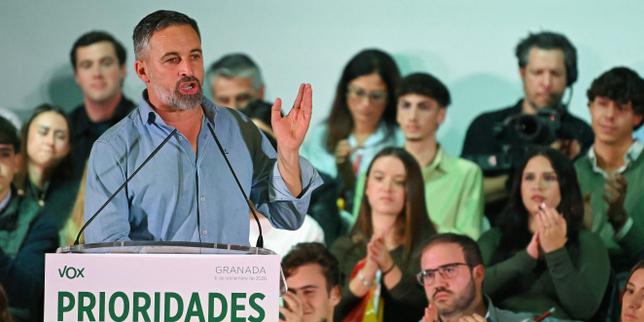
Alberto Núñez Feijóo of the conservative People's Party (PP) leans forward, warning of overwhelmed public services and uncontrolled borders. Next to him, Santiago Abascal, leader of the far-right Vox party, doesn't bother with nuance. He speaks of cultural replacement, of rising street crime, of border walls and immediate deportations.
Mateo looks at his aching knees. He looks at his daughter, who cannot afford a studio apartment in the city where she was born.
Who do you think wins that living room?
This is the psychological trap of modern European politics, and Spain has walked straight into the jaws of it. When wages stagnate and rent swallows sixty percent of a paycheck, anger needs an address. Telling a struggling father that his hardship is caused by global inflation, corporate real estate speculation, and decades of sluggish productivity growth feels abstract. Bloodless. Unsatisfying.
Pointing a finger at a crowded wooden boat arriving in the Canary Islands? That gives rage a face.
The Atlantic Crossing Nobody Wants to See
If you want to strip away the campaign slogans, take a flight southwest to the Canary Islands.
For years, Spain’s migration debate focused on the Strait of Gibraltar—a narrow ribbon of water separating Morocco from Andalusia, barely fourteen kilometers wide at its tightest point. Madrid poured millions into border surveillance, struck bilateral deals with Rabat, and fortified the towering razor-wire fences surrounding Ceuta and Melilla, Spain's two tiny enclaves on the North African coast.
The door slammed shut in the north. So the desperate found another way.
They turned toward the open Atlantic. The route from the coasts of Senegal, Mauritania, and Gambia to the Canary Islands is one of the deadliest stretches of water on Earth. People climb into open wooden fishing boats called cayucos, packed shoulder-to-shoulder with eighty, sometimes a hundred souls, carrying plastic jerrycans of gasoline and stale biscuits. They navigate across hundreds of kilometers of pitch-black ocean swells with nothing more than a cheap handheld GPS and a prayer.
Thousands never make it. Their bodies simply vanish into the deep Atlantic currents, uncounted and unnamed.
Those who survive wash ashore onto islands famous for sunburned tourists and all-inclusive resorts. Suddenly, local municipalities in El Hierro or Tenerife—places with tiny populations and modest budgets—are scrambling to house thousands of exhausted, traumatized teenagers in makeshift tents and converted warehouses.
You can see how easily this becomes political dynamite.
During an election cycle, images of overwhelmed reception centers flash across nightly news broadcasts. Far-right commentators frame it as an orchestrated siege. Meanwhile, the central government in Madrid argues with regional presidents over how to redistribute unaccompanied minors across mainland Spain. Every regional leader claims their shelters are full. Every party accuses the other of incompetence or cruelty.
Lost in the shouting match is a simple, stubborn truth: people do not risk drowning in the Atlantic because of a politician's speech in Madrid. They cross because drought has ruined their farms, because foreign industrial trawlers have emptied their coastal waters of fish, and because staying home feels like a slower death.
The Invisible Engine
Let us step back into the greenhouses of El Ejido, or into the bustling kitchens of Barcelona, or the quiet bedrooms where elderly Spaniards lie waiting for someone to help them bathe and take their morning pills.
If every undocumented migrant in Spain disappeared overnight—the exact fantasy sold on far-right campaign posters—the country would grind to a violent halt by Tuesday morning.
Think of Spain’s economy as a massive, intricate watch. On the outside, you see the gleaming gold hands: the booming tourism sector, the high-speed trains, the world-class restaurants, the sun-drenched retirement communities welcoming wealthy northern Europeans.
Inside the casing, turning the gears in total darkness, is migrant labor.
According to Spain’s own Social Security data, foreign workers account for a massive share of new job creation in recent years. They are the ones picking strawberries in Huelva, pouring concrete on Madrid’s newest luxury developments, delivering hot food through pouring rain on electric bicycles, and caring for an entire generation of Spanish grandparents whose own children had to move away for work.
Yet, because Spain’s immigration laws often trap newcomers in a bureaucratic purgatory—requiring years of continuous, provable residence before they can even apply for legal work permits—hundreds of thousands of people live in the shadows. They pay consumption taxes every time they buy bread or ride the metro. They rent rooms at inflated prices because landlords know they cannot complain to the authorities. They work twelve-hour shifts for cash under the table, stripped of sick leave, injury compensation, or legal protection.
And then, every four years, they become the villain in someone else’s election campaign.
Is there a darker irony than that? A nation leaning heavily on the backs of people it refuses to acknowledge, while politicians compete to see who can promise the harshest crackdown.
The Echoes of History
It is easy to forget, watching the heated rhetoric in the Spanish parliament, that Spain was a country of emigrants until very recently.
Not centuries ago. Within living memory.
In the 1950s and 1960s, millions of Spaniards packed cardboard suitcases and boarded trains bound for France, Germany, Switzerland, and Latin America. They fled poverty and Franco’s dictatorship. They lived in cramped dormitories on the outskirts of Paris, worked the dirtiest shifts in German factories, and sent money home in envelopes so their families could buy land or send a younger brother to school.
Back then, northern Europeans looked at Spanish workers with the exact same suspicion some Spaniards now direct at Moroccans, Colombians, or Senegalese. They muttered about noise, about strange food, about crime, about whether these southern newcomers could ever truly integrate into modern society.
Memory, however, is a fragile thing when fear enters the room.
Today, Spain sits at a crossroads that defines almost every Western democracy. The demographic math is absolute and unforgiving. Spain’s fertility rate hovers near 1.1 children per woman—far below the 2.1 needed just to keep the population stable. Without immigration, Spain’s workforce will shrink by millions over the next two decades. Fewer workers mean fewer taxpayers. Fewer taxpayers mean shuttered hospitals, broken pensions, and hollowed-out rural towns where the last school closed ten years ago.
This isn't a partisan talking point. It is gravity. You can argue about gravity all you want during a televised debate, shake your fist at it, and promise voters you will repeal it if elected. When you step off the stage, it still pulls you down.
Why the Debate Feels So Broken
So why does the political conversation feel so hopelessly stuck?
Because both sides are speaking different languages, and neither is fully honest about the friction involved.
When progressive politicians talk about immigration purely in terms of GDP growth and humanitarian duty, they often gloss over the real, localized growing pains. Integration does not happen by magic. When a neighborhood absorbs thousands of newcomers quickly without matching investments in public schools, healthcare clinics, and language programs, tension is inevitable. Pretending those pressures do not exist leaves working-class voters feeling gaslit—and drives them straight into the arms of extremists who validate their frustration, even if their solutions are pure fantasy.
Conversely, when conservative and far-right leaders sell mass deportation and sealed borders as a silver bullet, they are selling a lie. Spain has over three thousand kilometers of coastline and land borders that cannot be hermetically sealed without turning the country into a militarized fortress—and destroying the very industries that keep its economy afloat. Even the fiercest anti-immigrant governments in Europe have quietly ended up issuing hundreds of thousands of work visas once in office, simply because business owners bang on their doors begging for staff.
Watch what politicians do after the election, not what they scream into microphones before it.
In 2024, even amid fierce political pushback, Spain’s government moved forward with reforms to streamline work permits and residency pathways for hundreds of thousands of undocumented residents, recognizing a reality that business associations and the Catholic Church alike had been shouting about for years: legalizing workers brings them into the tax system, protects them from exploitation, and fills desperate labor shortages.
Still, on the campaign trail, nuance dies first. Fear travels faster than math. A ten-second clip of a politician shouting about "border chaos" will always outperform a twenty-minute explanation of demographic dependency ratios on social media.
The Choice Beneath the Noise
Imagine walking through the central market of Valencia on a Saturday morning.
The air smells of roasted almonds, salty sea breeze, and ripe oranges stacked in bright pyramids. Behind the stalls, hands move with practiced speed—weighing figs, slicing cured ham, wrapping fresh hake in white paper. Some of those hands belong to families who have worked those exact stalls for four generations. Others belong to men and women who arrived five years ago from Ecuador, Morocco, or Romania, speaking halting Spanish at first, now bantering effortlessly with regulars about the weather and last night’s football match.
They are all part of the same pulse. The same city. The same fragile, living ecosystem.
When Spaniards step into the voting booth, the ballot paper does not ask a simple question about whether they are "for" or "against" immigration. That choice is an illusion, a mirage conjured by campaign strategists to herd voters into neat, predictable pens.
The real question on the ballot is much harder, and infinitely more personal.
Will Spain design a system that manages a permanent reality with dignity, order, and shared investment—recognizing that the people harvesting its food and caring for its elders deserve a path out of the shadows? Or will it let fear dictate the rules, pretending it can wall itself off from the world while quietly relying on ghost hands to keep the lights on?
Somewhere out in the Atlantic tonight, another wooden boat is cutting through dark water toward the faint glow of coastal lights. And tomorrow morning, long before the campaign buses fire up their engines, the plastic roofs of El Ejido will begin to steam in the rising sun.


