Four years. One thousand, four hundred and sixty nights of sitting, napping, spilling coffee, and searching for a lost television remote.
For forty-eight months, a woman in Canada lived her entirely ordinary life atop a life-altering secret, separated from a small fortune by nothing more than two inches of worn polyester upholstery and aging foam. When she paid twenty-five dollars for that secondhand sofa at a local thrift shop, she wasn't hunting for treasure. She just needed a place to sit. She carried it home, wedged it into her living room, and let it absorb the quiet, unremarkable weight of her daily routine.
Then, one afternoon, her fingers slipped too deep into the dark crevice between the cushions.
Her knuckles grazed cold steel.
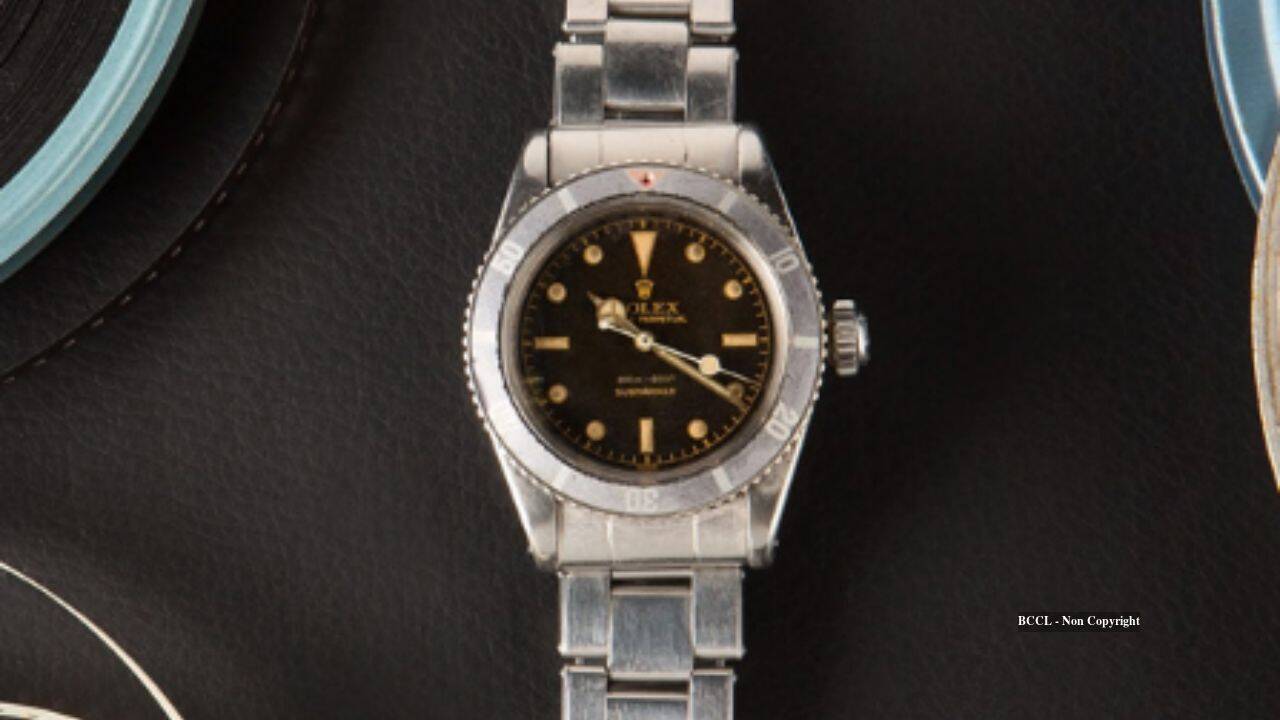
What she pulled out of the lint and stray pennies wasn't a forgotten butter knife or a child's toy. It was a vintage Rolex Daytona—specifically, a rare reference 6241 "Paul Newman" model, a timepiece so coveted by horological collectors that it would eventually hammer down at a Sotheby's auction for a staggering $191,000.
Stop and let that number settle in your chest. Twenty-five dollars in. Nearly two hundred thousand dollars out. A return on investment so absurd it defies every rational rule of modern economics.
We love these stories. We devour them over our morning coffee, sharing links with friends and whispering the same breathless question: What if that were me? Yet beneath the glossy thrill of a sudden windfall lies a much deeper, stranger truth about the things we throw away, the lives we leave behind, and the quiet desperation with which we search for meaning in a world that feels increasingly rigged against the average person.
The Architecture of Forgotten Things
To understand how a six-figure luxury watch ends up swallowed by a discount couch, you first have to understand how people actually lose things.
I spent three years working the sorting floor of a regional estate-liquidation warehouse, and if there is one lesson that environment burns into your memory, it is this: human beings are terrible archivists of their own lives. We think of our homes as curated museums of what we love. In reality, they are chaotic geological layers of distraction.
Every Tuesday morning, trucks would back up to our loading dock, disgorging the entire material histories of people who had passed away, divorced, or moved into assisted living. Families, overwhelmed by grief or sheer exhaustion, rarely sift through every pocket, drawer, or cushion. They keep the photo albums, take the obvious silver, and tell the haulers to clear the rest before the real estate agent arrives.
Inside those trucks, the bizarre becomes routine. I have personally pulled a loaded 1940s revolver from the lining of a winter coat, found three thousand dollars in crisp hundred-dollar bills taped to the underside of a spice rack, and discovered a box of unopened love letters from the Korean War wedged behind a broken vanity mirror.
Upholstered furniture, however, is the undisputed champion of accidental preservation.
Think of a sofa cushion not as a piece of decor, but as a mechanical trap. Every time someone sits down, the foam compresses, widening the gap between the seat and the wooden frame. Objects slip into that dark slot—keys, rings, loose change, watches taken off because a clasp felt too tight after a heavy dinner. When the person stands up, the foam expands, sealing the mouth of the trap shut. Over years, the fabric stretches, the stitching loosens, and the object migrates deeper, sometimes slipping right through a tear in the dust cover into the hollow cavity beneath the springs.
Out of sight. Out of mind.
Consider a hypothetical scenario to see how easily a fortune vanishes. Imagine an elderly gentleman—let's call him Arthur—living alone in a quiet suburb. Decades ago, in the late 1960s, Arthur bought a Rolex Daytona. Back then, it wasn't an untouchable status symbol; it was a rugged tool watch meant for race car drivers, retailing for just over two hundred dollars. Arthur wore it while gardening, while fixing his Buick, while watching the evening news. One night in his eighties, his wrists swelled. He unclasped the watch, laid it on the armrest while he dozed off, and knocked it into the cushions with an elbow. The next morning, his memory—frayed at the edges by age—told him he had left it at the diner, or perhaps lost it on a walk. He grieved the loss for a week and moved on. Years later, Arthur passed away. His nieces, flying in from out of state with forty-eight hours to empty a three-bedroom house, looked at his sagging, faded couch and did what anyone would do. They called a charity thrift store to haul it away.
That is not a failure of care. That is simply the friction of human mortality. We spend our prime years accumulating objects to prove we were here, and our final years slowly losing our grip on them.
Why a Vintage Rolex Commands a King's Ransom
When the Canadian buyer finally pulled that watch from the sofa, she didn't immediately know she was holding a down payment on a mansion. To the untrained eye, a vintage 1960s chronograph looks almost modest compared to the oversized, diamond-encrusted watches favored by modern celebrities. It measures a relatively compact 37 millimeters across. It doesn't scream for attention.
So why did collectors battle each other in a bidding war until the price hit $191,000?
To answer that, you have to understand the peculiar psychology of the luxury watch market—a world where scarcity, storytelling, and tiny manufacturing quirks collide to create astronomical value.
In the late 1960s, Rolex produced the reference 6241 Daytona with a specific, unconventional dial configuration known to collectors as an "exotic" dial. It featured contrasting sub-dials with distinctive Art Deco numerals and tiny square markers at the ends of the hash marks. At the time, nobody wanted them. They sat in jewelry store display cases gathering dust while buyers opted for standard, cleaner-looking models. Because they sold poorly, Rolex produced very few of them—estimates suggest fewer than three thousand were ever made in stainless steel.
Then came Paul Newman.
The legendary actor and race car driver wore an exotic-dial Daytona gifted to him by his wife, Joanne Woodward, who famously had the caseback engraved with the words DRIVE CAREFULLY ME. Photographs of Newman wearing the watch at racetracks circulated through Italian fashion and collector magazines in the 1980s. Suddenly, the ugly duckling of the Rolex catalog had a myth attached to it. It wasn't just stainless steel and gears anymore; it was distilled cool. It was cinema, speed, and romance strapped to a wrist.
In economics, there is a concept known as the Veblen effect, where demand for a good actually increases as its price rises, because the high cost itself becomes a badge of exclusivity. Vintage Rolex collecting takes the Veblen effect and injects it with pure nostalgia. Collectors aren't buying a device to tell time—a ten-dollar digital watch from a drugstore keeps far better time than a mechanical chronograph from 1968. They are buying an unrepeatable piece of history. They are buying the thrill of owning one of the few surviving artifacts from a specific moment in industrial design.
When that sofa-bound Daytona surfaced, it carried something else collectors obsess over: untouched originality.
Many vintage watches have been ruined over the decades by well-meaning watchmakers who polished the sharp edges off the steel cases, replaced faded dials with modern luminous parts, or swapped out worn hands. Because this watch had spent years entombed in a couch, shielded from sunlight, moisture, and clumsy repairs, its aging was entirely honest. The black acrylic bezel, the subtle patina on the sub-dials, the crispness of the lugs—it was a time capsule. For a collector, finding an unpolished, "fresh-to-market" Paul Newman Daytona is the equivalent of an art historian discovering a forgotten Rembrandt in an attic.
The Anatomy of a Modern Fairy Tale
Let's be honest about why this story gripped the internet. It wasn't because the public suddenly developed a deep passion for Swiss horology.
It gripped us because we are exhausted.
We live in an era where the traditional ladders of upward mobility feel greased. Housing prices outpace wages by absurd margins. Inflation quietly nibbles at savings accounts. The message broadcast from every financial headline is that wealth is built slowly, painfully, through decades of compounding interest, relentless side-hustles, and ruthless austerity—and even then, there are no guarantees.
Against that backdrop of grinding economic anxiety, a twenty-five-dollar thrift-store couch spitting out $191,000 feels like a glitch in the matrix. It is a secular miracle.
Look at the mechanics of the story's emotional appeal:
- The Humble Origin: She didn't buy the sofa at an exclusive estate sale in Beverly Hills. She bought it at a thrift store—a democratic space where anyone with twenty bucks in their pocket has the exact same odds.
- The Delay: Four years passed between the purchase and the discovery. That detail is crucial. It transforms the narrative from a simple transaction into a slow-burn mystery. It makes you look around your own living room right now—at the thrift-store bookshelf, the inherited dresser, the secondhand jacket hanging in the closet—and wonder what might be hiding three inches from your fingertips.
- The Purity of the Windfall: Nobody was cheated. There was no corporate backstabbing, no exploitation, no morally gray loophole. It was pure, unadulterated serendipity.
I remember the first time I experienced a fraction of that feeling. Years ago, while helping a friend clear out his late grandfather's garage, I bought an old, battered wooden toolbox from him for fifteen dollars because I needed something to hold my wrenches. When I got it home and pried open a jammed bottom drawer that had been painted shut decades earlier, I found a pristine, first-edition hardcover copy of a classic 1950s science fiction novel wrapped in wax paper. I sold it to a rare book dealer two weeks later for eight hundred dollars.
Eight hundred dollars isn't a fortune. It didn't change my tax bracket. Yet the sensation of holding that book—knowing it had survived floods, moves, and decades of neglect just to land in my hands—altered the way I looked at the physical world forever. It taught me that value isn't always announced with neon signs and price tags. Sometimes, it sits quietly in the dark, waiting for someone to pay attention.
What Happens When Lightning Strikes Your Living Room
Of course, the fairy tale version of the story ends the moment the auctioneer's gavel falls. Real life, as it always does, is slightly more complicated.
When an ordinary person stumbles upon an extraordinary artifact, the initial rush of adrenaline is almost immediately followed by a wave of paranoia and confusion. How do you know it's real? Counterfeit Rolexes have flooded global markets since the 1970s, and convincing fakes of vintage Daytonas exist by the thousands. If you walk into a local pawn shop with a $191,000 watch, you might get offered five hundred bucks by someone who either doesn't know what it is or hopes you don't.
Even after authentication, navigating a high-end auction house like Sotheby's or Christie's requires stepping into an intimidating, velvet-roped ecosystem. There are seller's premiums to negotiate, insurance policies to arrange while the watch sits in a safe, and wire transfers to verify. And then, inevitably, the taxman arrives. In most jurisdictions, a sudden windfall from selling a discovered asset triggers capital gains or windfall tax obligations. A $191,000 hammer price quickly shrinks to $120,000 or $130,000 once commissions and taxes take their bite.
Still, for a woman who spent twenty-five dollars on a used couch, walking away with well over a hundred thousand dollars is nothing short of transformative. It clears debts. It buys breathing room. It purchases the single rarest commodity in modern life: time.
And what about the original owner? Inevitably, whenever a story like this goes viral, a chorus of internet moralists chimes in, asking whether she should have tried to track down the person who donated the sofa.
It is a fair question, though one rooted in a misunderstanding of how thrift stores operate. Charity shops receive thousands of donations a week, largely anonymous, dropped off at loading docks without receipts or donor logs. Tracing a four-year-old couch back to a specific household is roughly as plausible as tracing a single drop of rain back to the cloud that dropped it. Furthermore, under long-standing legal principles governing abandoned property, once an item is donated without reservation and sold in good faith, title passes cleanly to the buyer. There was no theft here. Only fate transferring an unclaimed treasure from one chapter of human history to the next.
The Quiet Lesson of the Cushions
We spend an enormous amount of energy chasing the new. Every autumn, we line up for the latest smartphone, upgrade to the sleekest car, and discard furniture the moment a seam begins to fray. We have built an entire economy predicated on the idea that value is forward-looking—that the best things are always the ones just rolling off the assembly line.
Yet the story of the twenty-five-dollar couch whispers the exact opposite.
It reminds us that the past isn't dead; it is simply tucked out of sight, woven into the fabric of the everyday objects we overlook. It suggests that attentiveness—the simple, unhurried act of noticing the world around you, of reaching a little deeper into the places everyone else ignores—still carries a profound reward.
Next time you pass a thrift store with a sagging armchair sitting on the sidewalk, or run your hand along the worn grain of an antique table at a flea market, pause for a second. Listen to the quiet hum of the years trapped inside the wood and the thread. You probably won't pull a rare Swiss chronograph from the seams. The odds against it are astronomical.
Then again, someone had to find it. And for four years, she sat right on top of a miracle before she finally reached down and felt the cold steel.