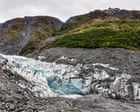
The coffee in my tin cup tasted of woodsmoke and old iron. We were sitting three thousand feet up on the spine of the Southern Alps, a place the old-timers called Kā Tiritiri o te Moana—the grand canoes adrift in the sea. Down in the valleys below, pastureland rolled toward the Pacific in emerald folds, flat and fat with dairy cows and clover. Up here, though, the world belonged to stone, wind, and ice. Or at least, it used to.
I remember my grandfather pointing out the Tasman Glacier when I was a boy. He told me it was a frozen river, slow as a glacier moves, carving its own gravity into the rock. He stood there in his wool jersey, smelling of lanolin and sheep fat, squinting against the raw South Island glare. He spoke of the ice as something permanent. Something older than the hills. He was wrong.
Today, that river of ice is bleeding out.
If you stand on the moraine walls now, you don’t hear the steady, grinding silence of ancient mass. You hear water. A billion tiny trickles coalescing into rushing, slate-gray torrents, tearing down the valley toward the sea. The latest atmospheric readings from Baring Head and Arrival Heights have finally put hard numbers to what the boot-soles of every backcountry guide have known for years: New Zealand greenhouse gas levels have hit unprecedented heights, and the upper reaches of our alpine crown are paying the price. Carbon dioxide and methane numbers have ticked upward in the global ledger, wrapping an invisible, suffocating shawl around the planet. And up here, where the air is thin enough to make your lungs ache, that shawl is turning to fire.
It is easy to look at a statistic like parts per million and feel nothing. Numbers are armor against grief. We stare at graphs on evening news broadcasts while eating toast, watching lines creep upward like fever charts on a patient we’ve never met. But this patient has a name. It’s the Fox. It’s the Franz Josef. It’s the millions of cubic meters of frozen freshwater that feed the hydroelectric grids, the trout rivers, the quiet irrigation channels of the Canterbury Plains.
Consider a hypothetical dairy farmer named Liam, whose family has milked cows near the banks of the Rangitata River for three generations. Liam doesn't spend his evenings pondering the chemistry of carbon bonds or the precise infrared-trapping capacity of methane. He worries about the weir. He worries about August rain when he needs winter snowpack. He watches the gauge on the river drop three inches lower every summer, exposing the bleached river stones earlier and earlier. When the glaciers are gone—and at the current rate of retreat, scientists project a staggering loss of ice volume by the end of this century—the natural battery of Aotearoa runs dry. The snow melts in spring, but it doesn't wait for summer anymore. It crashes down all at once, leaving the dry months starved of the slow, steady drip of high-altitude life.
Methane is the invisible actor in this drama. While carbon dioxide gets the marquee billing in international climate summits, New Zealand carries a peculiar atmospheric signature. Nearly half of our national emissions come from the heavy breathing of sheep and cattle, the belching fermentation of millions of ruminants chewing their cud on rolling green hills. To the casual traveler driving down State Highway One, those hills look like Eden. They look like peace. But every lamb chop exported, every liter of whole milk shipped across the Pacific to sprawling Asian megacities, carries an ecological backpack. We are exporting our soil, our water, and our sky.
The mechanics of this are brutally simple, stripped of political spin. Sunlight hits the earth, bounces back as heat, and meets a thickening ceiling of greenhouse gases. These gases act like a down comforter on a feverish body. They don't block the light in; they trap the warmth out. And glaciers, contrary to popular belief, are not just frozen water waiting for a cold day. They are dynamic, delicate thermal equilibrium machines. They exist on a knife-edge. Raise the ambient temperature by a fraction of a degree, and the math breaks down. The ice doesn't just melt faster; it loses its ability to accumulate winter mass to balance the summer loss.
This is where the human heart fractures. We are wired for immediate threats. A charging bull, a rising floodwater knocking at the back door, a sudden bank notice—these we understand. But an invisible atmospheric accumulation that steals our future degree by degree, season by season? That requires a different kind of imagination. It requires us to mourn things that are still here, standing before our eyes, but are already dead in geological time.
I walked back down the ridge last autumn. The trail was choked with hikers in bright Gore-Tex jackets, snapping selfies against the backdrop of the terminal lake. They pointed at the milky turquoise water below, marveling at the scenery, buying postcards in the gift shop at the base. They didn't see the ghosts. They didn't notice that where the ice used to touch the parking lot forty years ago, there was now only barren gray slate, freshly scoured by retreating stone.
The atmosphere doesn't negotiate. The physics of greenhouse gases do not care about export targets, political election cycles, or GDP growth. They simply press down, unrelenting, shifting the baseline of what normal means.
When the last of the great ice rivers has turned to rain, and the mountain peaks stand naked and black against the southern sky, we will look back at these decades with a strange, hollow wonder. We will ask ourselves how we managed to live so loudly while the world grew so quiet. Until then, the water keeps running. The gauges keep climbing. And the wind off the Tasman Sea blows cold and heavy, carrying the breath of a changing world straight through our clothes.


