The water in the Southern Alps does not flow; it shatters. It pours off ancient granite faces with a violence born of sheer altitude, freezing, turquoise, and terrifyingly clear. Standing knee-deep in the Waimakariri River, the current presses against your thighs like a physical hand, urging you downstream, whispering that you do not belong here.
Your fingers go numb within minutes. The air smells of wet slate, crushed pine needles, and the cold ozone of a gathering storm over the peaks. Yet, you are not watching the sky. You are watching the shadows beneath the surface.
You are looking for a ghost.
To understand why a creature born in the slow, muddy chalk streams of England now haunts these ferocious antipodean torrents, we have to travel back to a Victorian parlor filled with smoke, ambition, and a profound, aching homesickness.
The Longing For Home
Picture a sheep station owner in Canterbury in the 1860s. His name does not matter as much as his state of mind. He sits on a veranda made of imported timber, looking out over a landscape that is vast, brutal, and utterly alien. The tussock grass rolls away toward the horizon in endless shades of amber and straw. There are no hedgerows. There are no manicured country estates. There are no singing thrushes, and, most painfully of all, there are no trout.
To the British settler, a river without trout was not a river at all. It was an empty ditch. It was a wilderness waiting to be civilized.
They felt a deep, existential vertigo in the presence of New Zealand’s raw geography. The native fauna—strange, nocturnal, silent—offered little comfort to men raised on Wordsworth and Isaak Walton. They wanted familiar water to fish. They wanted the polite flick of a split-cane rod, the delicate drop of a dry fly, and the noble struggle against the wily Salmo trutta.
So, they engineered an ecological resurrection.
They did not just import fish. They imported a memory. They tried repeatedly, loading wooden crates of fertilized ova onto the ice-houses of wind-battered clipper ships that spent months rounding the Horn. Millions of miles of salt water. Months of pitch-and-roll misery. Success was a mathematical miracle. Yet, in 1867, the perseverance paid off. Brown trout were officially introduced into New Zealand waters.
What followed was an explosion of life so massive it borders on the mythological.
The Great Flood Of Silver
More than 60 million brown trout ova and fry were eventually channeled into these pristine waterways.
(Note: This staggering figure represents the cumulative stocking efforts across multiple acclimatization societies over several decades, transforming isolated releases into a nationwide inundation.)
Imagine what happened when those first resilient fry hit the water. They found a paradise completely devoid of apex freshwater predators. There were no native mammals hunting them from the banks, no historic parasites to keep their numbers in check, and an endless, buffet-style abundance of native aquatic insects that had never evolved to fear a heavy-scaled predator.
The trout did not just survive. They thrived with a terrifying vigor.
In the rivers of the old country, a brown trout measuring eighteen inches was a trophy to be mounted above the fireplace. In the South Island, descendants of those same fish grew fat, lazy, and monstrously large simply by gorging on native galaxias and giant stoneflies. They grew to ten pounds. Twelve pounds. Fifteen pounds. They populated every viable creek, stream, and alpine lake from the top of the North Island down to the roaring fiords of Fiordland.
The colonists had wanted a taste of home. Instead, they unlocked a biological tide.
The Cost Of Nostalgia
Cast your line now. Watch the weighted nymph tumble through the riffle, bouncing along the gravel bed just a few feet away from a submerged log.
Suddenly, the world stops.
The slack in your line disappears with a sharp, electric tug. The reel screams—that high, metallic song that makes your heart hammer against your ribs. Somewhere down in that freezing trench, a five-pound brown trout has turned sideways to the current, using the raw physics of the river to anchor itself against your will.
This is the thrill that draws anglers from Tokyo, London, and Montana to these shores every single year. It is an addiction disguised as a vacation.
Yet, as you fight the fish, pulling it inch by inch toward the gravel bar, a quiet irony hangs in the damp air. Those sixty million historic releases were a triumph of acclimatization, but they came with a silent, heavy toll. The native ecosystems did not ask for the silver king. Species of native freshwater fish, evolved over millions of years in isolation, found themselves competing with an aggressive, highly adaptable European landlord that viewed them primarily as breakfast.
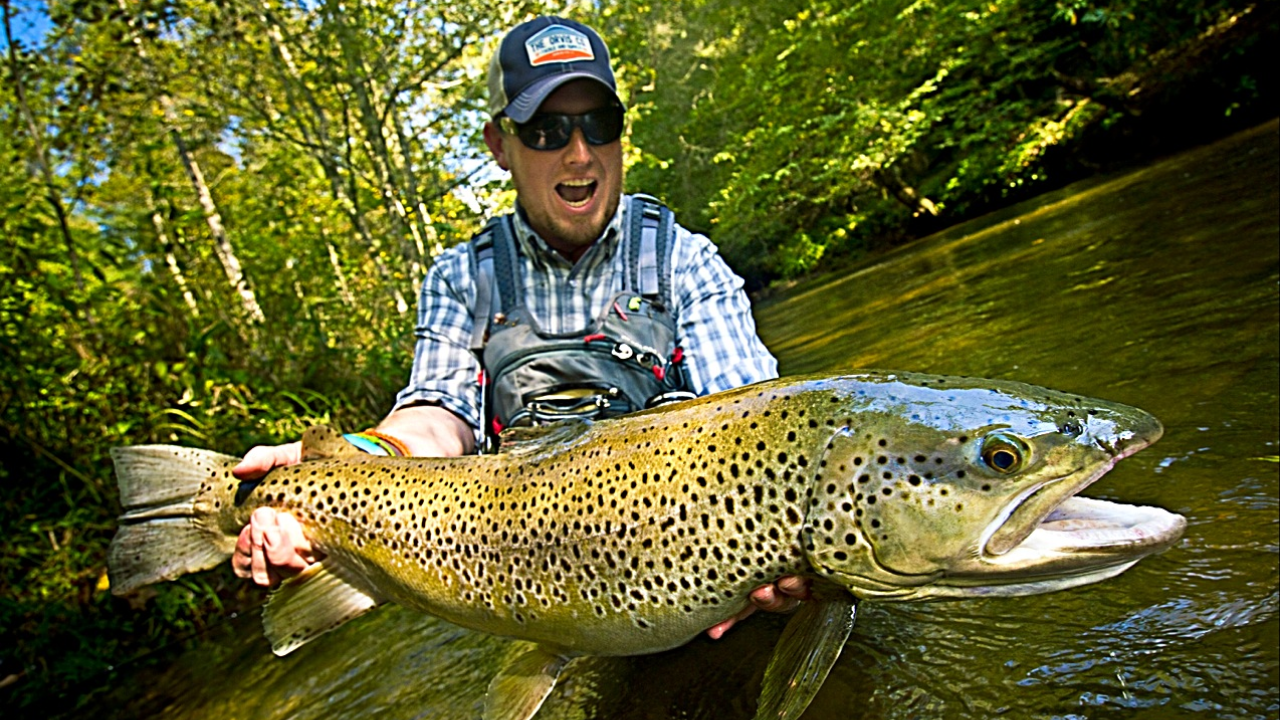
You net the fish. It is magnificent. Its flanks burn with buttery gold, punctuated by crimson spots haloed in electric blue. It is a masterpiece of evolution, sculpted by the very waters it conquered. You hold it in the shallows, supporting its belly, watching its gills flare as it pumps oxygen through its system.
You admire its fierce, untamed beauty.
Then, with a sudden, powerful snap of its tail, it is gone. The water closes over the spot where it hovered, leaving nothing behind except the relentless roar of the alpine current and the steady, quiet hum of a manufactured wilderness that became more real than the original.