Silence.
That is the actual product sold by Rockstar Games during the twelve-year drought following the release of Grand Theft Auto V, a deafening, suffocating absence of noise that turned a billion-dollar entertainment franchise into an exercise in collective obsession. If you stood outside the fortified glass doors of Rockstar North in Edinburgh on a rainy Tuesday evening, you wouldn't hear the chaotic symphony of Vice City traffic or the low thrum of synth-wave basslines bleeding through the drywall. You would hear the hum of climate-controlled server racks, the soft click of keycard badges against turnstiles, and the quiet, heavy footsteps of men and women who have signed away their right to speak about what they do for a living.
And then there are the men who built the vault in the first place, standing on the outside looking in, their noses pressed against the exact same glass as the rest of us.
When news broke that even the original architects of Grand Theft Auto—names like Dan Houser, Leslie Benzies, and the veterans of DMA Design who cobbled together a top-down crime simulator in Dundee during the late nineties—had never touched a controller loaded with Grand Theft Auto VI, the internet treated it like a trivia footnote. A cute quirk of corporate security. A testament to how tightly Take-Two Interactive guards its golden goose.
They missed the point entirely.
Look closer at that single, verified fact, and the glossy corporate narrative cracks wide open. When the people who invented a cultural juggernaut are locked out of its greatest evolution, you are no longer looking at a simple story about non-disclosure agreements and anti-leak protocols. You are looking at the slow, painful decoupling of art from its artists, a quiet revolution in how modern entertainment is manufactured, protected, and ultimately stripped of its original DNA.
The Architecture of Exile
To understand the weight of that lockout, you have to remember what Grand Theft Auto used to smell like.
In 1997, it smelled like stale coffee, burnt radiator dust, and damp wool in a cramped Scottish office. Back then, DMA Design wasn't a multinational titan employing thousands of motion-capture specialists and behavioral economists. It was a scrappy collective of programmers—David Jones, Mike Dailly, Gary Penn, and later the Houser brothers—who stumbled onto a broken police AI routine in a prototype called Race'n'Chase and realized that running from the cops was infinitely more thrilling than catching the bad guys.
I remember playing those early builds on a flickering CRT monitor in the late nineties, the plastic casing warm to the touch, the tinny speakers crackling with compressed audio. Every pixel felt like an inside joke whispered directly from the developers to the player. You could feel the fingerprints of the creators on every jagged street corner of Liberty City. There was no billion-dollar marketing apparatus standing between the vision in Sam and Dan Houser’s heads and the controller in your hands. When Grand Theft Auto III shattered the industry in 2001, it wasn't engineered by a committee of risk-mitigation lawyers; it was willed into existence by a tight-knit brotherhood of obsessives who knew every line of code because they had written it themselves at three in the morning.
Fast-forward nearly three decades, and the brotherhood is gone.
Dan Houser, the lead writer and creative soul whose cynical, razor-sharp satire gave Vice City, San Andreas, and GTA IV their beating hearts, walked away from Rockstar in 2020. Leslie Benzies, the legendary producer who acted as the studio's "closer"—the man famously flown in to stitch chaotic, sprawling codebases into coherent masterpieces—left in a bitter, high-profile legal battle years earlier. Lazlow Jones, the voice of Rockstar’s satirical radio waves for twenty years, departed shortly after Dan.
When these men say they haven't played GTA 6, they aren't offering a polite excuse to dodge interview questions. They are stating a cold, legal reality. In the modern AAA gaming industry, departure is total erasure. The moment your badge is deactivated, the firewall slams down. It does not matter if your name is etched into the bedrock of the franchise's intellectual property; once you step off the campus, you become a security risk.
Consider a hypothetical scenario to grasp the sheer absurdity of this corporate amnesia. Imagine if Francis Ford Coppola were barred from viewing dailies of a new Godfather installment, or if George Lucas were frisked at the door of Skywalker Ranch before a screening of a new Star Wars trilogy. Actually, that second one isn't even hypothetical—it happened. And just like Lucas watching The Force Awakens in a theater full of strangers, the founding fathers of Grand Theft Auto have been relegated to the cheap seats, waiting for a release date just like a fourteen-year-old kid refreshing a subreddit in his bedroom.
The Paranoia Machine
Why does the vault need to be this deep? Why lock out the very minds that taught the world how to care about Vice City in the first place?
Because in 2022, the nightmare happened.
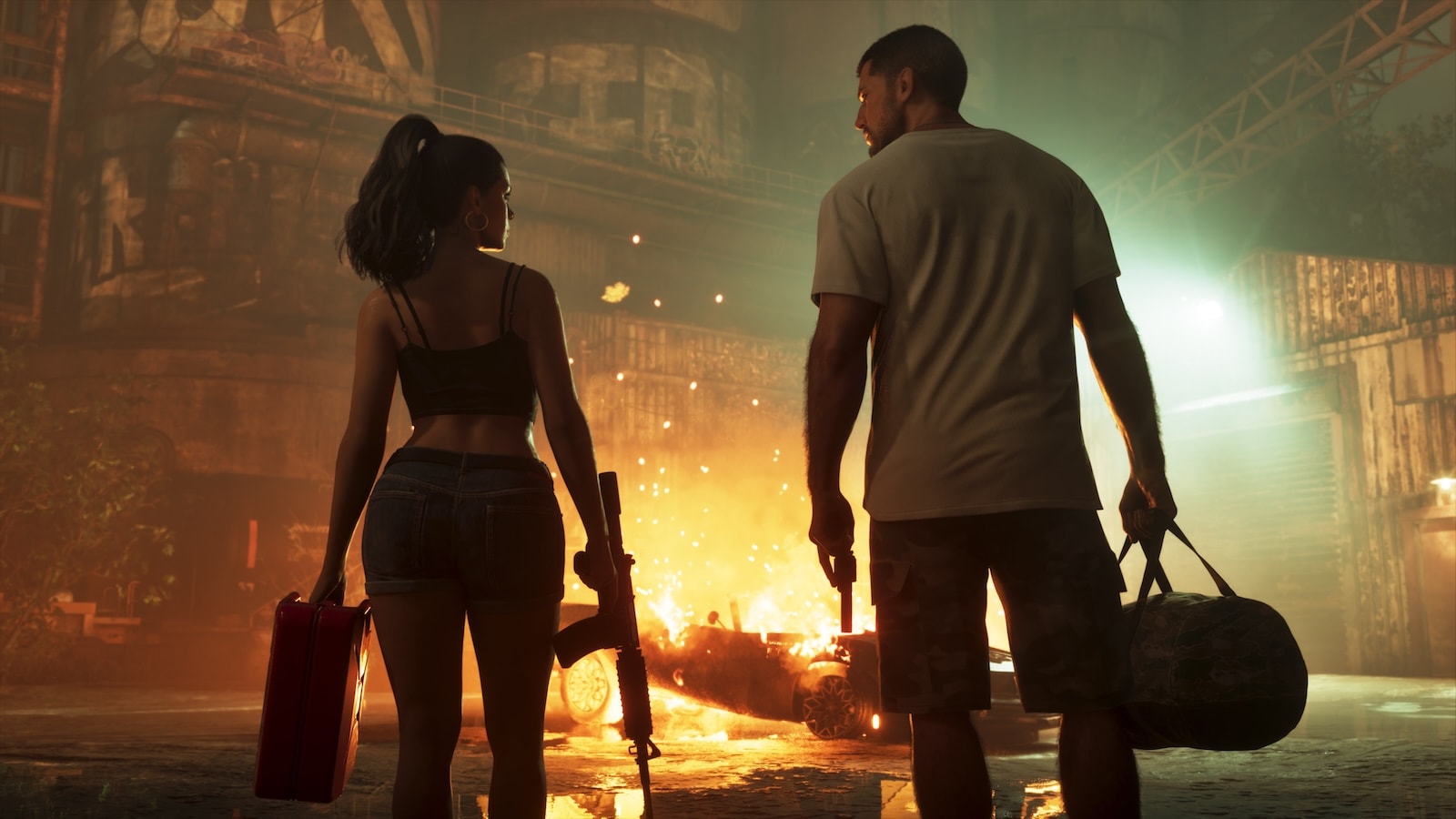
On a quiet Sunday morning in September, ninety videos of raw, unfinished GTA 6 development footage spilled onto the public internet like toxic runoff from a ruptured pipe. A teenage hacker in Oxfordshire, armed with little more than a Fire TV stick, a smartphone, and social engineering tactics that breached a corporate Slack channel, bypassed hundreds of millions of dollars in security infrastructure. Suddenly, millions of eyes were dissecting placeholder textures, debug menus, and incomplete character models of Lucia and Jason—the game’s dual protagonists—years before Rockstar was ready to show a single frame.
If you have never worked inside a creative studio during a catastrophic leak, it is hard to describe the specific flavor of nausea it induces. It isn't just anger; it is a profound sense of violation. Thousands of developers who had poured years of silent, invisible labor into lighting engines, water physics, and NPC pathfinding watched their unfinished work get mocked by strangers who didn't understand what a debug build was.
Take-Two Interactive’s response was swift, merciless, and permanent. The vault doors didn't just close; they were welded shut.
Today, the security architecture surrounding GTA 6 rivals that of a defense contractor. Let's look at how a modern blockbuster is actually built under these conditions. To understand it, picture an assembly line where every worker is blindfolded to what happens ten feet down the belt.
A junior environment artist in Rockstar India models a single palm tree or a rusted dumpster for Leonida’s coastline, never seeing the full map it belongs to. A quest designer in Rockstar Lincoln scripts a twenty-second dialogue branch without knowing how the mission ends. Even senior leads operate inside siloed permissions, accessing encrypted builds through Virtual Desktop Infrastructure where watermarks tied to their employee IDs float invisibly across the screen—ready to identify the exact monitor if a smartphone camera ever snaps a photo.
In an ecosystem built on zero-trust cryptography, nostalgia has no security clearance. You cannot grant a courtesy preview to a former founder, even if he wrote the original lore bible, because every external eyeball introduces a statistical vector of risk. When a single game carries a development and marketing budget estimated north of one to two billion dollars—more than the inflation-adjusted cost of building the Burj Khalifa—friendship becomes a liability.
What Happens When the Soul Leaves the Building
There is a quieter, sharper anxiety hiding beneath the corporate security theater, one that gamers rarely articulate directly, even though they feel it in their bones every time a delayed release date hits the news wire.
If none of the original creators have played GTA 6, and none of them built it, is it still Grand Theft Auto?
To answer that honestly, we have to confront a truth that terrifies both executives and die-hard fans: Grand Theft Auto was never really about the cars, the heists, or the polygon count. Dozens of studios have built sprawling open-world crime simulators with slick driving mechanics and high-definition explosions. Watch Dogs, Saints Row, Sleeping Dogs, Mafia—they all had the chassis, yet none of them captured the crown.
What separated Rockstar from the pack was an unmistakable, razor-edged voice. Specifically, it was Dan Houser’s voice.
Houser possessed a rare, paradoxical talent: he was a British outsider who understood American absurdity better than almost any American writer working in Hollywood. Through GTA III, Vice City, San Andreas, and GTA V, he held up a funhouse mirror to American capitalism, media hysteria, suburban hypocrisy, and political corruption. When you turned on the car radio in GTA, you weren't listening to filler audio; you were listening to a fiercely curated satire written by people who genuinely despised the phoniness of modern culture.
Now, consider the uncomfortable reality of GTA 6. It is the first mainline entry in the series' three-dimensional history crafted entirely without Dan Houser’s pen, without Leslie Benzies’ structural genius, and without Lazlow’s acidic commentary.
I will admit something that might sound like heresy to the hype machine: that absence makes me nervous. Anyone telling you with absolute certainty that GTA 6 will effortlessly recapture the magic of San Andreas or GTA V is selling you blind faith. Art is not an assembly-line commodity where you can swap out the lead authors, keep the brand logo, and guarantee the same alchemy. Think of The Simpsons after its original golden-era writers left in the late nineties. The animation got cleaner, the colors brighter, the budget bigger—and yet the spark that made it dangerous slowly evaporated into self-parody.
Of course, the counterargument is equally compelling. Rockstar didn't just lose legends; it retained thousands of veteran directors, programmers, and writers who spent decades apprenticing under Houser and Benzies. Sam Houser remains at the helm as president, acting as the institutional memory and final creative arbiter. And perhaps more importantly, American culture in the 2020s—dominated by algorithmic outrage, influencer desperation, Florida-man surrealism, and digital hyper-reality—demands a fresh set of eyes rather than a sixty-year-old British writer recycling jokes from 2013.
Still, the irony remains thick enough to choke on. The men who spent their twenties and thirties fighting censorship boards, congressional hearings, and moral panics to establish Grand Theft Auto as the ultimate outlaw brand are now completely estranged from the empire they forged.
The Corporate Machine Versus the Outlaw Myth
Let’s trace the trajectory of what happens when an outlaw art form succeeds too well.
In 2004, when the Hot Coffee modding scandal erupted over hidden, inaccessible mini-game code buried inside Grand Theft Auto: San Andreas, Rockstar was treated like public enemy number one. Politicians demanded federal investigations. Retailers pulled copies from shelves. The Federal Trade Commission hauled the studio over the coals. Back then, Rockstar’s defiance wasn't a marketing strategy; it was survival. The creators were in the trenches together, bound by siege mentality and creative recklessness.
Twenty-two years later, the rebels have become the establishment.
Grand Theft Auto V didn't just succeed; it broke the economics of the entertainment industry. With over 200 million copies sold and GTA Online generating steady, recurring billions through Shark Cards and digital microtransactions, Take-Two Interactive transformed from a scrappy publisher into a Wall Street juggernaut. Shareholders don't want creative recklessness; they want predictable quarterly returns, retention metrics, and ironclad intellectual property protection.
Look at how that shift changes the human experience on both sides of the screen.
Inside the studio, the infamous "crunch" culture of the Red Dead Redemption 2 era—where developers routinely worked eighty-to-hundred-hour weeks under relentless pressure—sparked a massive internal reckoning. Following investigative reports in 2018, Rockstar overhauled its management structure, eliminated toxic overtime practices, and shifted toward a more sustainable production model. That moral progress is worth celebrating, even if it stretched GTA 6’s development timeline past a decade.
Yet that same corporate maturation required total institutionalization. You cannot run a multi-billion-dollar, multi-studio global enterprise like a punk rock band. You need middle management. You need HR compliance. You need NDA enforcement so strict that even the guy who invented Tommy Vercetti and Trevor Philips doesn't get a courtesy link to a private stream.
Meanwhile, those exiled creators haven't simply vanished into quiet retirement. Leslie Benzies founded Build A Rocket Boy in Edinburgh, pouring hundreds of millions of dollars into MindsEye and Everywhere—an ambitious attempt to prove he still holds the secret sauce without the Rockstar logo. Dan Houser launched Absurd Ventures, building transmedia universes across audio fiction, graphic novels, and video games from scratch.
Think about the quiet, unspoken tension in that dynamic. Every single day, the original architects of Grand Theft Auto wake up knowing that their life's greatest creation is being finished by strangers behind locked doors, while they try to build something new in the shadow of their own past triumphs. You can leave Rockstar, as it turns out, but you never really escape the gravity of what you left behind.
What We Are Really Waiting For
When Grand Theft Auto 6 finally lands on consoles, the spectacle will be unprecedented. Digital storefronts will buckle under the download traffic. Midnight launch lines will wrap around city blocks in London, New York, Tokyo, and Algiers. Within seventy-two hours, analysts will declare it the fastest-selling entertainment launch in human history, dwarfing opening weekends for Avengers: Endgame and Avatar combined.
And somewhere in a quiet home office, far away from the marketing billboards and the Twitch launch parties, a handful of middle-aged men who once coded top-down sprites in a cold Scottish flat will finally download the game, pick up a controller, and press Start.
They will drive down Ocean Drive under neon palm trees rendered with ray-traced perfection. They will listen to the satirical talk radio, watch the NPCs argue on sidewalks, and test the physics of a police chase they invented by accident nearly thirty years ago. They will look at every frame not as consumers, and not as executives, but as parents watching a grown child walk across a stage in clothes they didn't pick out.
We spend so much time obsessing over release dates, trailer frame rates, and leaked map coordinates that we forget the strangest truth of all: Grand Theft Auto outgrew its creators long before the first trailer ever dropped. The vault wasn't built just to keep hackers out. It was built to keep the past out, ensuring that the machine keeps running long after the people who sparked the engine have walked away into the rain.