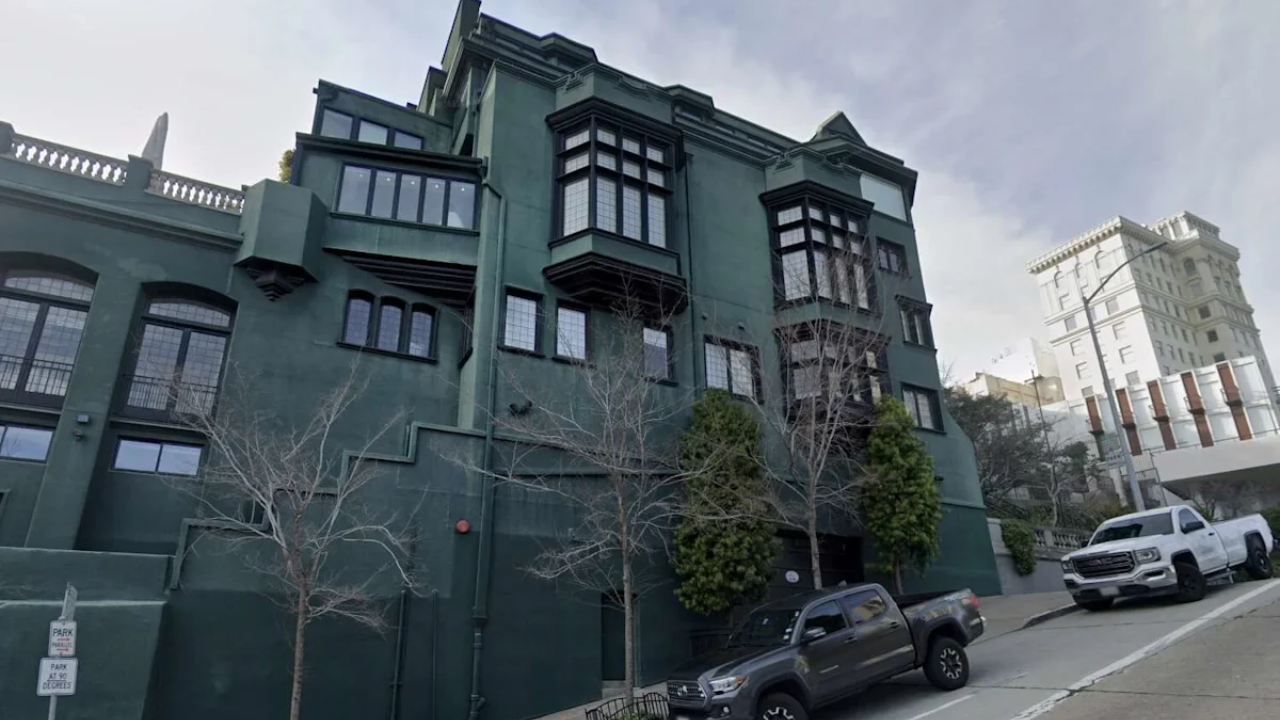
Walk past 2222 Broadway on a foggy Tuesday morning, and you will see what San Francisco wants you to see.
Limestone. Wrought iron. The quiet, intimidating geometry of Pacific Heights wealth, staring out over the Golden Gate Bridge like a monarch surveying a conquered territory. To the untrained eye, it is simply another trophy asset in a neighborhood where nine-figure net worths are the entry fee for a decent view. Right now, the property sits on the market with a price tag of $25 million, waiting for a tech founder, a venture capitalist, or an international industrialist to sign the wire transfer and claim the keys.
Wait. Look closer at the brickwork.
Real estate listings in this zip code love to sanitize the past. They use words like pedigree, provenance, and historic charm. They show you photographs of the sun-drenched terrace, the imported marble, and the manicured gardens, hoping you will mistake a high price tag for moral respectability. Yet, if the walls of this particular mansion could speak, they wouldn't whisper polite dinner-party anecdotes. They would roar with the sound of illicit champagne corks, whispered wartime secrets, and the heavy footsteps of men sneaking out the back door before dawn.
This house was not built for a family. It was built for a secret.
The Architecture of Obsession
To understand why a single piece of residential real estate can hold a city’s entire shadow history, you have to go back to 1906. San Francisco was burning, or just beginning to rise from the ash. While most of the city was scrambling for lumber and nails to rebuild basic shelter, a prominent San Francisco figure—historically tied to the era's booming commerce and political machinery—commissioned an architectural sanctuary on Broadway.
Imagine, for a moment, a hypothetical wealthy patron standing on this exact hillside in the late 1900s, blueprints rolled under one arm, looking down at the smoking ruins of the old city. Let’s call him Arthur, though his real-world counterparts wore the exact same bespoke wool suits and carried the same heavy gold pocket watches. Arthur didn't want a home where his wife would host charity teas. He wanted a love nest. A gilded cage tucked high enough on the hill to escape the prying eyes of Nob Hill society, yet close enough to the financial district to slip away during a long afternoon.
That is the invisible origin of so much luxury architecture. We like to pretend that grand mansions are monuments to civic pride and family legacy. Often, they are monuments to desire. They are physical manifestations of what rich men build when they think nobody is watching.
Consider the layout of such spaces. Every sweeping staircase, every tucked-away parlor, every secondary exit onto an alley wasn't just an aesthetic choice by the architect. It was a functional requirement for discretion. When you walk through a house designed for a mistress, the floor plan itself tells a story of paranoia and passion. You feel it in the way the hallways curve away from the main windows, shielding the interior from the street below.
When the Velvet Curtains Closed
Romance, especially the illicit kind, rarely survives the changing tides of San Francisco real estate. By the time the Roaring Twenties gave way to the desperation of the Great Depression, the mansion’s original purpose had curdled into something far more transactional.
During the 1930s, the property became linked to one of the city's most notorious high-end brothels.
If you have ever researched the underground economy of pre-war San Francisco, you know that vice wasn't relegated to the docks of the Barbary Coast. The real money—the untouchable, politically protected money—flowed through Pacific Heights. Judges, mayors, shipping magnates, and police commissioners didn't want to rub shoulders with drunken sailors in Chinatown basements. They wanted crystal glasses. They wanted heavy velvet drapes, Persian rugs, and a piano player in the parlor who knew when to play loud enough to drown out a conversation.
Picture the contrast. Outside on Broadway, milk wagons rattled over the cobblestones in the early morning mist, and society matrons walked their dogs past manicured hedges. Inside, behind thick limestone walls, the air hung heavy with expensive French perfume, cigar smoke, and the quiet clink of cash changing hands.
I remember walking through a preserved 1920s speakeasy in North Beach years ago, running my fingers along a hidden wooden panel that swung open into a narrow brick stairwell. The air back there smelled like damp earth and old cedar, a sensory time capsule of pure adrenaline. You could immediately feel the rush of a hundred different hurried exits—the sudden panic when a knock came at the front door, the scramble for coats, the silence that had to fall over a room in three seconds flat. That is the exact energy baked into the plaster of 2222 Broadway. When a house spends a decade operating outside the law, the secrecy becomes structural.
Uniforms, Whiskey, and the Brink of War
Then came December 1941, and the entire Pacific Coast tilted toward the ocean.
San Francisco ceased to be a playground for local elites and became the primary staging ground for the American war effort in the Pacific. Hundreds of thousands of young men poured through the Golden Gate, knowing there was a very real chance they would never see the California coastline again.
In the chaos of World War II, the Broadway mansion transformed once again, shedding its reputation as a house of ill repute to become a wartime officers’ club.
Think about the emotional whiplash contained within those four walls. Just a few years earlier, the rooms had echoed with the cynical laughter of corrupt politicians and madams. Suddenly, those same parlors were filled with twenty-two-year-old Navy ensigns and Army Air Corps pilots in crisp wool uniforms, drinking bourbon out of cut-glass tumblers and staring out at the Marin Headlands, wondering what awaited them in the South Pacific.
As a metaphor, the house acted like a theatrical stage that never struck its set—only the actors and the stakes changed. The velvet curtains remained. The grand fireplace still crackled. Yet the conversations shifted from municipal bribes and secret affairs to troop movements, letters from mothers in Ohio, and the quiet terror of shipping out at dawn. For thousands of young officers, this mansion was their final taste of civilization, beauty, and warmth before stepping onto a gray troop transport bound for Guadalcanal or Midway.
The Economics of Sanitizing the Past
Which brings us back to today, and that staggering $25 million asking price.
In modern San Francisco, real estate is the ultimate alchemy. Give a building enough square footage, throw in a chef’s kitchen with Sub-Zero appliances, add a panoramic view of Alcatraz and the Golden Gate, and you can wash away a century of scandal. Today’s buyers rarely ask who died in the master bedroom or which madam counted cash in the library. They care about price per square foot, seismic retrofitting, and whether the wine cellar holds two thousand bottles or three.
Let’s look at the numbers, because the math of Pacific Heights tells its own ruthless story. Over the past century, this property has weathered the 1906 earthquake aftermath, the 1929 crash, wartime rationing, the dot-com bust, and the recent post-pandemic exodus from downtown San Francisco. While commercial office towers half a mile away in the Financial District have traded at seventy percent discounts, trophy residential real estate on the northern slope of Pacific Heights has remained stubbornly, almost defiantly expensive.
Why? Because scarcity in San Francisco isn't just an economic principle; it is a geography problem. You cannot manufacture more land overlooking the bay. There are only so many flat-ish lots along Broadway with unobstructed sightlines to the water. When a house occupies one of those sacred perches, its history becomes a quirky cocktail party anecdote rather than a liability.
Actually, in a city increasingly dominated by sterile glass condos and minimalist tech-bro remodels, a little bit of dirt in the foundation might be the only thing that makes a mansion feel alive.
What We Actually Buy When We Buy History
I used to think that living in a house with a dark or scandalous past would feel suffocating. Years ago, I rented a tiny, crooked apartment in an old Victorian near Alamo Square that had once been a boarding house for gold miners, and later a commune in the late sixties. At night, when the fog rolled in and the floorboards groaned under the shifting temperature, you never quite felt alone. It was unsettling at first—almost eerie to realize that your quiet Tuesday night was happening on top of a thousand forgotten dramas.
Over time, though, that discomfort turned into a strange kind of comfort. You realize that you aren't the owner of a historic building; you are just the current night watchman.
That is the secret that whoever writes the $25 million check for 2222 Broadway will eventually discover. You can gut the bathrooms. You can rip out the old carpet, install smart-home lighting, and hang minimalist contemporary art over the mantel. You can turn a former brothel and wartime bar into a serene wellness sanctuary with a cold plunge and a Pilates studio.
Still, the ghosts don't leave. Not the supernatural kind, of course, but the human kind. The quiet residue of a lovesick tycoon waiting by the window, a madam locking the safe at 4:00 AM, a young lieutenant taking one last look at the Golden Gate Bridge before heading off to war.
Long after the current listing agent takes down the sign, and long after the next billionaire moves on to another coastal enclave, the limestone on Broadway will still be standing in the fog, keeping everyone's secrets.