Naval procurement has been trapped in the same design bottleneck for a century. Engineers call it the iron triangle. You can build a boat with high speed, long range, or a massive payload capacity. Pick two, because you cannot have the third. If you pack a hull with fuel for long transit, you sacrifice cargo space. If you build a lightning-fast interceptor, it lacks the range to cross an ocean and the muscle to carry heavy freight.
Ghostworks just blew up that entire premise.
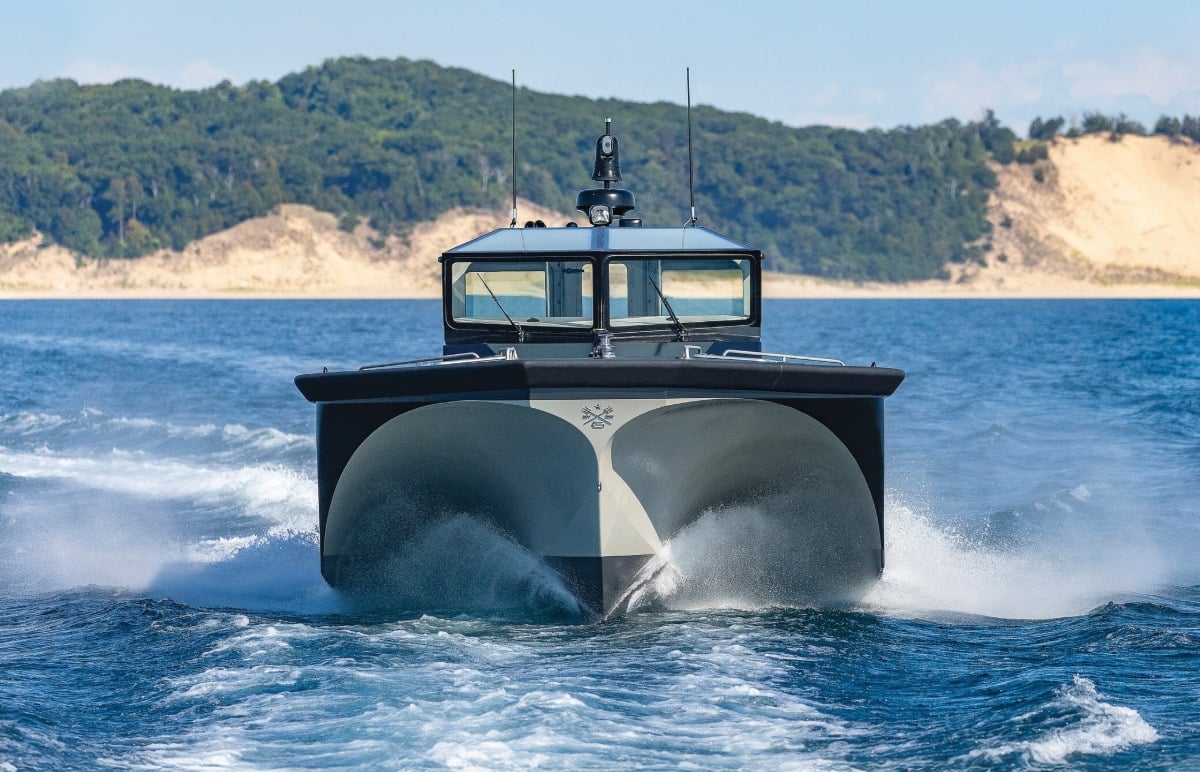
At the Pennsylvania Defense and Innovation Summit at the U.S. Army War College, the boutique shipyard introduced MRLN. Pronounced "Merlin," it stands for Multirole Remote Logistics Node. It isn't a new boat. It is a remote-pilot autonomy mission layer designed to sit on top of Ghostworks’ existing high-performance hulls, starting with their 40-foot carbon fiber Minerva-class M-Hull.
This isn't another tech startup building a single-use drone boat. It's a fundamental shift in how the military can deploy maritime assets in contested shallow waters.
The Problem with Current Naval Logistics
If you look at how the U.S. Navy and Marine Corps handle littoral logistics today, it's messy. Moving fuel, ammo, or medical supplies through contested island chains requires specialized vessels for every specific task. You have landing craft that move slow, fast transport ships that can't carry heavy loads into shallow water, and manned crews risking their lives in predictable transit corridors.
When a commander needs to change a mission profile on the fly, they usually have to swap the whole boat. That doesn't work in a fast-moving conflict.
MRLN fixes this by focusing entirely on modularity. Ghostworks partnered with General Atomics Aeronautical Systems (GA-ASI) and Mercury Marine to build the system. General Atomics took the sensor and autonomous software architectures they perfected on unmanned aircraft and adapted them for ocean swells. Mercury Marine brought drive-by-wire propulsion and their Command Gateway tech to ensure the boat can fight through heavy currents and hold its position indefinitely.
The result? A single 40-foot carbon fiber hull can carry 17,500 pounds of payload at a cruising speed of 30 knots while handling Sea State 4 conditions.
Breaking the Iron Triangle in the Field
The magic here isn't just the raw numbers. It is the ability to change what the boat does without sending it back to a shipyard. Operators can reconfigure mission profiles directly in the field.
Imagine a single Minerva-class vessel starting the morning running an autonomous fuel delivery to an isolated outpost in shallow water. Once that cargo is dropped, the operator reconfigures the profile remotely. On the return trip, that exact same vessel shifts into a high-speed search-and-rescue platform or an intelligence-gathering asset.
- Mission 1: Fuel delivery to isolated, shallow-water units.
- Mission 2: High-value cargo transport through contested channels.
- Mission 3: Rapid search-and-rescue insertion.
- Mission 4: Intelligence, surveillance, and reconnaissance (ISR) tracking.
- Mission 5: Fleet communications relay and station-keeping.
The system architecture is entirely subsystem-agnostic. It doesn't care what sensors or cargo pods you bolt onto it. It operates with its own independent communications connectivity, meaning it can function even when broader military networks are jammed or degraded.
Why Human in the Loop is a Necessity
Full autonomy sounds great in a marketing deck, but the real world is chaotic. Rogue waves, shifting sandbars, and unpredictable enemy countermeasures break pure AI logic every single day. Ghostworks didn't fall into the trap of making MRLN fully hands-off.
The system uses a human-in-the-loop setup. The vessel navigates, balances its propulsion, and manages its transit autonomously, but a remote human operator keeps eyes on the situational awareness data at all times. The second something goes sideways, or the mission objective changes, the human takes instant manual control.
This setup also lets the vessels operate as optionally manned. The hull is built to handle a physical crew when the situation dictates it, but when the risk profile goes up, you pull the people out and switch to remote piloting without losing performance.
What This Means for Next-Gen Fleet Design
Naval planners need to stop thinking about hulls and start thinking about software layers. Building massive, billion-dollar vessels takes a decade. Upgrading software and swapping modular cargo bays takes days.
Ghostworks is proving that high-strength, racing-grade carbon fiber hull forms mixed with aerospace-grade autonomy software can do the work of three different legacy platforms. It keeps humans out of the danger zone during routine logistics runs, and it gives field commanders tactical options they simply didn’t have last year.
If you want to see where naval architecture is going, look at how software integrations like MRLN are redefining the physical constraints of old-school shipyards. The future of the littoral battlespace belongs to the adaptable, not just the big.