Glass reflects what you want it to see.
That is the first lesson of the lens. Stand in the right light, adjust the angle by a fraction of a millimeter, and a dark room becomes a mirror. You do not see the dust motes hanging in the stale air. You do not see the peeling paint on the window frame. You see only your own face, neatly framed, reassuringly clear, looking back at you. Also making headlines lately: The Narrow Water Where the World Holds Its Breath.
For years, the public argument for accountability in law enforcement has rested on a simple, almost poetic faith in glass. Put a camera on an officer. Mount a small, black box of electronics to a uniform chest. Let the electronics hum quietly against the fabric, recording the heartbeat of the street, the sudden rise of a voice, the flash of red and blue light against asphalt. The promise was elementary. Sunlight is the best disinfectant.
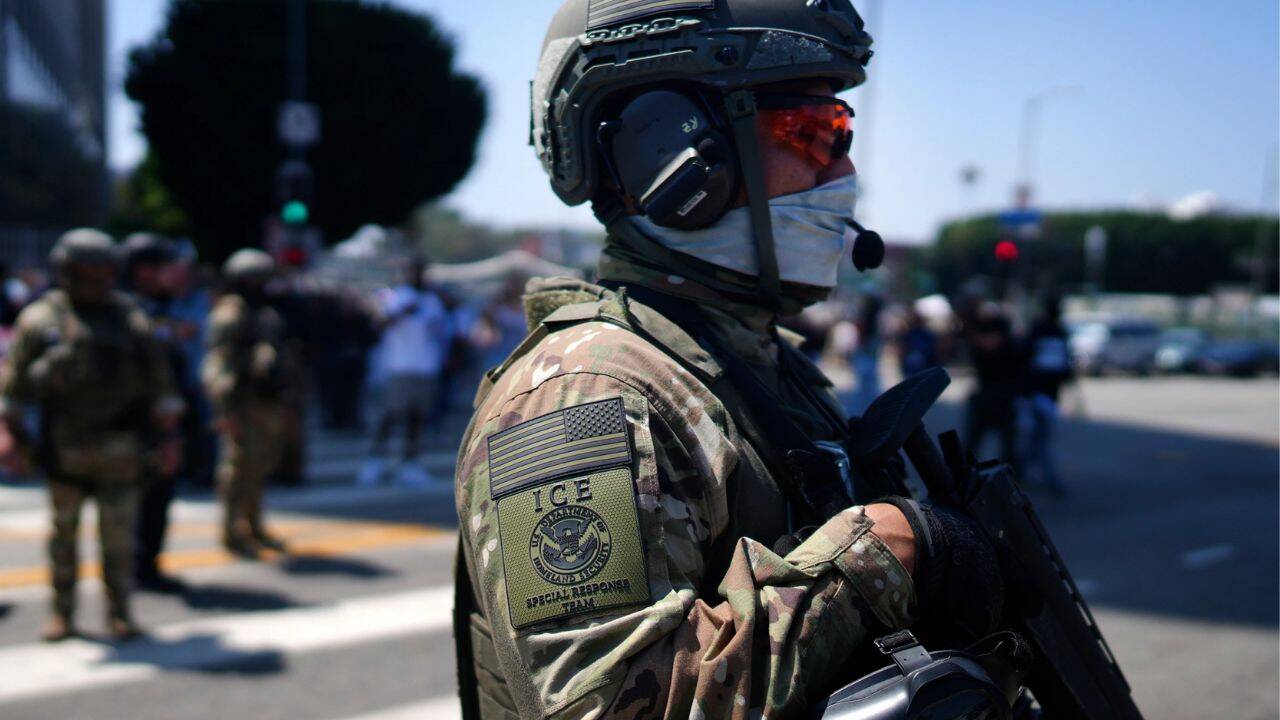
Then came Immigration and Customs Enforcement, rolling out its long-awaited body camera program. Additional details on this are detailed by The Washington Post.
Listen closely to the announcement. The hardware is there. The lenses are polished. The batteries hold a charge. But tucked away in the fine print, buried beneath bureaucratic boilerplate, sits a clause that changes the entire physics of the experiment.
The agency decides which footage goes public.
Pause for a second. Let that sink in.
Imagine you are standing in a dimly lit hallway. Across from you is a closed door. Behind that door, an encounter is taking place. Voices are raised. Someone reaches for a badge; someone else reaches for a phone. A body camera flashes. Every second of friction, every shouted command, every mistake and every act of restraint is captured in crisp, high-definition digital pixels. It exists. It is real. It is stored on a server somewhere, waiting.
And then, the person who holds the key to the door decides whether you are allowed to look through the glass.
This is not transparency. This is curation.
To understand why this distinction matters, we have to look past the press releases and step back into the messy, human reality of federal enforcement operations.
Consider a hypothetical scenario, though it mirrors patterns we have seen repeat across jurisdictions for decades. An enforcement team arrives at a workplace before dawn. The air is cold; breath hangs in clouds. The target is an individual who has lived in a quiet neighborhood for years, working an early shift, dropping children off at school. The interaction turns chaotic. A door is pushed open. Shouts pierce the morning silence. A struggle ensues. Within seconds, a chaotic swirl of motion is immortalized on a sensor attached to an agent's vest.
In the old days, before the era of digital optics, the story of those few seconds belonged to the contested memories of the people in the room. It was word against word. The agency would issue a statement. The family would issue a counter-statement. The truth fractured into a thousand jagged pieces, fought over in civil courtrooms and local council meetings.
The body camera was supposed to fix this. It was supposed to serve as an unblinking witness, an impartial arbiter that did not care about badges or immigration status, politics or public relations. It was supposed to provide a single, objective ground truth.
Instead, by giving the agency absolute discretion over redaction and release, the new policy turns the camera from an instrument of accountability into a narrative shield.
When an institution holds the exclusive right to edit history, history tends to favor the institution.
Think about how human memory works. We look for patterns. We seek simplicity in complex tragedies. If an agency releases a carefully clipped thirty-second segment of a ten-minute encounter, the public mind seizes upon it. The snippet becomes the whole. The context—the frantic questions, the lack of clear identification, the mounting panic—is sanded away by the editing software.
Conversely, when an incident goes sideways, when a tactical decision turns indefensible, the default setting is silence. Requests for footage disappear into a labyrinth of Freedom of Information Act exemptions, pending investigations, and privacy protections. Weeks turn into months. Months turn into years. By the time a court order finally pries the digital files loose from the server, the public has moved on. The urgency has bled out of the story. The damage is done, and the record remains forever skewed.
This is the hidden cost of conditional transparency. It creates an illusion of reform while preserving the machinery of control.
We have seen this script before. Across municipal police departments, county sheriffs' offices, and state troopers, the rollout of body-worn cameras was hailed as a revolution. Yet, studies and investigative reports have repeatedly shown that without strict, independent mandates for public disclosure—rules that require footage to be released within days, not years, regardless of how it reflects on the badge—the technology simply becomes another line item in the public relations budget.
Federal law enforcement operates behind an even thicker curtain. ICE agents cross state lines, coordinate with local jails, and execute operations with a sprawling jurisdictional footprint that often escapes local oversight. When they deploy body cameras without a transparent public release framework, they are not answering to the communities they patrol. They are answering only to themselves.
The danger here is not just political. It is psychological.
It wears down our collective capacity for empathy. When people stop believing that systems can be held accountable, they stop expecting justice. Cynicism creeps in like damp air through an old floorboard. We shrug. We accept that power protects power, that the lens will only ever show us what the powerful want us to see.
We cannot afford that cynicism. Not now.
The debate over body cameras is ultimately a debate over who gets to narrate our shared reality. Do we want a society where the state acts as the sole author of its own actions, editing out the messy, uncomfortable truths to preserve a pristine image? Or do we demand a system where the glass is truly transparent, allowing the raw, unfiltered light of reality to spill across the floor?
The cameras are turned on. The red lights are blinking in the dark.
The only question left is whether we will keep our eyes closed while someone else decides what we are allowed to witness.

/cdn.vox-cdn.com/uploads/chorus_asset/file/22155007/doc_ock.jpg)