At 8:42 in the morning, the espresso machine on the thirty-fourth floor of the King Abdullah Financial District usually makes a specific, comforting hiss. It is the sound of ambition waking up. Outside the floor-to-ceiling windows, the Riyadh skyline looks like a rendering of the twenty-second century—sharp geometric angles, crystalline facades designed by the world's most celebrated architects, and towers that catch the desert sun like giant mirrors. Inside, analysts adjust their cuffs, glance at global crude benchmarks, and sip coffee that costs more than a meal in most capitals.
Then the glass vibrates. In other updates, read about: रियाद पर हूती मिसाइल हमले की असली कहानी और खाड़ी के हवाई सुरक्षा कवच की असलियत.
Not the low, rhythmic rumble of highway traffic or the distant thud of ongoing construction that has defined Saudi Arabia’s capital for the last decade. This is a sharp, concussive slap against the atmosphere. A sound that bypasses the ears and registers directly in the sternum.
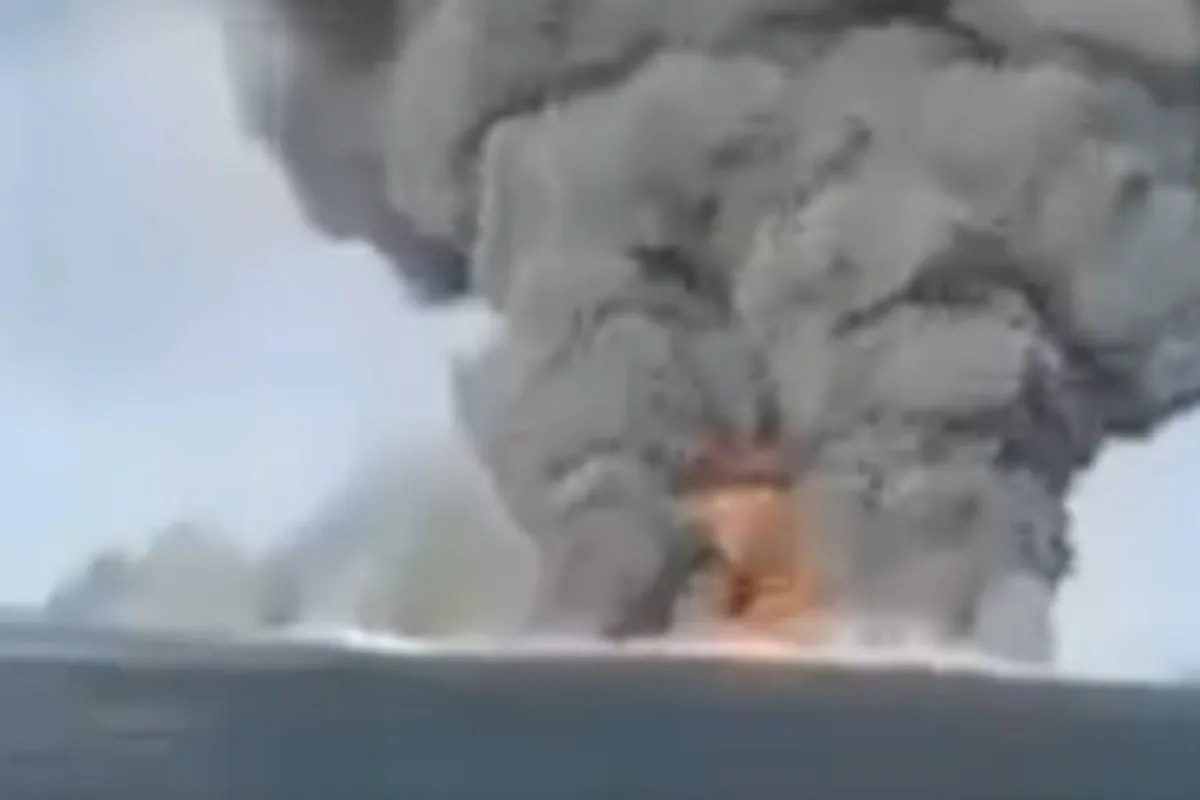
Within seconds, reports began filtering out of the capital like smoke through vents. Witnesses described a missile strike targeting Riyadh’s premier financial hub, with visible damage sustained by an Aramco tower. Sirens wailed across the pristine boulevards of the King Abdullah Financial District, known locally as KAFD, cutting through the curated silence of a zone built specifically to project permanence, stability, and post-oil inevitability. The New York Times has also covered this fascinating subject in great detail.
The wire services reported it in thirty words. Cold. Efficient. Forgettable.
They told you what happened. They missed the entire point of why it matters. Because when a projectile strikes the gleaming heart of Riyadh’s financial district and scars a tower bearing the Aramco name, the casualty isn't just concrete and reinforced glazing. It is a multi-trillion-dollar psychological contract.
The Architecture of Invincibility
To understand the shockwave moving through boardrooms from London to Singapore, you have to stand at the base of the KAFD towers on a normal Tuesday. I have walked those shaded, climate-controlled skywalks when the midday heat outside hits forty-five degrees Celsius. The entire district feels like an audacious bet against geography and history.
For years, Saudi Arabia has been selling the world a very specific story. Under Vision 2030, the kingdom set out to transform itself from a closed, oil-dependent monarchy into the undisputed commercial, financial, and logistical center of the Middle East. To pull that off, Riyadh demanded that multinational corporations move their regional headquarters to the city. Banks, consulting firms, tech giants—if they wanted lucrative state contracts, they had to plant their flags in Riyadh.
And the crown jewel of that mandate was KAFD. Built at a cost exceeding ten billion dollars, its honeycombed towers and angular roofs were engineered to scream one word to nervous foreign executives: safety.
Consider a hypothetical scenario that plays out in real life every single week in these buildings. Picture Tariq, a thirty-eight-year-old risk strategist who relocated his family from Dubai to Riyadh eighteen months ago, and Elena, a portfolio manager flying in from Zurich for a forty-eight-hour round of sovereign wealth meetings. Neither of them works in defense. Neither of them carries a weapon. They traffic in spreadsheets, yield curves, and infrastructure bonds. When Elena checks into her hotel overlooking the financial district, she isn't calculating blast radii. She is checking the Wi-Fi speed and the traffic time to the airport.
That is the invisible infrastructure of global capital. Money is profoundly cowardly. It will tolerate high taxes, brutal weather, and suffocating bureaucracy, provided one foundational condition is met: the illusion that tomorrow will look roughly like today.
When witnesses on the ground looked up to see smoke curling near an Aramco facility in the middle of the capital's financial district, that illusion cracked.
Why the Aramco Name Changes the Equation
If a stray munition hits an empty desert outpost, markets shrug. If it hits a peripheral warehouse, insurers adjust a decimal point and move on.
Aramco is different.
Saudi Aramco is not merely a company; it is the financial spine of the Saudi state and the central bank of global energy. Even as Riyadh pours hundreds of billions into tourism, artificial intelligence, and futuristic cities, Aramco’s crude revenues remain the engine funding the entire transformation. Every gleaming metro line, every sovereign fund investment, every subsidized corporate relocation traces back to the cash flow generated by those wells and pipelines.
To strike an Aramco tower inside the financial district is to send a message with surgical symbolism. Think of a medieval castle whose outer walls were supposedly pushed fifty miles away from the keep, only for an arrow to land directly on the dining table in the great hall.
This is not the first time the kingdom's energy infrastructure has felt the heat of regional conflict. Anyone watching the Gulf remembers September 2019, when coordinated drone and cruise missile strikes hit the Abqaiq and Khurais processing facilities, temporarily knocking out half of Saudi Arabia’s oil production—roughly five percent of the entire world's daily supply. Back then, the shock was operational. It exposed how vulnerable massive, centralized energy installations were to relatively inexpensive aerial threats.
But Abqaiq was an industrial complex in the Eastern Province. Riyadh’s financial district is where the suits live.
The Anatomy of a Modern Threat
You might wonder how a missile reaches the center of one of the most heavily defended capitals on earth. Saudi Arabia spends tens of billions of dollars annually on defense, maintaining sophisticated layered air defense networks—Patriot batteries, THAAD interceptors, and advanced radar arrays scanning the skies twenty-four hours a day.
Yet modern aerial warfare has rewritten the rules of interception.
Imagine trying to catch a handful of gravel thrown at you in a dark room while holding a flashlight. Even if you catch ninety-five percent of the pebbles, the one that slips past your fingers still hits you in the eye. Ballistic missiles travel at hypersonic speeds during their terminal descent, leaving defenders mere seconds to calculate trajectories and launch interceptors. When those projectiles are paired with low-flying cruise missiles or swarms of radar-evading drones, the math tilts dangerously in favor of the attacker.
Even a "successful" interception carries a price tag. When a multi-million-dollar interceptor collides with an incoming warhead miles above a dense urban center, gravity still wins. Shrapnel, propellant tanks, and scorched metal have to fall somewhere. To a witness standing on the sidewalk below, the distinction between a direct hit and falling debris from a mid-air collision is purely academic when glass is raining onto the pavement.
And in the hyper-connected nervous system of global media, the visuals do the damage long before the forensic investigators arrive. Smartphone videos uploaded within minutes show shattered panes, emergency lights flashing against marble facades, and startled office workers hustling toward underground parking levels. By the time official statements clarify the extent of the structural damage, the images have already bounced across every trading terminal from Wall Street to Tokyo.
The Quiet Calculation in the Boardroom
Let’s look at what happens in the hours after the dust settles, far away from the cordon tape in Riyadh.
In London, a compliance officer pulls up the firm's Middle East duty-of-care policy. In New York, a real estate committee quietly pauses a lease expansion in KAFD. In Frankfurt, an aviation insurer updates the war-risk premium for flights routing over the Arabian Peninsula.
None of these people make fiery speeches. They don't issue press releases condemning geopolitics. They simply adjust risk models.
That is the hidden cost of an attack on a financial district. You cannot measure it solely in shattered curtain walls or damaged HVAC units on an Aramco tower. You measure it in hesitation.
Consider the friction introduced into everyday business life:
- Talent retention: Convincing a senior software architect or a veteran investment banker to relocate their spouse and children to Riyadh already required generous compensation packages, housing allowances, and international school stipends. Security was the baseline promise that made those packages work. Once air-raid sirens become part of the morning commute, the cost of recruiting global talent spikes overnight.
- Capital allocation: Foreign direct investment—the lifeblood Vision 2030 desperately needs to hit its targets—relies on predictable horizons. Investors hate surprises that involve kinetic force. If an investor has to factor air defense interception rates into a discounted cash flow model for a Riyadh hotel or tech hub, they will demand a steeper return—or take their money to Singapore, Zurich, or Austin instead.
- Operational paralysis: Even brief lockdowns, airspace closures, and emergency evacuations remind executives just how tightly coupled the Gulf's economy remains to regional fault lines. You can build a wall of glass around a financial district, but you cannot wall off geography.
The Illusion of Compartmentalization
For the past few years, the dominant thesis among Gulf policymakers and Western business leaders was that economics could be cleanly separated from regional turmoil. The idea was simple: build an oasis of prosperity so compelling, so interconnected with global finance, that everyone has a vested interest in keeping it peaceful.
I used to believe that thesis myself. Walking through Riyadh’s booming districts, seeing cranes towering over every horizon and young Saudi entrepreneurs pitching venture funds until midnight, the momentum felt unstoppable. You looked at the sheer scale of the concrete being poured and thought, Nobody blows up a construction site this expensive.
History, however, has zero respect for sunk costs.
The Middle East does not allow neat compartments. When conflicts simmer across borders—whether driven by proxy networks, maritime chokepoints in the Red Sea, or broader regional escalations—the wealth centers of the Gulf sit squarely within range. Missile technology has democratized reach. Groups that once struggled to project power beyond a single valley can now threaten skyscrapers hundreds of miles away.
And when they aim at a financial district, they aren't trying to conquer territory. They are trying to break confidence. They know that a damaged Aramco tower in Riyadh generates more global anxiety per pound of explosive than a hundred rounds fired in a remote border skirmish.
What Remains When the Sirens Stop
By the next morning, crews in high-visibility vests are already at work in Riyadh. Cracked glass gets taped, boarded, and scheduled for replacement. Sweeping trucks clear the fine dust from the wide avenues. Inside the undamaged towers, the espresso machines hiss again, and analysts log back into their terminals, determined to prove that business goes on.
Resilience is a point of pride in the kingdom, and rightly so. Riyadh will repair the facade of the Aramco tower faster than most Western cities could approve a building permit. The cranes will keep swinging. The deals will keep getting pitched.
Yet something subtle has shifted in the air above those honeycombed roofs.
When Tariq and Elena—our hypothetical strategist and portfolio manager—walk back across the skybridge to their offices, they still carry their leather briefcases and their encrypted phones. Outwardly, nothing has changed. The marble still gleams. The air conditioning still hums at a crisp twenty-one degrees.
Except now, every time a heavy door slams down the hall, or a low-flying jet rumbles overhead, both of them pause for half a second and look toward the window.