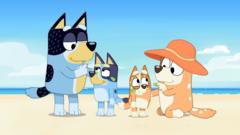
A blue heeler puppy from Brisbane has done what decades of Australian trade envoys could not. She conquered the global entertainment market. Bluey is a multi-billion-dollar juggernaut, dominating screens from London to Los Angeles, and driving massive licensing revenue for the BBC and Disney. Yet, while the show is celebrated for its hyper-local portrayal of suburban Queensland life, it remains entirely silent on the deepest history of the land it occupies.
The ground beneath the Heelers’ fictional home is Turrbal and Yuggera country. These lands carry languages that have been spoken continuously for over 60,000 years. If Bluey were to broadcast even a single episode in one of Australia’s First Nations languages, it would instantly expose tens of millions of children worldwide to the oldest living culture on earth.
It does not happen. The reason is not a lack of interest from creators or a lack of appetite from audiences. The barrier is a systemic combination of broadcasting policy failures, the rigid financial structures of international co-productions, and a streaming distribution model that values mass scale over cultural preservation. While smaller, state-subsidized networks in other countries successfully use animation to save endangered tongues, the commercial machinery behind Australia's biggest cultural export is designed to keep local languages off the global stage.
The Brutal Math of Global Dubbing
The television industry operates on strict financial formulas. When BBC Studios and Ludo Studio produce Bluey, they look at translation through the lens of return on investment. Dubbing an animated series into a new language is a costly, highly technical process.
A standard localization effort requires translating scripts, hiring native-speaking voice actors, matching mouth movements, and re-mixing the entire audio track. For a major global market like Latin American Spanish or Mandarin Chinese, these costs are easily absorbed by the millions of potential subscribers who will watch the localized version. The investment yields direct financial returns.
For indigenous languages, the commercial equation collapses.
Consider a language like Yolngu Matha or Gamilaraay. These languages have thousands, or in some cases only hundreds, of fluent speakers left. A commercial distributor looking purely at spreadsheets sees no financial justification for spending tens of thousands of dollars per episode to dub a show for a target audience of that size. The cost per viewer is simply too high.
This is where public broadcasting is supposed to step in. Public funding exists precisely to correct market failures, supporting projects that have high social value but low commercial viability. However, Australia's public broadcasting infrastructure is not set up to handle this responsibility at scale.
The Policy Gap at the Heart of Australian Broadcasting
The Australian Broadcasting Corporation operates under a strict charter. It must provide services that contribute to a sense of national identity and reflect the cultural diversity of the Australian community. Yet, the funding to turn these ideals into reality has been systematically eroded.
Over the past decade, successive federal budget decisions have squeezed the ABC’s operational capacity. When a public broadcaster is forced to choose between maintaining basic news bureaus and funding expensive indigenous language dubs for children's programming, news and mainstream content always win. The numbers tell the story.
While the ABC has made efforts to include Indigenous words and greetings in its programming, these are sporadic and symbolic. They are a far cry from producing or dubbing full-length, high-profile episodes.
Australia's dedicated indigenous broadcaster, National Indigenous Television, operates on a fraction of the budget allocated to mainstream networks. NITV has successfully dubbed smaller children's shows into languages like Pitjantjatjara, but these projects rely on piecemeal grants and community goodwill. They lack the institutional backing required to touch a flagship property like Bluey.
The contrast with other nations is stark.
How New Zealand Left Australia Behind
To see what is possible when a government prioritizes linguistic survival, one only has to look across the Tasman Sea. New Zealand has built a robust infrastructure for Maori language broadcasting that serves as a global model.
The New Zealand government funded a complete Te Reo Maori dub of Disney’s Moana and The Lion King. These were not obscure, low-budget indie projects. They were massive, mainstream theatrical releases.
Language Support Infrastructure: A Comparison

Country: New Zealand
Central Funding Body: Te Māngai Pāho (Dedicated funding for Māori media)
Treaty Mandate: Strong legislative backing under Treaty of Waitangi
Key Achievements: Full Te Reo dubs of major Disney films; daily mainstream integration

Country: Australia
Central Funding Body: No dedicated, centralized Indigenous media funding equivalent
Treaty Mandate: No national treaty or constitutional recognition of language rights
Key Achievements: Scattered, short-form children's content on low-budget networks
This did not happen by accident. New Zealand established Te Māngai Pāho, a government funding agency dedicated solely to promoting Māori language and culture through broadcasting. This agency has a clear mandate and a secure budget. It allows creators to bypass the commercial gatekeepers of international media companies.
If an agency like Te Māngai Pāho existed in Australia with equivalent funding, the conversation around Bluey would be entirely different. The money to pay for the translation, the cultural consultants, and the voice actors would come from a dedicated public fund. The commercial distributors would have no financial excuse to say no.
Instead, Australian media policy leaves language preservation to underfunded community groups and overstretched public broadcasters. The result is a system that praises diversity in promotional materials but refuses to pay for it on screen.
The Cultural Protocol Bottleneck
Even if the funding issues were resolved tomorrow, translating a show like Bluey into an Indigenous Australian language presents unique cultural and logistical hurdles.
In Australia, languages are deeply tied to specific tracts of land and particular communities. You cannot simply hire a translator in Sydney to translate a script into an Indigenous language without extensive consultation.
To dub Bluey into Yuggera, the language of the Brisbane area, producers would need to engage in a lengthy process of community consultation. Elders must be consulted to ensure that words are used correctly and that cultural protocols are respected.
Some modern concepts do not have direct equivalents in ancient languages. Linguists and community elders must work together to develop new words or adapt existing ones. This is a slow, careful process that runs directly counter to the breakneck speed of modern animation production.
[Traditional Animation Pipeline] ---> [Fast, Linear Translation] ---> [Global Distribution]
                                             VS
[Consultation with Elders]   ---> [Linguistic Reconstruction]  ---> [Community Approval]
This second pathway requires time. In the commercial television industry, time is the most expensive commodity of all. Producers are under constant pressure to deliver episodes to streaming platforms to keep subscribers engaged. The administrative friction of cultural consultation is often viewed by international distributors as a risk to delivery schedules.
The Algorithm Does Not Value Oral History
The shift from traditional broadcast television to subscription streaming services has changed how content is valued. Platforms like Disney+ run on algorithms designed to maximize watch time and user retention.
These algorithms rely heavily on metadata, tagging, and massive scale. A show dubbed into a language with only five thousand speakers does not move the needle for a global streaming service's recommendation engine.
Worse, the physical design of these platforms marginalizes minority languages. Dropdown menus for audio tracks typically list dominant global languages like English, Spanish, German, and Japanese. There is rarely a slot or a search category for regional or indigenous languages.
This structural invisibility means that even if an indigenous dub of Bluey were produced, it would likely sit buried deep within the platform's interface, invisible to the vast majority of users. Without a deliberate, policy-driven mandate forcing platforms to highlight these languages, the market will continue to ignore them.
The True Value of a Talking Dog
The debate over Bluey and language is not about political correctness. It is about the survival of human heritage.
Languages are not just collections of words. They are unique ways of understanding the world, containing deep ecological knowledge and philosophical frameworks developed over millennia. When a language dies, that knowledge disappears forever.
Children's television is the most powerful tool for language normalization in existence. If a child sees their favorite television character speaking a language, that language ceases to be an artifact of the past. It becomes a living, breathing part of their modern world.
The global success of Bluey has given Australia an unprecedented cultural platform. Using that platform to broadcast the oldest living languages on earth would be an act of profound cultural leadership. It would show that Australia values its deep history as much as its modern success.
But as long as the decision rests solely with commercial distributors and underfunded public broadcasters, the blue heeler will keep speaking the language of her colonizers, while the ancient voices of her home suburb remain silent.