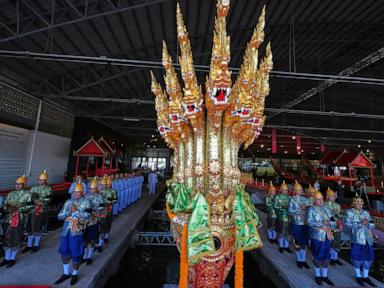
Blisters. That is the first thing nobody mentions when the photographs of gold-leafed prows and silk banners hit the international wire services.
Look closely at any glossy press release showing the preparations for Thailand’s Royal Barges Procession, and you will see immaculate symmetry. You will see fifty-two ancient vessels resting on the brown waters of Bangkok, lacquered in deep red and black, glittering like sunken treasure hauled back into the tropical sun. What the camera misses is the raw, peeling skin on the palms of two thousand two hundred sailors.
I stood along the Thonburi bank of the Chao Phraya River during a sweltering rehearsal afternoon a few years back, watching the Royal Thai Navy drill in the thick, humid air that smells permanently of diesel, jasmine, and river mud. Even from a hundred yards away, you could hear the slap of the wooden paddles hitting the water in unison. Thwack. Silence. Thwack. Silence.
The standard news coverage treats this centuries-old ritual like an elaborate boat parade—a colorful logistical marvel staged for tourists and dignitaries. That framing misses the point entirely. When you watch a line of fifty men in a single, narrow wooden hull try to move forty-six meters of solid teakwood against a treacherous river current without a single engine, you realize you are not watching a parade. You are watching a high-wire act performed over muddy water, where one mistimed breath can turn a sacred national symbol into a splintered catastrophe.
The Weight of Seven Hundred Years
To understand why grown men spend months weeping with muscle fatigue in the Bangkok heat, you have to understand what these boats actually are.
In the West, we put our history behind velvet ropes. We drain the fluids, polish the brass, and lock the artifacts inside climate-controlled museums so nothing can ever hurt them again. Thailand does the exact opposite. They take irreplaceable, centuries-old masterpieces of naval architecture and throw them into one of the busiest, choppiest commercial waterways in Southeast Asia.
Consider a hypothetical sailor—let’s call him Somchai, a twenty-two-year-old conscript from the rural northeast who had never seen the ocean, let alone rowed a royal vessel, before joining the Navy. When Somchai steps into the Suphannahong—the legendary Golden Swan barge, carved from a single gigantic teak trunk over a century ago—he isn't just boarding a boat. He is stepping inside a living relic that traces its lineage straight back to the Ayutthaya Kingdom in the fourteenth century.
Back then, these barges were not ceremonial. They were warships.
During the height of Ayutthaya’s power, river warfare was the ultimate test of military dominance. Kings commanded armadas of hundreds of oar-powered vessels, using the rhythm of chants to keep hundreds of paddlers synchronized amid the chaos of cannon fire and crashing hulls. Over the centuries, as the capital moved south to Bangkok and gunboats replaced wooden galleys, the barges shifted from instruments of war to floating cathedrals of Buddhist statecraft. Today, the Royal Barges Procession happens only on the rarest, most auspicious occasions—a coronation, a major royal anniversary, or the Royal Kathin ceremony, where the King travels by river to present new robes to Buddhist monks at Wat Arun, the Temple of Dawn.
Because the event happens so infrequently—sometimes once a decade, sometimes twice in five years—institutional memory is fragile. Every time the palace announces a procession, the Navy has to resurrect a dying art form from scratch.
Anatomy of an Impossible Machine
If you have never tried to steer a forty-six-meter canoe with zero keel and fifty human motors, it is hard to appreciate the sheer physics working against the crew.
The Chao Phraya is not a placid ornamental pond. It is a wide, muscular river with shifting undercurrents, sudden tidal surges, and the lingering wake of heavy cargo barges that churn the water even when river traffic is halted for rehearsals. The royal barges themselves are absurdly narrow—some barely three meters wide at the beam—with towering, intricately carved prows shaped like mythical serpents, garudas, and swans that catch crosswinds like giant sails.
How do you keep a floating needle straight in a crosswind?
You rely on a system of human telemetry that predates modern engineering by half a millennium. At the center of the flagship sits the coxswain, beating a rhythmic pulse with a silver-tipped bamboo pole or a small metal bell. Alongside him stands the chanter, whose voice carries across the water in a haunting, melodic cadence known as Kap He Ruea—the traditional boat songs composed by Prince Thammathibet in the eighteenth century.
These chants are not background music. They are the operating system.
When the chanter draws out a vowel, the oarsmen lift their paddles high into the air, catching the sunlight on the gold leaf in what looks like the wings of a giant bird. When the pitch drops, fifty blades plunge into the brown river simultaneously. If Somchai, sitting in row fourteen, loses focus for half a second and dips his blade early, he throws off the balance of the hull. If three men dip early, the barge veers toward the concrete embankments or, worse, drifts into the path of the vessel beside it.
During early dry-land training—before the sailors are even trusted near the priceless wooden hulls—they sit on concrete bleachers beside mock-up troughs of water, rowing for hours under the brutal tropical sun. Trainers walk the aisles with measuring sticks, checking the exact angle of every wrist, the height of every lifted blade, the posture of every spine. I remember watching one drill instructor bark at a line of recruits whose paddles were out of alignment by less than two inches. To an outsider, it looked like obsessive micromanagement. To the instructor, two inches in August meant a collision in October.
The Invisible Army Behind the Gold
While the sailors break their backs on the water, an entirely different kind of obsession unfolds inside the Royal Barges National Museum in Bangkok Noi, a quiet canal off the main river.
Months before a single oar touches the water, master artisans from the Fine Arts Department descend upon the towering sheds where the fleet sleeps between processions. For years at a time, the barges sit in dry dock, slowly surrendering to Bangkok’s relentless humidity. Wood warps. Lacquer cracks. Tiny beetles bore microscopic tunnels into century-old teak.
The restoration process is painfully slow, almost meditative in a city famous for roaring tuk-tuks and frantic neon energy. Artisans strip away flaking pigment by hand, apply fresh layers of black rak resin—a toxic sap harvested from lacquer trees that can blister human skin on contact—and press whisper-thin squares of real gold leaf onto thousands of tiny scales along the hull of the Anantanakkharat, the seven-headed Naga barge.
Think of it like restoring a Renaissance fresco, except instead of hanging the painting on a quiet museum wall afterward, you are going to launch it into a muddy river and let two thousand sailors climb all over it.
The stakes for these craftsmen are deeply personal. Many come from families who have worked on the royal fleet for three or four generations. When a craftsman applies glass mosaic tiles to the eyes of a mythical creature on the bow of a barge, he isn't clocking in for a government shift. He is signing his name to a piece of eternity, knowing full well that his grandchildren might one day point to that exact curve of gold leaf during a future reign.
Yet, when I spoke to observers near the dry docks, there was a quiet anxiety humming beneath the pride. Younger Thai artisans are increasingly drawn to digital design, commercial architecture, or jobs that don't require breathing lacquer fumes for modest civil-servant wages. Every time the fleet is restored, fewer master carvers remain who know the old secrets—how to mix natural pigments that won't fade under UV rays, or how to bend steamed wood to match a seventeenth-century curve without modern power tools.
Why This Matters Now
It is easy for a cynical modern observer—especially someone scrolling past photos on a phone screen thousands of miles away—to dismiss the Royal Barges Procession as an expensive anachronism. In an era of economic uncertainty, climate anxiety, and rapid modernization, why spend millions of baht and months of military manpower rowing gilded wooden boats down a river?
I used to harbor a version of that skepticism myself. Before seeing the rehearsals up close, I assumed the whole spectacle was largely a theatrical performance engineered for state television cameras and diplomatic prestige.
Standing on that riverbank changed my mind.
Watching those crews drill in the pouring monsoon rain—completely stripped of the pomp, wearing faded navy t-shirts and plastic ponchos instead of silk ceremonial tunics—stripped away the pageantry and revealed something much rawer. Thailand is a nation constantly negotiating the friction between hyper-modernity and deep tradition. Just a mile from the river, glass skyscrapers pierce the smog, high-speed skytrains hum above six-lane traffic jams, and teenagers scroll through TikTok in air-conditioned megamalls. Everything moves fast, breaks fast, and gets replaced.
The Royal Barges Procession is the deliberate, stubborn refusal to let everything become disposable.
It demands that thousands of people slow down to the speed of a human heartbeat. It forces modern naval officers, bureaucrats, impoverished conscripts, and master artisans to surrender their individual egos to a collective rhythm that has survived the fall of kingdoms, colonial pressures, world wars, and political upheavals. You cannot rush a forty-six-meter teakwood barge. You cannot automate the chanter’s breath. You cannot fake the calluses on the paddlers' hands.
The Silence Before the Oars Drop
When the actual day of the procession finally arrives, the transformation is almost disorienting.
The faded t-shirts vanish, replaced by vibrant, traditional red and gold uniforms modeled on ancient royal guards. The riverbanks, usually choked with commuter ferries and water taxis, fall eerily silent as commercial traffic is halted for hours. Hundreds of thousands of people line the concrete embankments, bridges, and temple courtyards, dressed in yellow or ceremonial colors, sweating quietly under umbrellas in the afternoon heat.
And then, from up the river, you hear it before you see it.
It is not the roar of engines or the blare of brass bands. It is a single, resonant human voice echoing off the water, rising and falling in an ancient minor key. Kap He Ruea.
Around the bend of the Chao Phraya comes the vanguard, followed by the Golden Swan, its towering neck gleaming like molten metal against the murky brown current. Fifty paddles rise in unison, pause for a fraction of a second at the top of their arc, and catch the late afternoon sun—a sudden burst of gold hanging in the humid air before plunging cleanly beneath the surface without a single stray splash.
Down in the hull, Somchai’s shoulders are burning, his palms are wrapped in medical tape beneath his uniform, and his eyes are locked squarely on the neck of the sailor sitting six inches in front of him, waiting for the next breath of the song.