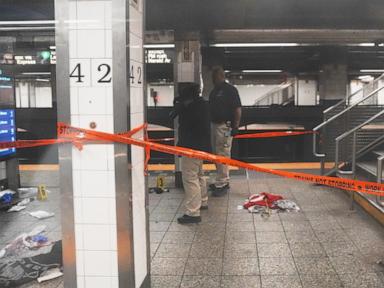
The newly released body camera footage from the April 11, 2026, shooting at Grand Central-42nd Street station does more than just document a killing. It exposes the razor-thin margin between a routine transit patrol and a nightmare in the heart of New York City. At approximately 9:40 a.m., NYPD detectives encountered 44-year-old Anthony Griffin on the 4/5/6 platform. Griffin, armed with a machete and having already slashed three elderly commuters, ignored more than 20 commands to drop his weapon, repeatedly claiming to be "Lucifer" before advancing on officers. He was shot twice and later pronounced dead at Bellevue Hospital.
While the footage provides a visceral look at the final seconds of Griffin’s life, it also raises haunting questions about the systemic failures that allowed a man with a known criminal history and obvious mental instability to roam the subway system with a blade.
The Twenty Commands
The video is a study in escalating tension. We see Detective Ryan Giuffre and his partner confront a man who isn't just a threat, but a person completely detached from reality. "Nobody wants to shoot you," Giuffre can be heard shouting, his voice a mix of professional authority and genuine desperation. "Drop the f**** knife."
Griffin didn't flee. He didn't surrender. Instead, he descended further into a private hell, shouting that he "didn't want to be here" and begging the officers to "shoot me." This is the "suicide by cop" scenario that every officer fears, yet the detectives remained remarkably patient given the carnage Griffin had already left behind.
Before the confrontation, Griffin had boarded a Manhattan-bound 7 train at Vernon Boulevard in Queens. Upon arriving at Grand Central, he began a random spree of violence that targeted the city's most vulnerable. He slashed an 84-year-old man on the 7 platform, then moved to the upper level where he attacked a 65-year-old man and a 70-year-old woman. One victim suffered a skull fracture. The blood on the platform was still fresh when the detectives drew their service weapons.
A Failure of the Safety Net
Anthony Griffin was not a ghost in the system. He had three prior arrests. In a city that has poured millions into transit safety and mental health outreach, Griffin’s presence on that platform with a machete represents a massive crack in the "holistic" safety net officials often brag about.
The NYPD has recently flooded the subway system with overtime details—the very detail these two detectives were working. While this increased presence likely saved lives by ensuring a rapid response, it highlights a reactive rather than proactive strategy. We are effectively using elite detectives as high-stakes security guards because the city’s mental health and social services cannot keep "Lucifer" off the 7 train.
The Anatomy of a Split-Second Decision
Critics of police use-of-force often point to the "21-foot rule," a tactical principle suggesting that a suspect armed with a knife can close the distance and strike an officer before they can effectively draw and fire. In the narrow, crowded confines of a subway platform, that distance feels even shorter.
The body camera footage shows Griffin advancing. He isn't sprinting; he is walking with a grim, delusional purpose. The detectives are backing away, creating as much space as the concrete pillars and platform edges allow.
- De-escalation efforts: The officers offered Griffin help, promising to get him medical attention.
- Tactical retreat: They moved backward until their backs were nearly against the stairs.
- The tipping point: Griffin closed the gap to within a few feet, machete raised.
At that moment, the "why" of Griffin’s mental state became secondary to the "how" of stopping a lethal threat. Detective Giuffre fired two rounds. The threat stopped.
The Transit Safety Paradox
Mayor Zohran Mamdani and Commissioner Jessica Tisch were quick to praise the officers, and rightfully so. Had they not been there, the 70-year-old woman or the 84-year-old man might have been the fourth and fifth fatalities of the morning.
However, the "Lucifer" incident underscores a paradox. New York City is safer statistically than it was in the 1990s, yet the "perceived" safety of the subway is at an all-time low. Random acts of violence—the "slashing on the 4 train"—do more to erode public trust than a thousand successful arrests.
The victims in this case—all seniors—were doing nothing more than navigating their city. They weren't involved in a dispute; they were simply in the path of a man who thought he was the Prince of Darkness. This randomness is what keeps commuters on edge and what makes the body camera footage so terrifying to watch. It could have been anyone.
Moving Beyond the Tape
The internal investigation into the shooting is ongoing, which is standard procedure. But the footage already tells us what we need to know about the tactical side of the encounter. The officers followed their training. They gave warnings. They attempted to humanize the suspect. They fired only when the machete was inches from their own skin.
The real investigation needs to happen elsewhere. We need to know how a man with three prior arrests and a clear mental health crisis ended up at Vernon Boulevard with a machete. We need to know why the "increased presence" in the subway didn't catch a man brandishing a weapon before he reached the busiest transit hub in the world.
The video ends with the officers performing CPR on the man they just shot. It is a grim, necessary postscript to a tragedy that was months, if not years, in the making. If the city only focuses on the heroics of the detectives and ignores the institutional decay that put them in that position, we are simply waiting for the next "Lucifer" to board the train.
There is no victory in the Grand Central shooting. There is only a grim confirmation that the subway remains a frontline for a mental health crisis the city is still struggling to contain.